Search

Thermo Scientific™
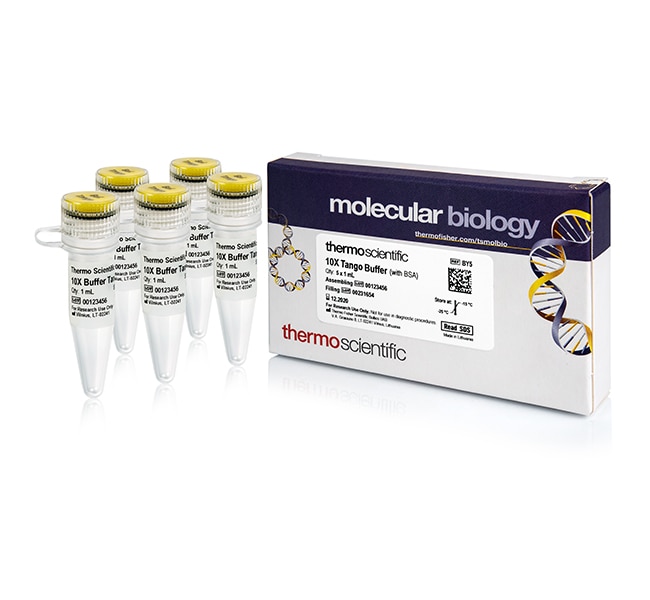
Tango Buffer (10X)
Thermo Scientific 10X Buffer Y ensures the optimum reaction conditions for restriction enzymes and is premixed with BSA for enhancedRead more
| Catalog Number | Quantity |
|---|---|
| BY5 | 5 x 1.0 mL |
Catalog number BY5
Price (USD)
22.65
Online exclusive
24.35Save 1.70
Each
Quantity:
5 x 1.0 mL
Price (USD)
22.65
Online exclusive
24.35Save 1.70
Each
Thermo Scientific 10X Buffer Y ensures the optimum reaction conditions for restriction enzymes and is premixed with BSA for enhanced stability. Our Five Buffer System ensures the optimum reaction conditions for each restriction enzyme. This system consists of 10X B (blue), G (green), O (orange), R (red), and Tango (yellow) buffers. All restriction enzymes are supplied in color-coded tubes to indicate the recommended reaction buffer. The recommended buffer and/or the universal Tango buffer are supplied with each enzyme.
Tango buffer has been designed for double digestions of DNA with conventional restriction enzymes. Visit the Thermo Scientific DoubleDigest tool for more information.
To ensure consistent enzyme performance, Thermo Scientific restriction enzyme buffers contain BSA, which enhances the stability of many enzymes and binds contaminants that may be present in DNA preparations. Multiple freeze-thaw cycles of the buffers will not cause BSA precipitation.
Thermo Scientific restriction enzymes exhibit 100% of their certified activity in the recommended buffer. However, some enzymes require additives to achieve 100% activity. For example, AjuI, AlfI, BdaI, BplI, BseMII, FaqI, Eco57I, Eco57MI, Hin4I, and TsoI require S-adenosylmethionine, which is supplied with the enzyme, while AarI and BveI require an oligonucleotide (also supplied with the enzyme). Esp3I requires DTT.
Tango buffer has been designed for double digestions of DNA with conventional restriction enzymes. Visit the Thermo Scientific DoubleDigest tool for more information.
To ensure consistent enzyme performance, Thermo Scientific restriction enzyme buffers contain BSA, which enhances the stability of many enzymes and binds contaminants that may be present in DNA preparations. Multiple freeze-thaw cycles of the buffers will not cause BSA precipitation.
Thermo Scientific restriction enzymes exhibit 100% of their certified activity in the recommended buffer. However, some enzymes require additives to achieve 100% activity. For example, AjuI, AlfI, BdaI, BplI, BseMII, FaqI, Eco57I, Eco57MI, Hin4I, and TsoI require S-adenosylmethionine, which is supplied with the enzyme, while AarI and BveI require an oligonucleotide (also supplied with the enzyme). Esp3I requires DTT.
For Research Use Only. Not for use in diagnostic procedures.
Specifications
Product TypeTango Buffer
Quantity5 x 1.0 mL
Concentration10X
Product LineTango
Research CategoryTraditional Cloning
Unit SizeEach