Search


Citations & References (30)
Invitrogen™
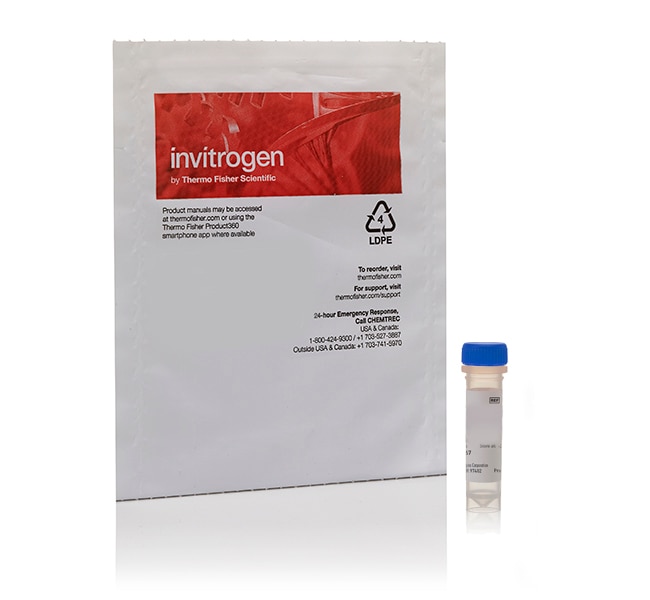
Click-IT™ AHA (L-Azidohomoalanine)
Click-iT® AHA (L-azidohomoalaine) provides a fast, sensitive, non-toxic and most importantly non-radioactive alternative to the traditional radioactive technique, 35S-methionine forRead more
| Catalog Number | Quantity |
|---|---|
| C10102 | 5 mg |
Catalog number C10102
Price (USD)
409.00
Each
Quantity:
5 mg
Price (USD)
409.00
Each
Click-iT® AHA (L-azidohomoalaine) provides a fast, sensitive, non-toxic and most importantly non-radioactive alternative to the traditional radioactive technique, 35S-methionine for the detection of nascent protein. AHA is an amino acid analog that contains a very small modification, specifically an azido moiety that can be fed to cultured cells and incorporated into proteins during active protein synthesis. Detection utilizes the chemoselective ligation or “click " reaction between an azide and an alkyne where the azido modified protein is detected with one of the Click-iT® Protein Analysis Detection Kits containing either TAMRA, Dapoxyl®, or biotin alkyne. Detection sensitivity with these reagents in 1-D gels and Western blots is in the low femtomole range and compatible with downstream LC-MS⁄MS and MALDI MS analysis or Multiplexed Proteomics® reagents for differential analyses of newly synthesized proteins together with total glycoproteins, total phosphoproteins or total protein.
For Research Use Only. Not for use in diagnostic procedures.
Specifications
Detection MethodBiotin-based, Fluorescence
Labeling MethodMetabolic Labeling
Product LineClick-iT, Molecular Probes
Product TypeAHA
Quantity5 mg
Shipping ConditionRoom Temperature
Labeling TargetProteins
Label or DyeAlexa Fluor 488, Alexa Fluor 555, Alexa Fluor 594, Alexa Fluor 647, Biotin, Oregon Green 488, TMR (Tetramethylrhodamine)
Unit SizeEach
Contents & Storage
Store in freezer -5°C to -30°C.
Frequently asked questions (FAQs)
I am using Click-iT AHA (L-azidohomoalanine) kit to label nascent proteins in live cells, then detecting with TAMRA alkyne after fixation and permeabilization and a click reaction. But I'm seeing nucleolar labeling in the cells. It this expected?
I am observing no signal or very low signal for my click-labeled samples. What can I do to improve the signal?
Citations & References (30)
Citations & References
Abstract
Selective identification of newly synthesized proteins in mammalian cells using bioorthogonal noncanonical amino acid tagging (BONCAT).
Journal:Proceedings of the National Academy of Sciences of the United States of America
PubMed ID:16769897
In both normal and pathological states, cells respond rapidly to environmental cues by synthesizing new proteins. The selective identification of a newly synthesized proteome has been hindered by the basic fact that all proteins, new and old, share the same pool of amino acids and thus are chemically indistinguishable. We
In situ visualization and dynamics of newly synthesized proteins in rat hippocampal neurons.
Journal:Nature neuroscience
PubMed ID:20543841
Protein translation has been implicated in different forms of synaptic plasticity, but direct in situ visualization of new proteins is limited to one or two proteins at a time. Here we describe a metabolic labeling approach based on incorporation of noncanonical amino acids into proteins followed by chemoselective fluorescence tagging
Two-color labeling of temporally defined protein populations in mammalian cells.
Journal:Bioorganic & medicinal chemistry letters
PubMed ID:18774715
The proteome undergoes complex changes in response to disease, drug treatment, and normal cellular signaling processes. Characterization of such changes requires methods for time-resolved protein identification and imaging. Here, we describe the application of two reactive methionine (Met) analogues, azidohomoalanine (Aha) and homopropargylglycine (Hpg), to label two protein populations in
Fluorescence visualization of newly synthesized proteins in mammalian cells.
Journal:Angewandte Chemie (International ed. in English)
PubMed ID:17036290
Noncanonical amino acid tagging enables the selective fluorescent visualization of newly synthesized proteins in mammalian cells (see the picture). Susceptibility to tagging is determined by the spatial and temporal character of the protein synthesis, thus providing a complement to methods which identify relevant members of the proteome.
Spatial coupling of mTOR and autophagy augments secretory phenotypes.
Journal:Science (New York, N.Y.)
PubMed ID:21512002
Protein synthesis and autophagic degradation are regulated in an opposite manner by mammalian target of rapamycin (mTOR), whereas under certain conditions it would be beneficial if they occurred in unison to handle rapid protein turnover. We observed a distinct cellular compartment at the trans side of the Golgi apparatus, the