Search


Citations & References (1)
Invitrogen™
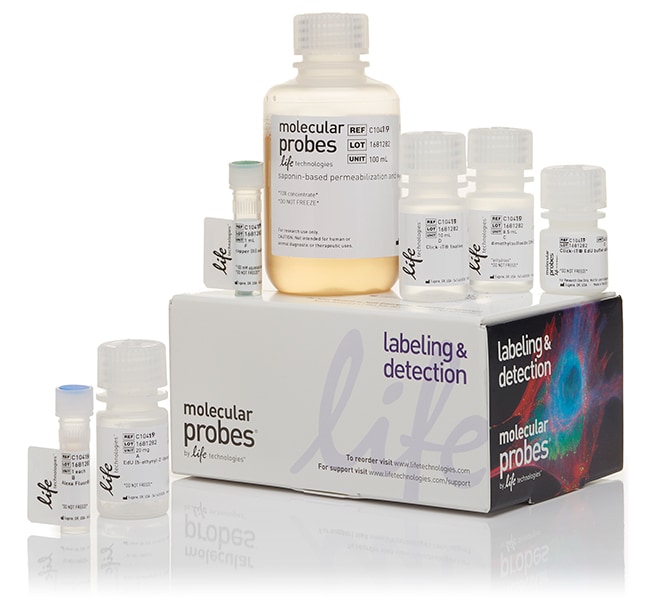
Click-iT™ EdU Alexa Fluor™ 647 Flow Cytometry Assay Kit
The Click-iT™ EdU Alexa Fluor™ 647 Flow Cytometry Assay Kit provides a simplified, more robust assay for analyzing DNA replicationRead more
Have Questions?
Change view

| Catalog Number | Quantity |
|---|---|
| C10419 | 100 assays |
| C10424 | 50 assays |
Catalog number C10419
Price (USD)
1,316.00
Each
Quantity:
100 assays
Price (USD)
1,316.00
Each
The Click-iT™ EdU Alexa Fluor™ 647 Flow Cytometry Assay Kit provides a simplified, more robust assay for analyzing DNA replication in proliferating cells as compared to traditional BrdU methods. Newly synthesized DNA is analyzed using the 633/5 nm laser of the flow cytometer.
• Accurate--Superior Results compared to BrdU Assays
• Fast--Results in as little as 90 minutes
• Economical--More assays per kit
View selection guide for all Click-iT™ EdU and Click-iT™ Plus EdU assays for flow cytometry.
An Advanced Method Giving You Results Superior to BrdU
The most accurate method of proliferation analysis is direct measurement of DNA synthesis. Originally, this was performed through incorporation of radioactive nucleosides, i.e., 3H-thymidine. This method was replaced by antibody-based detection of the nucleoside analog bromodeoxyuridine (BrdU). The Click-iT™ EdU Flow Cytometry Assay Kits are novel alternatives to the BrdU assay. EdU (5-ethynyl-2´-deoxyuridine) is a thymidine analog which is incorporated into DNA during active DNA synthesis. Detection is based on click chemistry: a copper catalyzed covalent reaction between an azide and an alkyne. In this application, the alkyne is found in the ethynyl moiety of EdU, while the azide is coupled to Alexa Fluor ™ 488, Alexa Fluor™ 647, or Pacific BlueTM dyes. Standard flow cytometry methods are used for determining the percentage of S-phase cells in the population (Fig 1).
Mild Conditions Allow Use with Cell Cycle Dyes and Antibodies
The advantages of Click-iT™ EdU labeling are readily evident while performing the assay (Fig 2). The small size of the dye azide allows for efficient detection of the incorporated EdU using mild conditions, while standard aldehyde-based fixation and detergent permeabilization are sufficient for the Click-iT™ detection reagent to gain access to the DNA. This is in contrast to BrdU assays that require DNA denaturation (using HCl, heat, or digestion with DNase) to expose the BrdU so that it may be detected with an anti-BrdU antibody. Sample processing for the BrdU assay can result in signal alteration of the cell cycle distribution as well as destruction of antigen recognition sites when using the HCl method. In contrast, the easy-to-use EdU cell proliferation kit is compatible with cell cycle dyes. This EdU assay kit can also be multiplexed with antibodies against surface and intracellular markers.
Quick and Simple Protocol
The Click-iT™ EdU protocol is based on the aldehyde fixation and detergent permeabilization steps for immunohistochemical antibody labeling, but EdU is compatible with other
fixation/permeabilization agents including saponin and methanol. In just five steps you’ll be ready to analyze your cell proliferation data:
• Treat cells with EdUM
• Fix and permeabilize cells
• Detect S-phase cells with Click-iT™ detection cocktail for 30 min
• Wash once
• Analyze
Get Accurate Results Economically
By increasing the number of assays per kit, the Click-IT™ EdU Alexa Fluor™ 647 Flow Cytometry Assay Kit is less expensive than the traditional BrdU assays making them ideal for large experiments.
For research use only. Not intended for any human or animal therapeutic of diagnostic use.
• Accurate--Superior Results compared to BrdU Assays
• Fast--Results in as little as 90 minutes
• Economical--More assays per kit
View selection guide for all Click-iT™ EdU and Click-iT™ Plus EdU assays for flow cytometry.
An Advanced Method Giving You Results Superior to BrdU
The most accurate method of proliferation analysis is direct measurement of DNA synthesis. Originally, this was performed through incorporation of radioactive nucleosides, i.e., 3H-thymidine. This method was replaced by antibody-based detection of the nucleoside analog bromodeoxyuridine (BrdU). The Click-iT™ EdU Flow Cytometry Assay Kits are novel alternatives to the BrdU assay. EdU (5-ethynyl-2´-deoxyuridine) is a thymidine analog which is incorporated into DNA during active DNA synthesis. Detection is based on click chemistry: a copper catalyzed covalent reaction between an azide and an alkyne. In this application, the alkyne is found in the ethynyl moiety of EdU, while the azide is coupled to Alexa Fluor ™ 488, Alexa Fluor™ 647, or Pacific BlueTM dyes. Standard flow cytometry methods are used for determining the percentage of S-phase cells in the population (Fig 1).
Mild Conditions Allow Use with Cell Cycle Dyes and Antibodies
The advantages of Click-iT™ EdU labeling are readily evident while performing the assay (Fig 2). The small size of the dye azide allows for efficient detection of the incorporated EdU using mild conditions, while standard aldehyde-based fixation and detergent permeabilization are sufficient for the Click-iT™ detection reagent to gain access to the DNA. This is in contrast to BrdU assays that require DNA denaturation (using HCl, heat, or digestion with DNase) to expose the BrdU so that it may be detected with an anti-BrdU antibody. Sample processing for the BrdU assay can result in signal alteration of the cell cycle distribution as well as destruction of antigen recognition sites when using the HCl method. In contrast, the easy-to-use EdU cell proliferation kit is compatible with cell cycle dyes. This EdU assay kit can also be multiplexed with antibodies against surface and intracellular markers.
Quick and Simple Protocol
The Click-iT™ EdU protocol is based on the aldehyde fixation and detergent permeabilization steps for immunohistochemical antibody labeling, but EdU is compatible with other
fixation/permeabilization agents including saponin and methanol. In just five steps you’ll be ready to analyze your cell proliferation data:
• Treat cells with EdUM
• Fix and permeabilize cells
• Detect S-phase cells with Click-iT™ detection cocktail for 30 min
• Wash once
• Analyze
Get Accurate Results Economically
By increasing the number of assays per kit, the Click-IT™ EdU Alexa Fluor™ 647 Flow Cytometry Assay Kit is less expensive than the traditional BrdU assays making them ideal for large experiments.
For research use only. Not intended for any human or animal therapeutic of diagnostic use.
For Research Use Only. Not for use in diagnostic procedures.
Specifications
Detection MethodFluorescence
Dye TypeAlexa Fluor™ 647
Emission Wavelength650/670
FormatTube(s)
Quantity100 assays
Shipping ConditionRoom Temperature
For Use With (Equipment)Flow Cytometer
Product LineAlexa Fluor, Click-iT
Product TypeFlow Cytometry Assay Kit
Unit SizeEach
Contents & Storage
Contains EdU (5-ethynyl-2' -deoxyuridine), Alexa Fluor™ 647 azide, anhydrous dimethylsulfoxide (DMSO), Click-iT™ fixative, Click-iT™ saponin-based permeabilization and wash buffer, copper (II) sulfate,, and Click-iT™ EdU buffer additive.Store at 2°C to 8°C Dessicate and protect from light.
Frequently asked questions (FAQs)
I will be performing a cell proliferation assay using Click-iT EdU kit. At what point can I stop overnight, or do I have to perform all the steps continuously?
Can I combine Click-iT or Click-iT Plus reactions with phalloidin conjugates used for actin staining?
Are the Alexa Fluor azides from Click-iT EdU kits available separately?
I am observing no signal or very low specific signal for my click-labeled samples. What can I do to improve the signal?
I am observing high non-specific background when I image my Click-iT EdU TUNEL-labeled samples. What is causing this and what can I do to reduce the background?
Citations & References (1)
Citations & References
Abstract
Polybrene inhibits human mesenchymal stem cell proliferation during lentiviral transduction.
Journal:PLoS One
PubMed ID:21887340
'Human mesenchymal stem cells (hMSCs) can be engineered to express specific genes, either for their use in cell-based therapies or to track them in vivo over long periods of time. To obtain long-term expression of these genes, a lentivirus- or retrovirus-mediated cell transduction is often used. However, given that the