Search


Citations & References (22)
Invitrogen™
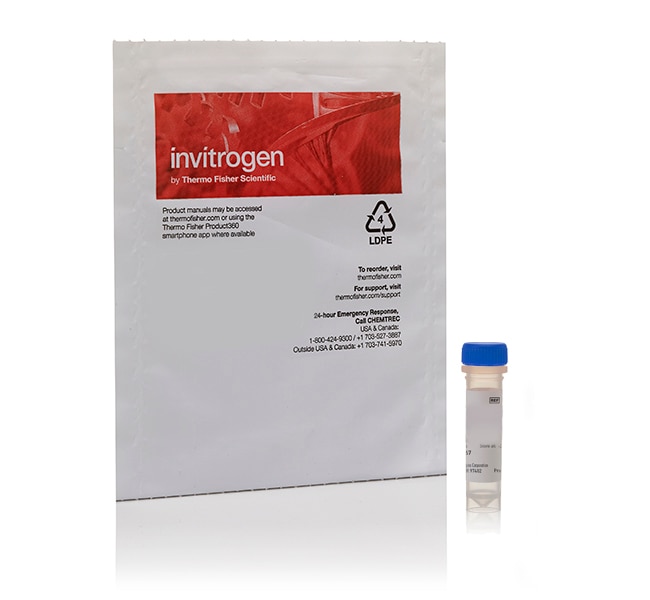
CellLight™ Lysosomes-RFP, BacMam 2.0
CellLight Lysosomes-RFP, BacMam 2.0, provides an easy way to label lysosomes with red fluorescent protein (RFP) in live cells. SimplyRead more
| Catalog Number | Quantity | Color |
|---|---|---|
| C10597 | 1 mL | Red-Orange, Orange |
Catalog number C10597
Price (MXN)
-
Quantity:
1 mL
Color:
Red-Orange, Orange
CellLight Lysosomes-RFP, BacMam 2.0, provides an easy way to label lysosomes with red fluorescent protein (RFP) in live cells. Simply add the reagent to your cells, incubate overnight, and the cells are ready to image in the morning.
Want to label other cell structures? Learn more about CellLight fluorescent protein labeling tools
This ready-to-use construct is transfected into cells using BacMam 2.0 technology, where it expresses RFP fused to lamp1 (lysosomal associated membrane protein 1). You can observe lysosomes-RFP behavior in live cells independently of organelle pH and label with multiple tracking or tracing dyes to image dynamic cellular processes.
Cells expressing CellLight constructs can also be fixed with formaldehyde for multiplexed imaging using immunocytochemical techniques.
CellLight Technology is:
• Fast and convenient: simply add CellLight reagent to your cells, incubate overnight, and image—or store frozen, assay-ready cells for later use
• Highly efficient: up to 90% transduction of a wide range of mammalian cell lines, including primary cells, stem cells, and neurons
• Flexible: co-transduce more than one BacMam reagent for multiplex experiments or co-localization studies; tightly control expression levels by simply varying the dose
• Less toxic: CellLight reagents are non-replicating in mammalian cells and are suitable for biosafety level (BSL) 1 handling
BacMam Technology
CellLight Lysosomes-RFP, BacMam 2.0, is a fusion construct of Lamp1 (lysosomal associated membrane protein 1) and TagRFP, providing accurate and specific targeting to cellular lysosomes-RFP. This fusion construct is packaged in the insect virus baculovirus, which does not replicate in human cells and is designated as safe to use with biosafety level (BSL) 1 in most laboratories. BacMam technology ensures that most mammalian cell types are transduced/transfected with high efficiency and minimal toxicity. This transient transfection can be detected after overnight incubation for up to five days—enough time to carry out most dynamic cellular analyses. Like any transfection/transduction technique, the BacMam method does not transfect/transduce all of the cells with equal efficiency, making it poorly suited to cellular population studies or automated imaging/counting. CellLight reagents are ideal for experiments where cellular or subcellular co-locatization is required, or for cellular function studies that need special resolution.
Visualize staining your cell without wasting your reagents, antibodies, or time with our new Stain-iT Cell Staining Simulator.
Want to label other cell structures? Learn more about CellLight fluorescent protein labeling tools
This ready-to-use construct is transfected into cells using BacMam 2.0 technology, where it expresses RFP fused to lamp1 (lysosomal associated membrane protein 1). You can observe lysosomes-RFP behavior in live cells independently of organelle pH and label with multiple tracking or tracing dyes to image dynamic cellular processes.
Cells expressing CellLight constructs can also be fixed with formaldehyde for multiplexed imaging using immunocytochemical techniques.
CellLight Technology is:
• Fast and convenient: simply add CellLight reagent to your cells, incubate overnight, and image—or store frozen, assay-ready cells for later use
• Highly efficient: up to 90% transduction of a wide range of mammalian cell lines, including primary cells, stem cells, and neurons
• Flexible: co-transduce more than one BacMam reagent for multiplex experiments or co-localization studies; tightly control expression levels by simply varying the dose
• Less toxic: CellLight reagents are non-replicating in mammalian cells and are suitable for biosafety level (BSL) 1 handling
BacMam Technology
CellLight Lysosomes-RFP, BacMam 2.0, is a fusion construct of Lamp1 (lysosomal associated membrane protein 1) and TagRFP, providing accurate and specific targeting to cellular lysosomes-RFP. This fusion construct is packaged in the insect virus baculovirus, which does not replicate in human cells and is designated as safe to use with biosafety level (BSL) 1 in most laboratories. BacMam technology ensures that most mammalian cell types are transduced/transfected with high efficiency and minimal toxicity. This transient transfection can be detected after overnight incubation for up to five days—enough time to carry out most dynamic cellular analyses. Like any transfection/transduction technique, the BacMam method does not transfect/transduce all of the cells with equal efficiency, making it poorly suited to cellular population studies or automated imaging/counting. CellLight reagents are ideal for experiments where cellular or subcellular co-locatization is required, or for cellular function studies that need special resolution.
Visualize staining your cell without wasting your reagents, antibodies, or time with our new Stain-iT Cell Staining Simulator.
For Research Use Only. Not for use in diagnostic procedures.
Specifications
ColorRed-Orange, Orange
Detection MethodFluorescence
Dye TypeRFP (TagRFP)
EmissionVisible
Excitation Wavelength Range555⁄584
For Use With (Equipment)Confocal Microscope, Fluorescence Microscope
FormLiquid
Product LineCellLight
Quantity1 mL
Shipping ConditionWet Ice
TechniqueFluorescence Intensity
Label TypeFluorescent Dye
Product TypeLysosomal Probe
Sub Cellular LocalizationLysosomes
Unit SizeEach
Contents & Storage
Store at 2°C to 6°C, protected from light. Do Not Freeze.
Frequently asked questions (FAQs)
How can I increase the transduction efficiency with the BacMam 2.0 reagents such as the the CellLight and Premo products?
Is there any way to preserve the CellLights labeling beyond 5 days?
Are the CellLights products toxic to cells?
For how long will the CellLights products label my cells?
What cell types can the CellLights products be used with?
Citations & References (22)
Citations & References
Abstract
Cell entry and trafficking of human adenovirus bound to blood factor X is determined by the fiber serotype and not hexon:heparan sulfate interaction.
Journal:PLoS One
PubMed ID:21637339
'Human adenovirus serotype 5 (HAdV5)-based vectors administered intravenously accumulate in the liver as the result of their direct binding to blood coagulation factor X (FX) and subsequent interaction of the FX-HAdV5 complex with heparan sulfate proteoglycan (HSPG) at the surface of liver cells. Intriguingly, the serotype 35 fiber-pseudotyped vector HAdV5F35
Particles on the move: intracellular trafficking and asymmetric mitotic partitioning of nanoporous polymer particles.
Journal:
PubMed ID:23713907
'Nanoporous polymer particles (NPPs) prepared by mesoporous silica templating show promise as a new class of versatile drug/gene delivery vehicles owning to their high payload capacity, functionality, and responsiveness. Understanding the cellular dynamics of such particles, including uptake, intracellular trafficking, and distribution, is an important requirement for their development as
GX15-070 (obatoclax) induces apoptosis and inhibits cathepsin D- and L-mediated autophagosomal lysis in antiestrogen-resistant breast cancer cells.
Journal:Mol Cancer Ther
PubMed ID:23395885
'In estrogen receptor-positive (ER+) breast cancer cells, BCL2 overexpression contributes to antiestrogen resistance. Direct targeting of the antiapoptotic BCL2 members with GX15-070 (obatoclax), a BH3-mimetic currently in clinical development, is an attractive strategy to overcome antiestrogen resistance in some breast cancers. Recently, GX15-070 has been shown to induce both apoptosis
The possible
Journal:Mol Ther
PubMed ID:23032976
Polycations such as polyethylenimine (PEI) are used in many novel nonviral vector designs and there are continuous efforts to increase our mechanistic understanding of their interactions with cells. Even so, the mechanism of polyplex escape from the endosomal/lysosomal pathway after internalization is still elusive. The
Inhibitors of intravesicular acidification protect against Shiga toxin in a pH-independent manner.
Journal:Traffic
PubMed ID:22132807
Shiga toxin inhibits protein synthesis after being transported from the cell surface to endosomes and retrogradely through the Golgi apparatus to the endoplasmic reticulum (ER) and into the cytosol. In this study, we have abolished proton gradients across internal membranes in different ways and investigated the effect on the various