Search


Citations & References (30)
Invitrogen™
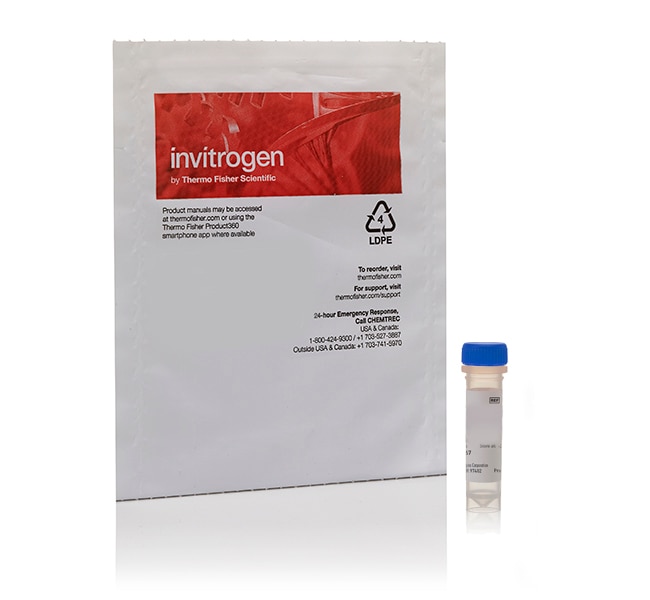
CellLight™ Mitochondria-GFP, BacMam 2.0
CellLight Mitochondria-GFP, BacMam 2.0, provides an easy way to label mitochondria with green fluorescent protein (GFP) in live cells. SimplyRead more
| Catalog Number | Quantity |
|---|---|
| C10600 | 1 mL |
Catalog number C10600
Price (USD)
676.65
Online exclusive
720.00Save 43.35
Each
Quantity:
1 mL
Price (USD)
676.65
Online exclusive
720.00Save 43.35
Each
CellLight Mitochondria-GFP, BacMam 2.0, provides an easy way to label mitochondria with green fluorescent protein (GFP) in live cells. Simply add the reagent to your cells, incubate overnight, and the cells are ready to image in the morning.
Want to label other cell structures? Learn more about CellLight fluorescent protein labeling tools
This ready-to-use construct is transfected into cells using BacMam 2.0 technology, where it expresses GFP fused to the leader sequence of E1 alpha pyruvate dehydrogenase. You can observe mitochondria-GFP behavior in live cells independently of mitochondrial membrane potential and label with multiple tracking or tracing dyes to image dynamic cellular processes.
Cells expressing CellLight constructs can also be fixed with formaldehyde for multiplexed imaging using immunocytochemical techniques.
CellLight Technology is:
• Fast and convenient: simply add CellLight reagent to your cells, incubate overnight, and image—or store frozen, assay-ready cells for later use
• Highly efficient: up to 90% transduction of a wide range of mammalian cell lines, including primary cells, stem cells, and neurons
• Flexible: co-transduce more than one BacMam reagent for multiplex experiments or co-localization studies; tightly control expression levels by simply varying the dose
• Less toxic: CellLight reagents are non-replicating in mammalian cells and are suitable for biosafety level (BSL) 1 handling
BacMam Technology
CellLight Mitochondria-GFP, BacMam 2.0, is a fusion construct of the Leader sequence of E1 alpha pyruvate dehydrogenase and emGFP, providing accurate and specific targeting to cellular mitochondria-GFP. This fusion construct is packaged in the insect virus baculovirus, which does not replicate in human cells and is designated as safe to use with biosafety level (BSL) 1 in most laboratories. BacMam technology ensures that most mammalian cell types are transduced/transfected with high efficiency and minimal toxicity. This transient transfection can be detected after overnight incubation for up to five days—enough time to carry out most dynamic cellular analyses. Like any transfection/transduction technique, the BacMam method does not transfect/transduce all of the cells with equal efficiency, making it poorly suited to cellular population studies or automated imaging/counting. CellLight reagents are ideal for experiments where cellular or subcellular co-locatization is required, or for cellular function studies that need special resolution.
Visualize staining your cell without wasting your reagents, antibodies, or time with our new Stain-iT Cell Staining Simulator.
Want to label other cell structures? Learn more about CellLight fluorescent protein labeling tools
This ready-to-use construct is transfected into cells using BacMam 2.0 technology, where it expresses GFP fused to the leader sequence of E1 alpha pyruvate dehydrogenase. You can observe mitochondria-GFP behavior in live cells independently of mitochondrial membrane potential and label with multiple tracking or tracing dyes to image dynamic cellular processes.
Cells expressing CellLight constructs can also be fixed with formaldehyde for multiplexed imaging using immunocytochemical techniques.
CellLight Technology is:
• Fast and convenient: simply add CellLight reagent to your cells, incubate overnight, and image—or store frozen, assay-ready cells for later use
• Highly efficient: up to 90% transduction of a wide range of mammalian cell lines, including primary cells, stem cells, and neurons
• Flexible: co-transduce more than one BacMam reagent for multiplex experiments or co-localization studies; tightly control expression levels by simply varying the dose
• Less toxic: CellLight reagents are non-replicating in mammalian cells and are suitable for biosafety level (BSL) 1 handling
BacMam Technology
CellLight Mitochondria-GFP, BacMam 2.0, is a fusion construct of the Leader sequence of E1 alpha pyruvate dehydrogenase and emGFP, providing accurate and specific targeting to cellular mitochondria-GFP. This fusion construct is packaged in the insect virus baculovirus, which does not replicate in human cells and is designated as safe to use with biosafety level (BSL) 1 in most laboratories. BacMam technology ensures that most mammalian cell types are transduced/transfected with high efficiency and minimal toxicity. This transient transfection can be detected after overnight incubation for up to five days—enough time to carry out most dynamic cellular analyses. Like any transfection/transduction technique, the BacMam method does not transfect/transduce all of the cells with equal efficiency, making it poorly suited to cellular population studies or automated imaging/counting. CellLight reagents are ideal for experiments where cellular or subcellular co-locatization is required, or for cellular function studies that need special resolution.
Visualize staining your cell without wasting your reagents, antibodies, or time with our new Stain-iT Cell Staining Simulator.
For Research Use Only. Not for use in diagnostic procedures.
Specifications
ColorGreen
Detection MethodFluorescence
Dye TypeGFP (EmGFP)
EmissionVisible
Excitation Wavelength Range488⁄510
For Use With (Equipment)Confocal Microscope, Fluorescence Microscope
FormLiquid
Product LineCellLight
Quantity1 mL
Shipping ConditionWet Ice
TechniqueFluorescence Intensity
Label TypeFluorescent Dye
Product TypeMitochondria Probe
Sub Cellular LocalizationMitochondria
Unit SizeEach
Contents & Storage
Store at 2°C to 6°C, protected from light. Do Not Freeze.
Frequently asked questions (FAQs)
How can I increase the transduction efficiency with the BacMam 2.0 reagents such as the the CellLight and Premo products?
Is there any way to preserve the CellLights labeling beyond 5 days?
Are the CellLights products toxic to cells?
For how long will the CellLights products label my cells?
What cell types can the CellLights products be used with?
Citations & References (30)
Citations & References
Abstract
Standardized mitochondrial analysis gives new insights into mitochondrial dynamics and OPA1 function.
Journal:Int J Biochem Cell Biol
PubMed ID:22433900
'Mitochondria form dynamic tubular networks through processes of fission and fusion. Defect in mitochondrial dynamics lead to various pathologies, including several common and some rare neurodegenerative disorders. OPA1 and MFN2 are two key players in mitochondrial fusion associated with Autosomal Dominant Optic Atrophy and Charcot Marie Tooth neuropathy type 2A
Ketamine induces toxicity in human neurons differentiated from embryonic stem cells via mitochondrial apoptosis pathway.
Journal:Curr Drug Saf
PubMed ID:22873495
'Ketamine is widely used for anesthesia in pediatric patients. Growing evidence indicates that ketamine causes neurotoxicity in a variety of developing animal models. Our understanding of anesthesia neurotoxicity in humans is currently limited by difficulties in obtaining neurons and performing developmental toxicity studies in fetal and pediatric populations. It may
Energy metabolism in human pluripotent stem cells and their differentiated counterparts.
Journal:PLoS One
PubMed ID:21698063
'BACKGROUND: Human pluripotent stem cells have the ability to generate all cell types present in the adult organism, therefore harboring great potential for the in vitro study of differentiation and for the development of cell-based therapies. Nonetheless their use may prove challenging as incomplete differentiation of these cells might lead
Nitrite activates protein kinase A in normoxia to mediate mitochondrial fusion and tolerance to ischaemia/reperfusion.
Journal:
PubMed ID:24081164
'Nitrite (NO2(-)), a dietary constituent and nitric oxide (NO) oxidation product, mediates cardioprotection after ischaemia/reperfusion (I/R) in a number of animal models when administered during ischaemia or as a pre-conditioning agent hours to days prior to the ischaemic episode. When present during ischaemia, the reduction of nitrite to bioactive NO
Inhibition of AMP-activated protein kinase a (AMPKa) by doxorubicin accentuates genotoxic stress and cell death in mouse embryonic fibroblasts and cardiomyocytes: role of p53 and SIRT1.
Journal:J Biol Chem
PubMed ID:22267730
'Doxorubicin, an anthracycline antibiotic, is widely used in cancer treatment. Doxorubicin produces genotoxic stress and p53 activation in both carcinoma and non-carcinoma cells. Although its side effects in non-carcinoma cells, especially in heart tissue, are well known, the molecular targets of doxorubicin are poorly characterized. Here, we report that doxorubicin