Search


Citas y referencias (9)
Invitrogen™
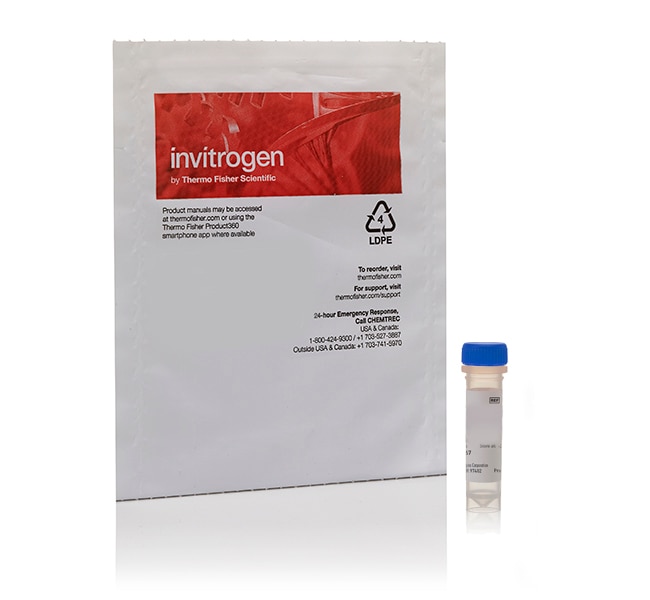
CellLight™ Tubulin-GFP, BacMam 2.0
CellLight™ Tubulin-GFP, BacMam 2.0, proporciona un método sencillo de etiquetar tubulinas con proteína verde fluorescente (GFP) en células vivas. SolamenteMás información
| Número de catálogo | Cantidad | Objetivo |
|---|---|---|
| C10613 | 1 vial | Citoesqueleto, tubulina |
Número de catálogo C10613
Precio (MXN)
-
Cantidad:
1 vial
Objetivo:
Citoesqueleto, tubulina
CellLight™ Tubulin-GFP, BacMam 2.0, proporciona un método sencillo de etiquetar tubulinas con proteína verde fluorescente (GFP) en células vivas. Solamente tiene que añadir reactivo a las células y dejarlas incubar toda la noche; por la mañana, las células estarán listas.
¿Desea etiquetar otras estructuras celulares? Obtenga más información sobre las herramientas de etiquetado de proteínas fluorescentes CellLight™
Esta construcción lista para su uso se transfecta en las células donde expresa la GFP fusionada a la tubulina humana, mediante tecnología BacMam 2.0. Puede observar el comportamiento de la tubulina-GFP en células casi sin citotoxicidad y etiquetarlos con varios colorantes de seguimiento o rastreo para obtener imágenes de procesos celulares dinámicos.
Las células que expresan construcciones CellLight™ también se pueden fijar con formaldehído para la adquisición de imágenes multiplex mediante técnicas inmunocitoquímicas.
La tecnología CellLight™ es:
• Rápida y cómoda: solamente tiene que añadir reactivo CellLight™ a las células, dejarlas incubar durante la noche y realizar la adquisición de imágenes, o bien almacenar las células congeladas listas para ensayos para utilizarlas posteriormente
• Muy eficaz: hasta un 90 % de transducción de una amplia variedad de líneas celulares de mamíferos, incluidas las células primarias, las células madre y las neuronas.
• Flexible: cotransduzca más de un reactivo BacMam para experimentos multiplex o estudios de colocalización; controle de cerca los niveles de expresión mediante simples variaciones de la dosis.
• Menos tóxica: Los reactivos CellLight™ no se replican en células de mamíferos y son adecuados para la manipulación de nivel de bioseguridad (BSL) 1
Tecnología BacMam
CellLight™ Tubulin-GFP, BacMam 2.0, es una construcción fusionada de tubulina humana y emGFP que se dirige de forma precisa y específica a la tubulina celular-GFP. Esta construcción fusionada está envasada en el baculovirus del virus de insecto, que no se replica en las células humanas y está designado como seguro para su uso en la mayoría de laboratorios con nivel de bioseguridad (BSL) 1. La tecnología BacMam garantiza que la mayoría de los tipos de células de mamíferos se transduzcan o transfecten con alta eficacia y una toxicidad mínima. Esta transfección transitoria se puede detectar tras una incubación nocturna durante hasta cinco días, tiempo suficiente para llevar a cabo la mayoría de análisis celulares dinámicos. Como cualquier otra técnica de transfección o transducción, el método BacMam no transfecta o transduce todas las células con la misma eficacia, lo que hace que no sea adecuado para estudios de población celular o procesos de recuento o adquisición de imágenes automatizados. Los reactivos CellLight™ son perfectos para experimentos en los que se requiere la colocalización celular o subcelular o para estudios de la función celular que necesiten una resolución especial.
¿Desea etiquetar otras estructuras celulares? Obtenga más información sobre las herramientas de etiquetado de proteínas fluorescentes CellLight™
Esta construcción lista para su uso se transfecta en las células donde expresa la GFP fusionada a la tubulina humana, mediante tecnología BacMam 2.0. Puede observar el comportamiento de la tubulina-GFP en células casi sin citotoxicidad y etiquetarlos con varios colorantes de seguimiento o rastreo para obtener imágenes de procesos celulares dinámicos.
Las células que expresan construcciones CellLight™ también se pueden fijar con formaldehído para la adquisición de imágenes multiplex mediante técnicas inmunocitoquímicas.
La tecnología CellLight™ es:
• Rápida y cómoda: solamente tiene que añadir reactivo CellLight™ a las células, dejarlas incubar durante la noche y realizar la adquisición de imágenes, o bien almacenar las células congeladas listas para ensayos para utilizarlas posteriormente
• Muy eficaz: hasta un 90 % de transducción de una amplia variedad de líneas celulares de mamíferos, incluidas las células primarias, las células madre y las neuronas.
• Flexible: cotransduzca más de un reactivo BacMam para experimentos multiplex o estudios de colocalización; controle de cerca los niveles de expresión mediante simples variaciones de la dosis.
• Menos tóxica: Los reactivos CellLight™ no se replican en células de mamíferos y son adecuados para la manipulación de nivel de bioseguridad (BSL) 1
Tecnología BacMam
CellLight™ Tubulin-GFP, BacMam 2.0, es una construcción fusionada de tubulina humana y emGFP que se dirige de forma precisa y específica a la tubulina celular-GFP. Esta construcción fusionada está envasada en el baculovirus del virus de insecto, que no se replica en las células humanas y está designado como seguro para su uso en la mayoría de laboratorios con nivel de bioseguridad (BSL) 1. La tecnología BacMam garantiza que la mayoría de los tipos de células de mamíferos se transduzcan o transfecten con alta eficacia y una toxicidad mínima. Esta transfección transitoria se puede detectar tras una incubación nocturna durante hasta cinco días, tiempo suficiente para llevar a cabo la mayoría de análisis celulares dinámicos. Como cualquier otra técnica de transfección o transducción, el método BacMam no transfecta o transduce todas las células con la misma eficacia, lo que hace que no sea adecuado para estudios de población celular o procesos de recuento o adquisición de imágenes automatizados. Los reactivos CellLight™ son perfectos para experimentos en los que se requiere la colocalización celular o subcelular o para estudios de la función celular que necesiten una resolución especial.
Para uso exclusivo en investigación. No apto para uso en procedimientos diagnósticos.
Especificaciones
ColorVerde
Método de detecciónFluorescente
Tipo de coloranteGFP (EmGFP)
EmisiónVisible
Intervalo de longitud de onda de excitación488⁄510
Para utilizar con (equipo)Microscopio confocal, microscopio de fluorescencia
FormularioLíquido
Línea de productosCellLight
Cantidad1 vial
Condiciones de envíoHielo húmedo
ObjetivoCitoesqueleto, tubulina
TécnicaIntensidad de fluorescencia
Tipo de etiquetaProteína fluorescente
Tipo de productoTubulina
Sub Cellular LocalizationTubulina, citoesqueleto, Tubulin
Unit SizeEach
Contenido y almacenamiento
Almacenar de 2 °C a 6 °C, protegido de la luz. No congelar.
Preguntas frecuentes
How can I increase the transduction efficiency with the BacMam 2.0 reagents such as the the CellLight and Premo products?
Is there any way to preserve the CellLights labeling beyond 5 days?
Are the CellLights products toxic to cells?
For how long will the CellLights products label my cells?
What cell types can the CellLights products be used with?
Citations & References (9)
Citations & References
Abstract
Particles on the move: intracellular trafficking and asymmetric mitotic partitioning of nanoporous polymer particles.
Journal:
PubMed ID:23713907
'Nanoporous polymer particles (NPPs) prepared by mesoporous silica templating show promise as a new class of versatile drug/gene delivery vehicles owning to their high payload capacity, functionality, and responsiveness. Understanding the cellular dynamics of such particles, including uptake, intracellular trafficking, and distribution, is an important requirement for their development as
Advanced laboratory techniques for sample processing and immunolabeling using microwave radiation.
Journal:J Neurosci Methods
PubMed ID:19520116
A better understanding of improved microwave technology has increased the benefits and versatility of the technique as it applies to all aspects of immunohistochemistry. The role of continuous magnetron power output (wattage) combined with precise control of sample heating demonstrated their significance to complex labeling protocols. Here, we present results
Cytoskeletal control of CD36 diffusion promotes its receptor and signaling function.
Journal:Cell
PubMed ID:21854984
The mechanisms that govern receptor coalescence into functional clusters--often a critical step in their stimulation by ligand--are poorly understood. We used single-molecule tracking to investigate the dynamics of CD36, a clustering-responsive receptor that mediates oxidized LDL uptake by macrophages. We found that CD36 motion in the membrane was spatially structured
Spreading of neurodegenerative pathology via neuron-to-neuron transmission of ß-amyloid.
Journal:J Neurosci
PubMed ID:22745479
Alzheimer's disease (AD) is the major cause of dementia. During the development of AD, neurofibrillary tangles progress in a fixed pattern, starting in the transentorhinal cortex followed by the hippocampus and cortical areas. In contrast, the deposition of ß-amyloid (Aß) plaques, which are the other histological hallmark of AD, does
BacMam technology and its application to drug discovery.
Journal:Expert Opin Drug Discov
PubMed ID:23488908
The recombinant baculovirus/insect cell system was firmly established as a leading method for recombinant protein production when a new potential use for these viruses was revealed in 1995. It was reported that engineered recombinant baculoviruses could deliver functional expression cassettes to mammalian cell types; a system which has come to