Search


Citations & References (17)
Invitrogen™
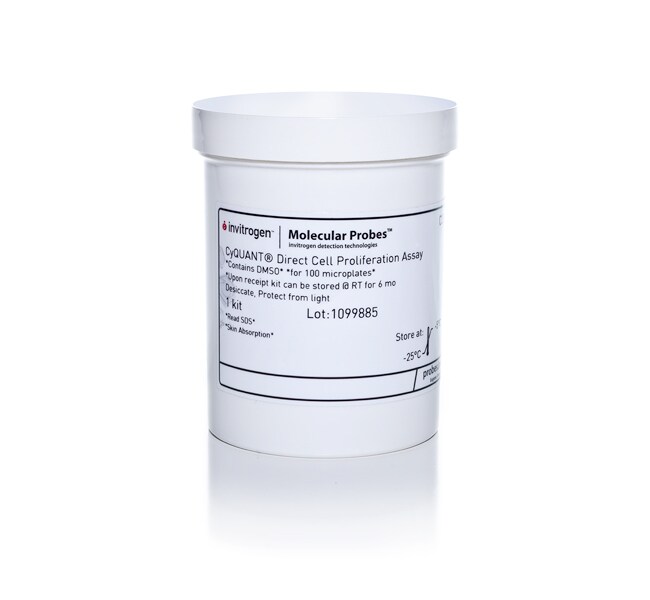
CyQUANT™ Cell Proliferation Assays
CyQUANT cell proliferation assays are fast and highly sensitive fluorescence methods for counting cells to assess cell growth and cytotoxicity in microplate format. These assays use fluorescent nucleic-acid-binding dyes to measure cell number based on DNA content.
Have Questions?
Change view

| Catalog Number | Cell Type | Quantity |
|---|---|---|
| C35012 | Direct Cell | 100 Microplates |
| C35011 | Direct Cell | 10 Microplates |
| C35013 | Direct Red Cell | 10 Microplates |
| C35007 | NF Cell | 200 Assays |
| C7026 | For cells in culture | 1000 Assays |
| C35006 | NF Cell | 1000 Assays |
| C7027 | Cell Lysis Buffer | 50 mL |
Catalog number C35012
Price (USD)
3,787.65
Online exclusive
3,945.00Save 157.35
Each
Cell Type:
Direct Cell
Quantity:
100 Microplates
Price (USD)
3,787.65
Online exclusive
3,945.00Save 157.35
Each
Since the amount of DNA in cells is highly regulated, methods to detect DNA content offer improved accuracy over metabolism-based cellular proliferation or cytotoxicity assays, which can be affected by cell changes that are unrelated to cell number. CyQUANT cell proliferation assays use cell-permeant, DNA-binding dyes that enhance fluorescence when bound to nucleic acids to measure cellular DNA content. The resulting fluorescent signal can be compared to standards to determine cell number, enabling fast and sensitive microplate assays to measure cell proliferation and cytotoxicity.
Choose from a range of CyQUANT cell proliferation assays based on experimental needs and workflows.
The CyQUANT and CyQUANT NF (No Freeze) cell proliferation assays provide cell proliferation measurements based on the total cell count, including both live and dead cells. The CyQUANT Direct Cell Proliferation Assay only detects live, healthy cells by using a masking dye that blocks staining of dead cells with compromised membranes, providing measurement of both cellular proliferation and cytotoxicity.
CyQUANT Cell Proliferation Assay
The CyQUANT Cell Proliferation Assay (Cat. No. C7026) enables precise DNA measurement for total cell count using the green-fluorescent CyQUANT GR dye and allows for the convenient freezing and storage of samples for up to four weeks. Easily compare multiple samples with minimal hands-on time by freezing, lysing, and reading fluorescence on a standard microplate reader.
Features of the CyQUANT Cell Proliferation Assay include:
- Direct DNA measurement—utilizes the green-fluorescent CyQUANT GR dye (ex/em 480/520 nm), a proprietary dye with strong fluorescence enhancement when bound to nucleic acids, for accurate measurement of DNA content to count both live and dead cells
- Broad linear range—quantify 50 to 50,000 cells per well without relying on metabolic activity
- Quickly compare samples—compare multiple samples in a microplate format with minimal hands-on time; simply remove media, freeze and lyse cells, then read fluorescence on a standard microplate reader with a fluorescein filter
- Convenient sample storage—freeze and store time course samples for up to four weeks, enabling batch analysis and direct comparison of samples taken at different time points
- Comprehensive kit—includes the CyQUANT GR dye, cell lysis buffer, and bacteriophage λ DNA as a reference standard; extra CyQUANT Cell Lysis Buffer available separately (Cat. No. C7027)
CyQUANT NF (No Freeze) Cell Proliferation Assay
The CyQUANT NF (No Freeze) Cell Proliferation Assay (Cat. Nos. C35006 and C35007) offers a streamlined protocol for total cell count by eliminating the freeze-thaw cell lysis step of the original CyQUANT Cell Proliferation Assay using a cell-permeant DNA-binding dye and a plasma membrane permeabilization/dye delivery reagent. This sensitive and rapid cell counting assay provides a wide detection range and is completed in just one hour without the need for cell lysis.
Features of the CyQUANT NF Cell Proliferation Assay include:
- Streamlined protocol—eliminates the freeze-thaw cell lysis step using the cell-permeant and green-fluorescent CyQUANT NF DNA-binding dye (ex/em 480/520 nm) in combination with a plasma membrane permeabilization reagent for accurate measurement of DNA content to count both live and dead cells
- Wide detection range—linear detection range from 100 to 20,000 cells per well in a 96-well microplate
- Sensitive and rapid assay—more sensitive than MTT or alamarBlue™ assays, complete proliferation protocol in just one hour
- No cell lysis required—eliminates the need for cell lysis, long incubations, radioactivity, or stain removal
CyQUANT Direct Cell Proliferation Assay
The CyQUANT Direct Cell Proliferation Assay (Cat. Nos. C35011, C35012, and C35013) provides a simple, no-wash, add-and-read workflow ideal for high-throughput screening cellular proliferation and cytotoxicity assays. This assay uses a green- or red-fluorescent cell-permeant DNA-binding probe that enters all cells and a cell-impermeant background suppressor that blocks staining in dead cells or cells with compromised membranes, ensuring that only live, healthy cells are stained. The assay measures changes in cell proliferation as well as cytotoxicity to allow for accurate assessment of cell growth, viability, and compound toxicity.
Features of the CyQUANT Direct Cell Proliferation Assay include:
- Dual measurement—assesses both cell proliferation and membrane integrity, staining only live, viable cells
- Convenient workflow—no washes, cell lysis, temperature equilibrations, or radioactivity required; ideal for high-throughput screening
- Two fluorescent options—available in green CyQUANT Direct (ex/em 508/527 nm) and red CyQUANT Direct Red (ex/em 622/645 nm) for multiplexing with other fluorescent dyes or proteins; can switch between HTS and HCS plate readers if multiplex assays require different platforms
- Wide detection range—linear detection from less than 100 to 20,000 cells per well in most cell types
- Rapid and easy protocol—no-wash, homogeneous format with a fast proliferation protocol; simply mix the probe and suppressor, add to cells, incubate for one hour, and measure fluorescence
- Stable signal—fluorescent signal remains stable for several hours, providing workflow flexibility
- Multiplexing capability—compatible with spectrally distinct fluorescent probes or luminescence assays because cells are not lysed, allowing use with different platforms
- Correlation with metabolic assays—excellent concordance with metabolism- or energy (ATP)-based cell health assays for reliable comparison of historical data
For Research Use Only. Not for use in diagnostic procedures.
Specifications
Cell TypeDirect Cell
Culture EnvironmentSuspension Cell Culture, Adherent Cell Culture
Detection MethodFluorescence
Dye TypeCyQuant
Emission Wavelength535 nm
Excitation/Emission508/527 nm
Excitation Wavelength480 nm
Format96-well Plate, 384-well Plate, 1536-well Plate
Incubation Time60 min
Quantity100 Microplates
Shipping ConditionRoom Temperature
ColorGreen
For Use With (Application)Cell Proliferation
For Use With (Equipment)Microplate Reader, Spectrophotometer, HTS Reader
Product LineCyQUANT
Product TypeCell Proliferation Assay
Unit SizeEach
Contents & Storage
- 5 mL CyQUANT™ Direct nucleic acid stain (component A)
- 25 ml CyQUANT™ Direct background suppressor I (component B)
- Store both at 2°C to 25°C. Desiccate and protect from light.
Frequently asked questions (FAQs)
MTT cell proliferation plate assays require cellular metabolism to modify the reagent and thus, only live cells will be counted. Is this true for CyQUANT Direct Cell Proliferation Assay, too?
MTT cell proliferation assays require cellular metabolism to turn over the reagent, and thus only live cells will be counted. Is this true for CyQUANT Direct as well?
What volumes should I use to make a 10X stock solution for the CyQUANT Direct Cell Proliferation Assay (Cat. No. C35011, C35012)?
Are the components of the CyQUANT Direct Red Cell Proliferation Assay and CyQuant Direct Cell Proliferation Assay kits interchangeable?
What is the difference between the CyQUANT Direct Red Cell Proliferation Assay (Cat. Nos. C35013, C35014) and the green fluorescent CyQuant Direct Cell Proliferation Assay (Cat Nos. C35011, C35012)?
Citations & References (17)
Citations & References
Abstract
Application of a high-content multiparameter cytotoxicity assay to prioritize compounds based on toxicity potential in humans.
Journal:J Biomol Screen
PubMed ID:18566484
'Prioritization of compounds based on human hepatotoxicity potential is currently a key unmet need in drug discovery, as it can become a major problem for several lead compounds in later stages of the drug discovery pipeline. The authors report the validation and implementation of a high-content multiparametric cytotoxicity assay based
Activator of G protein signaling 3 promotes epithelial cell proliferation in PKD.
Journal:J Am Soc Nephrol
PubMed ID:20488951
'The activation of heterotrimeric G protein signaling is a key feature in the pathophysiology of polycystic kidney diseases (PKD). In this study, we report abnormal overexpression of activator of G protein signaling 3 (AGS3), a receptor-independent regulator of heterotrimeric G proteins, in rodents and humans with both autosomal recessive and
The matricellular protein cysteine-rich protein 61 (CCN1/Cyr61) enhances physiological adaptation of retinal vessels and reduces pathological neovascularization associated with ischemic retinopathy.
Journal:J Biol Chem
PubMed ID:21212276
'Retinal vascular damages are the cardinal hallmarks of retinopathy of prematurity (ROP), a leading cause of vision impairment and blindness in childhood. Both angiogenesis and vasculogenesis are disrupted in the hyperoxia-induced vaso-obliteration phase, and recapitulated, although aberrantly, in the subsequent ischemia-induced neovessel formation phase of ROP. Yet, whereas the histopathological
Selective blockade of cytoskeletal actin remodeling reduces experimental choroidal neovascularization.
Journal:Invest Ophthalmol Vis Sci
PubMed ID:21178140
'The efficacy of the peptide Ac-EEED on reducing cell adhesion and proliferation in vitro and choroidal neovascularization (CNV) in vivo was examined. The peptide chimera containing the Ac-EEED sequence was chemically linked to the N terminus of the XMTM delivery peptide from the E(rns) viral surface protein. Ac-EEED or scrambled
Loss of activator of G-protein signaling 3 impairs renal tubular regeneration following acute kidney injury in rodents.
Journal:FASEB J
PubMed ID:21343176
The intracellular mechanisms underlying renal tubular epithelial cell proliferation and tubular repair following ischemia-reperfusion injury (IRI) remain poorly understood. In this report, we demonstrate that activator of G-protein signaling 3 (AGS3), an unconventional receptor-independent regulator of heterotrimeric G-protein function, influences renal tubular regeneration following IRI. In rat kidneys exposed to