Search

Invitrogen™
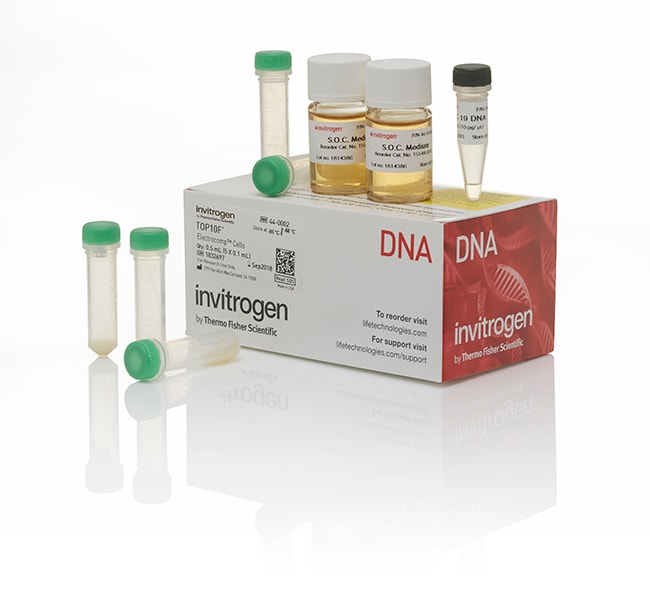
TOP10F' Electrocomp™ Kit
TOP10F´ Electrocomp Kit E. coli cells are identical to TOP10 cells, with the addition of an F´ episome. The F´Read more
| Catalog Number | Quantity |
|---|---|
| C66511 | 10 x 100 μL |
Catalog number C66511
Price (USD)
604.00
Each
Quantity:
10 x 100 μL
Price (USD)
604.00
Each
TOP10F´ Electrocomp Kit E. coli cells are identical to TOP10 cells, with the addition of an F´ episome. The F´ episome carries the tetracycline resistance gene and allows isolation of single-stranded DNA (ssDNA) from vectors that have an f1 origin of replication. In addition, the F´ episome carries the lacIq repressor for inducible expression from trc, tac, and lac promoters using IPTG.
TOP10F´ competent cells are transformed via electroporation, thus achieving higher transformation efficiencies than chemically competent cells and may be used in more challenging applications, including cloning a low amount of DNA or cDNA and gDNA library construction. These cells allow stable replication of high copy number plasmids and are provided at a transformation efficiency of >1 x 10¹⁰ cfu/ μg supercoiled DNA and are ideal for high-efficiency cloning and plasmid propagation.
As a derivative of TOP10, TOP10F´ cells carry mutations in the methylation-dependent restriction system (mcrA, mcrBC, and mrr) allowing one to clone both prokaryotic and eukaryotic genomic DNA, as well as efficient plasmid rescue from eukaryotic genomes. Similar to other DH strains, the TOP10 strain also has recA1 and endA1 mutations to increase insert stability and improve the quality of plasmid DNA prepared from minipreps.
TOP10F´ Electrocomp Kit E. coli cells offer:
• Transformation efficiencies of >1 x 10¹⁰ cfu/μg
• Stable F´ episome that allows isolation of ssDNA and carries lacIq repressor for inducible expression from trc, tac, and lac promoters
• hsdR for efficient transformation of unmethylated DNA from PCR amplifications
• mcrA for efficient transformation of methylated DNA from genomic preparations
• lacZΔM15 for blue/white color screening of recombinant clones on plates containing either X-Gal or Bluo-Gal
• endA1 for cleaner DNA preparations and better results in downstream applications due to elimination of nonspecific digestion by Endonuclease I
• recA1 for reduced occurrence of nonspecific recombination in cloned DNA
Note: TOP10F´ cells require IPTG induction for blue-white color screening. A high-voltage electroporation apparatus is also required.
Genotype
F´ [lacIq, Tn10(TetR)] mcrA Δ(mrr-hsdRMS-mcrBC) φ80lacZΔM15 ΔlacX74 recA1 araD139 Δ(ara-leu)7697 galU galK rpsL(StrR) endA1 nupG
Find the strains and formats that fit your needs
We offer other DH strains in chemically competent and electrocompetent cell.
Electroporation cuvettes with 0.1 cm, 0.2 cm, and 0.4 cm gaps are available.
The TOP10 strain is available in several MultiShot formats for high throughput applications.
We offer other strains for ssDNA production, such as DH12S.
Explore bacterial growth media formats.
For Research Use Only. Not for use in diagnostic procedures.
Specifications
Blue/White ScreeningYes (lacZΔM15)
Cloning Methylated DNAYes (mcrA)
Cloning Unstable DNANot suitable for cloning unstable DNA
Improves Plasmid QualityYes (endA1)
PlasmidMay be used for plasmids >20 kb
Preparing Unmethylated DNANo
Product LineElectrocomp
Product TypeElectrocompetent Cells
Quantity10 x 100 μL
Reduces RecombinationYes (recA1)
Shipping ConditionDry Ice
Transformation Efficiency LevelHigh Efficiency (>1010 cfu/μg)
FormatTube
SpeciesE. coli (K12)
Unit SizeEach
Contents & Storage
• TOP10F' Electrocomp E. coli (10 x 100 μL)
Store at -80°C.
• pUC19 vector (50 μL at 10 pg/μL)
Store pUC19 DNA at -20°C.
• S.O.C. Medium (15 mL)
Store at room temperature.
Store at -80°C.
• pUC19 vector (50 μL at 10 pg/μL)
Store pUC19 DNA at -20°C.
• S.O.C. Medium (15 mL)
Store at room temperature.