Search


Citations & References (4)
Invitrogen™
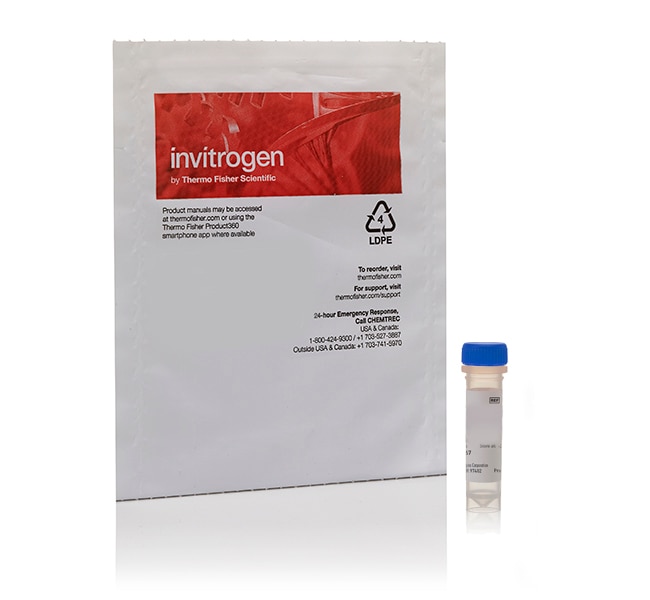
Escherichia coli (K-12 strain) BioParticles™, Alexa Fluor™ 594 conjugate
The Molecular Probes™ BioParticles™ product line consists of a series of fluorescently labeled, heat- or chemically killed bacteria and yeastRead more
| Catalog Number | Quantity |
|---|---|
| E23370 | 2 mg |
Catalog number E23370
Price (USD)
295.00
Each
Quantity:
2 mg
Price (USD)
295.00
Each
The Molecular Probes™ BioParticles™ product line consists of a series of fluorescently labeled, heat- or chemically killed bacteria and yeast in a variety of sizes, shapes, and natural antigenicities. These fluorescent BioParticles™ products have been employed to study phagocytosis by fluorescence microscopy, quantitative spectrofluorometry, and flow cytometry.
We offer E. coli (K-12 strain), S. aureus (Wood strain, without protein A) and zymosan (S. cerevisiae) BioParticles™ conjugates covalently labeled with a variety of different fluorophores (special care has been taken to remove free dye after conjugation). Unlike the fluorescence of fluorescein-labeled BioParticles™ conjugates, which is partially quenched in acidic environments, the fluorescence of the Alexa Fluor™, BODIPY™ FL, tetramethylrhodamine and Texas Red™ dye conjugates is uniformly intense over the pH range from 3 to 10.
BioParticles Specifications:
• Label (Ex/Em): Alexa Fluor™ 594 (∼590/617 nm)
• Particle: E. coli (K-12 strain)
• Opsonizing reagent available
Using BioParticles Products
BioParticles™ conjugates are provided as lyophilized powders. There are approximately 3 x 10⁸ E. coli or S. aureus particles per mg solid and approximately 2 x 10⁷ zymosan particles per mg solid. BioParticles™ conjugates can be reconstituted in the buffer of your choice for use in phagocytosis assays. The fluorescence of BioParticles™ conjugates that are bound to the surface of the cell (but not internalized) can be quenched by ethidium bromide, trypan blue, or other quenchers. In addition to cellular applications, fluorescent BioParticles™ conjugates may be effective as flow cytometry calibration references when sorting bacteria and yeast mutants. These small particles may also be useful references for light scattering studies because their sizes and shapes differ in characteristic ways.
Find More BioParticles™ Products
We offer a large range of dye-labeled and unlabeled E. coli (K-12 strain), S. aureus (Wood strain, without protein A), and zymosan (S. cerevisiae) BioParticles™ products. Find out about these products and their applications by reviewing Probes for Following Receptor Binding and Phagocytosis—Section 16.1 in the Molecular Probes™ Handbook.
For pH-sensitive endocytosis assays, see our pHrodo™ BioParticles™ conjugates.
For Research Use Only. Not for human or animal therapeutic or diagnostic use.
We offer E. coli (K-12 strain), S. aureus (Wood strain, without protein A) and zymosan (S. cerevisiae) BioParticles™ conjugates covalently labeled with a variety of different fluorophores (special care has been taken to remove free dye after conjugation). Unlike the fluorescence of fluorescein-labeled BioParticles™ conjugates, which is partially quenched in acidic environments, the fluorescence of the Alexa Fluor™, BODIPY™ FL, tetramethylrhodamine and Texas Red™ dye conjugates is uniformly intense over the pH range from 3 to 10.
BioParticles Specifications:
• Label (Ex/Em): Alexa Fluor™ 594 (∼590/617 nm)
• Particle: E. coli (K-12 strain)
• Opsonizing reagent available
Using BioParticles Products
BioParticles™ conjugates are provided as lyophilized powders. There are approximately 3 x 10⁸ E. coli or S. aureus particles per mg solid and approximately 2 x 10⁷ zymosan particles per mg solid. BioParticles™ conjugates can be reconstituted in the buffer of your choice for use in phagocytosis assays. The fluorescence of BioParticles™ conjugates that are bound to the surface of the cell (but not internalized) can be quenched by ethidium bromide, trypan blue, or other quenchers. In addition to cellular applications, fluorescent BioParticles™ conjugates may be effective as flow cytometry calibration references when sorting bacteria and yeast mutants. These small particles may also be useful references for light scattering studies because their sizes and shapes differ in characteristic ways.
Find More BioParticles™ Products
We offer a large range of dye-labeled and unlabeled E. coli (K-12 strain), S. aureus (Wood strain, without protein A), and zymosan (S. cerevisiae) BioParticles™ products. Find out about these products and their applications by reviewing Probes for Following Receptor Binding and Phagocytosis—Section 16.1 in the Molecular Probes™ Handbook.
For pH-sensitive endocytosis assays, see our pHrodo™ BioParticles™ conjugates.
For Research Use Only. Not for human or animal therapeutic or diagnostic use.
For Research Use Only. Not for use in diagnostic procedures.
Specifications
Detection MethodFluorescence
Dye TypeAlexa Fluor™ 594
FormLyophilized Powder
Quantity2 mg
Shipping ConditionRoom Temperature
SpeciesE. coli
For Use With (Equipment)Fluorescence Microscope
Product LineAlexa Fluor, BioParticles
Product TypeE.coli Conjugate
pH3 to 10
Unit SizeEach
Contents & Storage
Store in freezer (-5 to -30°C) and protect from light.
Frequently asked questions (FAQs)
Are the Invitrogen BioParticles products sterile?
What is the type of bond that attaches the dyes to the BioParticles probes?
What can the BioParticles product line be used for?
Citations & References (4)
Citations & References
Abstract
PLD$ is involved in phagocytosis of microglia: expression and localization changes of PLD4 are correlated with activation state of microglia.
Journal:PLoS One
PubMed ID:22102906
Phospholipase D4 (PLD4) is a recently identified protein that is mainly expressed in the ionized calcium binding adapter molecule 1 (Iba1)-positive microglia in the early postnatal mouse cerebellar white matter. Unlike PLD1 and PLD2, PLD4 exhibits no enzymatic activity for conversion of phosphatidylcholine into choline and phosphatidic acid, and its
Live cell imaging of zebrafish leukocytes.
Journal:Methods Mol Biol
PubMed ID:19378109
Zebrafish are ideally suited for the live imaging of early immune cell compartments. Macrophages that initially appear on the yolk surface prior to the onset of circulation are the first functional immune cells within the embryo, predating the emergence of the first granulocytic cells-the heterophilic neutrophils. Both cell types have
The activation of P2X7 receptor impairs lysosomal functions and stimulates the release of autophagolysosomes in microglial cells.
Journal:J Immunol
PubMed ID:19201858
Recently, autophagy has been associated with the TLR signaling pathway to eliminate intracellular pathogens in the innate immune system. However, it is unknown if other pathways regulate autophagy during the immunologic response. Given the critical role of the purinergic P2X7 receptor (P2X7R) pathway during various immunologic functions (i.e., caspase activation
Fluorescence-activated cell sorting (FACS) of Drosophila hemocytes reveals important functional similarities to mammalian leukocytes.
Journal:Proc Natl Acad Sci U S A
PubMed ID:14976247
Drosophila is a powerful model for molecular studies of hematopoiesis and innate immunity. However, its use for functional cellular studies remains hampered by the lack of single-cell assays for hemocytes (blood cells). Here we introduce a generic method combining fluorescence-activated cell sorting and nonantibody probes that enables the selective gating