Search


Citations & References (52)
Invitrogen™
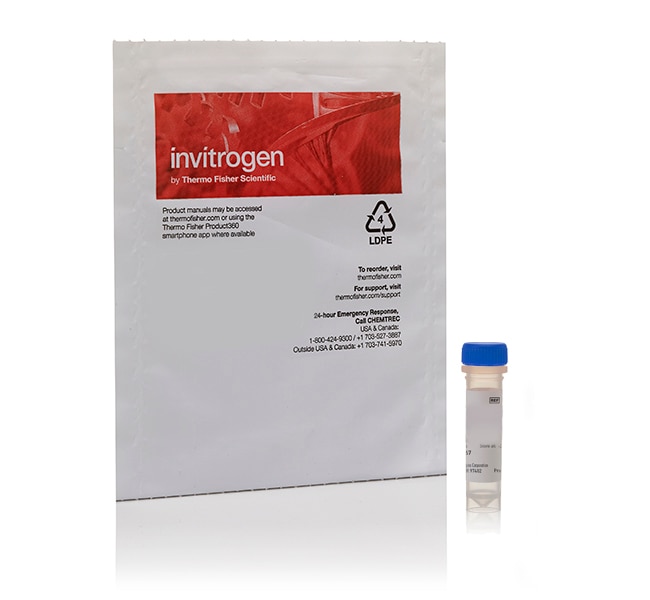
Ethidium Homodimer-2 (EthD-2) - 1 mM Solution in DMSO
The cell-impermeant viability indicator ethdium homodimer-2 (EthD-2) is a high-affinity nucleic acid stain that is weakly fluorescent until bound toRead more
| Catalog Number | Quantity |
|---|---|
| E3599 | 200 μL |
Catalog number E3599
Price (USD)
450.00
Each
Quantity:
200 μL
Price (USD)
450.00
Each
The cell-impermeant viability indicator ethdium homodimer-2 (EthD-2) is a high-affinity nucleic acid stain that is weakly fluorescent until bound to DNA and emits red fluorescence (excitation/emission maxima ∼535/624).
Note: A protocol is not included with this classic reagent as they are readily available in the literature. The reagent is provided already dissolved at 1 mM in DMSO. A typical protocol for staining dead cells is to prepare a working solution at 0.1 to 10 μM in a physiological buffer and incubate with cells for 30-45 minutes at room temperature before analyzing on a fluorescent microscope, flow cytometer, or plate reader.
Visualize staining your cell without wasting your reagents, antibodies, or time with our new Stain-iT Cell Staining Simulator.
Note: A protocol is not included with this classic reagent as they are readily available in the literature. The reagent is provided already dissolved at 1 mM in DMSO. A typical protocol for staining dead cells is to prepare a working solution at 0.1 to 10 μM in a physiological buffer and incubate with cells for 30-45 minutes at room temperature before analyzing on a fluorescent microscope, flow cytometer, or plate reader.
Visualize staining your cell without wasting your reagents, antibodies, or time with our new Stain-iT Cell Staining Simulator.
For Research Use Only. Not for use in diagnostic procedures.
Specifications
ColorOrange
DescriptionEthidium Homodimer-2 (EthD-2) - 1 mM Solution in DMSO
Detection MethodFluorescence
Dye TypeCell-Impermeant
Emission624 nm
Excitation Wavelength Range535 nm
For Use With (Application)Cell staining assays
For Use With (Equipment)Fluorescence Microscope
Quantity200 μL
Shipping ConditionRoom Temperature
Label TypeFluorescent Dye
Product TypeViability Indicator
Sub Cellular LocalizationNucleic Acids, Nucleus
Unit SizeEach
Contents & Storage
Store in freezer at -5°C to -30°C and protect from light.
Citations & References (52)
Citations & References
Abstract
Differential effects of deuterium oxide on the fluorescence lifetimes and intensities of dyes with different modes of binding to DNA.
Journal:J Histochem Cytochem
PubMed ID:9016307
'Deuterium oxide (D2O) increases both the fluorescence lifetime and the fluorescence intensity of the intercalating dyes propidium iodide (PI) and ethidium bromide (EB) when bound to nucleic acid structures. We have used spectroscopic analysis coupled with conventional and phase-sensitive flow cytometry to compare the alterations in intensity and lifetime of
Diverse microglial motility behaviors during clearance of dead cells in hippocampal slices.
Journal:Glia
PubMed ID:15042586
'We used two-channel three-dimensional time-lapse fluorescence confocal imaging in live rat hippocampal slice cultures (1-7 days in vitro) to determine the motility behaviors of activated microglia as they engage dead and dying cells following traumatic brain tissue injury. Live microglia were labeled with a fluorescently conjugated lectin (IB(4)), and dead
Calmodulin antagonists differentially affect capacitation-associated protein tyrosine phosphorylation of mouse sperm components.
Journal:J Cell Sci
PubMed ID:12668727
'Sperm capacitation in vitro is thought to be correlated with the increased protein tyrosine phosphorylation of a subset of sperm components. Our group recently used a pharmacological approach to demonstrate that calmodulin (CaM), a 17 kDa calcium sensor protein, has a role in sperm capacitation. In the present study, we
Automated image analysis of live/dead staining of the fungus Aureobasidium pullulans on microscope slides and leaf surfaces.
Journal:Biotechniques
PubMed ID:11056819
'An image analysis program and protocol for the identification and enumeration of live versus dead cells of the yeast-like fungus Aureobasidium pullulans was developed for both populations on microscope slides and leaf surfaces. Live cells took up CellTracker Blue, while nonviable cells stained with DEAD Red. Image analysis macro programs
A2E-epoxides damage DNA in retinal pigment epithelial cells. Vitamin E and other antioxidants inhibit A2E-epoxide formation.
Journal:J Biol Chem
PubMed ID:12646558
'The autofluorescent pigments that accumulate in retinal pigment epithelial cells with aging and in some retinal disorders have been implicated in the etiology of macular degeneration. The major constituent is the fluorophore A2E, a pyridinium bisretinoid. Light-exposed A2E-laden retinal pigment epithelium exhibits a propensity for apoptosis with light in the