Search


Citations & References (1)
Invitrogen™
E-PAGE™ Midi Protein Gels, 3.7 mm
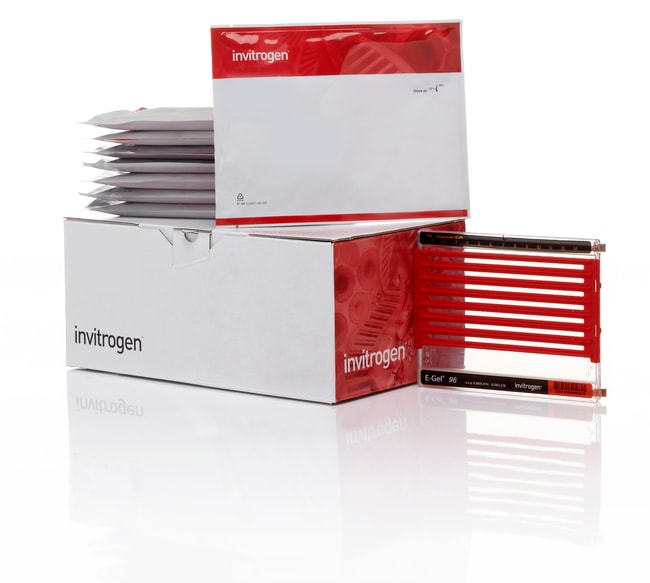
E-PAGE™ Gels are self-contained, pre-cast gels that include a gel matrix and electrodes packaged inside a disposable cassette.
Have Questions?
Change view

| Catalog Number | Wells | Gel Percentage |
|---|---|---|
| EP09606 | 96-well | 6% |
| EP04808 | 48-well | 8% |
Catalog number EP09606
Price (USD)
793.65
Online exclusive
844.00Save 50.35
Each
Wells:
96-well
Gel Percentage:
6%
Price (USD)
793.65
Online exclusive
844.00Save 50.35
Each
E-PAGE Gels are self-contained, pre-cast gels that include a gel matrix and electrodes packaged inside a disposable cassette. Protein separation on an E-PAGE Gel requires an EBase Integrated Device, a compact and automated platform designed for medium- and high-throughput electrophoresis.
Each E-PAGE 8% 48-well gel contains 48 sample lanes and 4 marker lanes with a 3.2-cm separation length. E-PAGE 48-well gels can be loaded with a 12- or 8-channel pipettor or 4- or 8-tip robotic system (Figure 1).
Each E-PAGE 6% 96-well gel contains 96 sample lanes and 8 marker lanes with a 1.6-cm separation length. The well openings of the cassette are compatible with the standard 96-well plate format and can be conveniently loaded with a multichannel pipettor or 8-, 12-, or 96-tip liquid-handling robotic device (Figure 2).
Both E-PAGE 48 and 96 cassettes can be opened to remove the gel for downstream staining or blotting (Figures 3 and 4). In addition, each cassette is labeled with an individual barcode to facilitate identification of the gel using commercial barcode readers.
More about the E-PAGE precast gel system
The Invitrogen E-PAGE precast gel system is designed for fast, mess-free medium- and high-throughput protein electrophoresis. It consists of the E-PAGE precast gels, E-Base Integrated devices for running the gels, and free E-Editor 2.0 software for image analysis.
The all-in-one E-Gel Power Snap Plus Electrophoresis System is designed for fast and convenient high-throughput gel electrophoresis. With dry precast E-PAGE gel technology, you can run protein samples in as little as 14 minutes. The device arrives with pre-programmed protocols for both E-PAGE gel types.
For Research Use Only. Not for use in diagnostic procedures.
Specifications
For Use With (Equipment)E-BASE
Gel Thickness3.7 mm
Length (Metric)8 cm
Mode of SeparationMolecular Weight
Quantity8 gels (1 kit)
Sample Loading VolumeUp to 20 μL
Shelf Life6 Months
Shipping ConditionRoom Temperature
Storage RequirementsStore at room temperature, do not allow the temperature to drop below 4°C or rise above 40°C
Width (Metric)13 cm
Gel Percentage6%
Gel SizeMidi
Gel TypeE-PAGE
Product LineE-PAGE
Separation Range10 to 300 kDa
Separation TypeDenaturing
Wells96-well
Unit SizeEach
Frequently asked questions (FAQs)
Are there robotic scripts for running E-Gel 48/96 or E-PAGE 48/96 gels?
What is the difference between the EG and EP program for the E-Base system?
What sample loading buffer should be used for E-PAGE gels?
Where can I download the latest version of the E-Gel 96 analysis software?
Are the E-PAGE Gels (example Cat. No. EP09606) compatible with the iBlot3 device (Cat. O. IB31001)?
Citations & References (1)
Citations & References
Abstract
Detection of tetracysteine-tagged proteins using a biarsenical fluorescein derivative through dry microplate array gel electrophoresis.
Journal:Electrophoresis
PubMed ID:15300761
The design of an extended-run 96-well sodium dodecyl sulfate-polyacrylamide gel electrophoresis (SDS-PAGE) system and the development of protein detection technology based upon fluorescein derivatives that bind to peptide epitope tags, allows the creation of a truly high-throughput analysis of protein expression, where less than 20 min are needed to separate