Search


Citations & References (1)
Invitrogen™
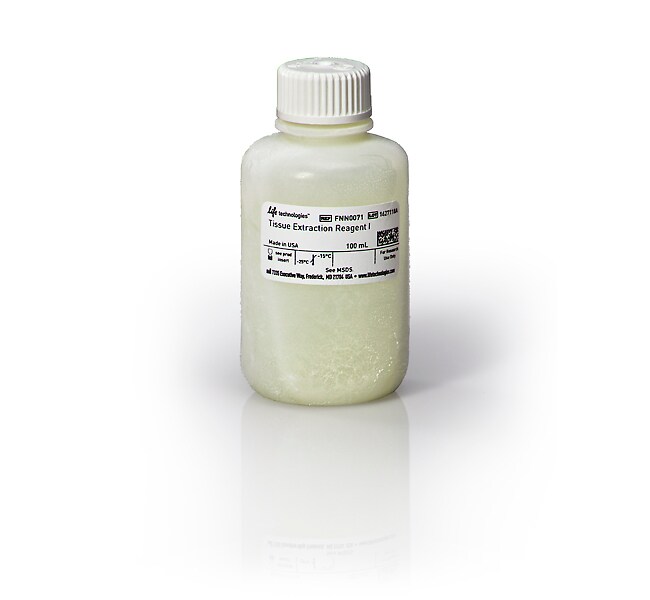
Tissue Extraction Reagent I
Lysis buffer for total protein extraction from tissue samples
| Catalog Number | Quantity |
|---|---|
| FNN0071 | 100 ml |
Catalog number FNN0071
Price (USD)
200.00
Each
Quantity:
100 ml
Price (USD)
200.00
Each
Build Your Own Immunoassay, Cell Analysis, Cell Lysis, Immunoassays, Protein Sample Preparation and Protein Purification, Proteins, Expression, Isolation and Analysis
Tissue Extraction Reagent I is a ready-to-use Tris-based lysis buffer for total protein extraction from tissue samples by homogenization. Cell lysates prepared with Tissue Extraction Reagent I are compatible with immunoassays such as ELISA, western blot, and Luminex assay.
Buffer formulation: 50 mM Tris, pH 7.4, 250 mM NaCl, 5 mM EDTA, 2 mM Na3VO4, 1 mM NaF, 20 mM Na4P2O7, 0.02% NaN3, detergent
This cell lysis buffer does not contain protease inhibitors and should be supplemented with 1 mM PMSF and protease inhibitor cocktail (Cat. No. A32955) just prior to use.
Tissue Extraction Reagent I may be supplemented with salts, reducing agents, or chelating agents as needed.
For Research Use Only. Not for use in diagnostic procedures.
Specifications
For Use With (Application)Luminex Assay, Western Blot, Sample preparation for ELISA
Product TypeTissue Extraction Reagent
Quantity100 ml
Shipping ConditionDry Ice
Label TypeEnzyme Labeled
Unit SizeEach
Contents & Storage
Store at 2°C to 8°C
Frequently asked questions (FAQs)
What extraction reagents are recommended for efficient mouse tissue analysis?
What is the difference in application between Tissue Extraction Reagent I (Cat. No. FNN0071) and Tissue Extraction Reagent II (Cat. No. FNN0081)?
Is Tissue Extraction Reagent I (Cat. No. FNN0071) compatible with the BCA Protein Assay Kit (Cat. No. 23227, 23225)?
During my ProcartaPlex assay data analysis, I am getting a warning message that there is high bead aggregation. What should I do?
During my ProcartaPlex assay data analysis, the beads fall below or to the lower left of their bead region on the bead map. Why is this?
Citations & References (1)
Citations & References
Abstract
Novel method of monitoring trace cytokines and activated STAT molecules in the paws of arthritic mice using multiplex bead technology.
Journal:BMC Immunol
PubMed ID:21073728
The use of mouse models to study human disease provides useful data that can provide support for research projects or an existing drug discovery program. How well a model recapitulates the human condition and the ease and reproducibility of data collected will determine how much confidence a scientist can place