Search
 Element Search
 Structure Search

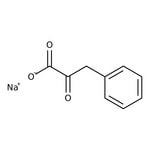

Thermo Scientific Chemicals
Sodium phenylpyruvate, 98%
CAS: 114-76-1 | C9H7NaO3 | 186.142 g/mol
Have Questions?
Change view


Catalog number H56767.14
also known as H56767-14
Price (EUR)
228,00
Each
Quantity:
25 g
Price (EUR)
228,00
Each
Chemical Identifiers
CAS114-76-1
IUPAC Namesodium 2-oxo-3-phenylpropanoate
Molecular FormulaC9H7NaO3
InChI KeyMQGYVGKMCRDEAF-UHFFFAOYSA-M
SMILES[Na+].[O-]C(=O)C(=O)CC1=CC=CC=C1
View more
Specifications Specification Sheet
Specification SheetAssay (unspecified)>97.5%
Phenylpyruvic acid, sodium salt is a substrate for phenylpyruvate decarboxylase and phenylpyruvate tautomerase.
This Thermo Scientific Chemicals brand product was originally part of the Alfa Aesar product portfolio. Some documentation and label information may refer to the legacy brand. The original Alfa Aesar product / item code or SKU reference has not changed as a part of the brand transition to Thermo Scientific Chemicals.
Applications
Phenylpyruvic acid, sodium salt is a substrate for phenylpyruvate decarboxylase and phenylpyruvate tautomerase.
Solubility
Soluble in water
Notes
Store at 2-8°C. Avoin oxidizing agents.
Phenylpyruvic acid, sodium salt is a substrate for phenylpyruvate decarboxylase and phenylpyruvate tautomerase.
Solubility
Soluble in water
Notes
Store at 2-8°C. Avoin oxidizing agents.
RUO – Research Use Only
General References:
- Joyce B. Boylen.; J. H. Quastel. Effects of l-phenylalanine and sodium phenylpyruvate on the formation of adrenaline from l-tyrosine in adrenal medulla in vitro.Biochem J. 1961, 80 (3),644-648.
- J. B. Boylen.; J. H. Quastel. Effects of L-Phenylalanine and Sodium Phenylpyruvate on the Formation of Melanin from L-Tyrosine in Melanoma. Nature. 1962, 193,376 - 377.