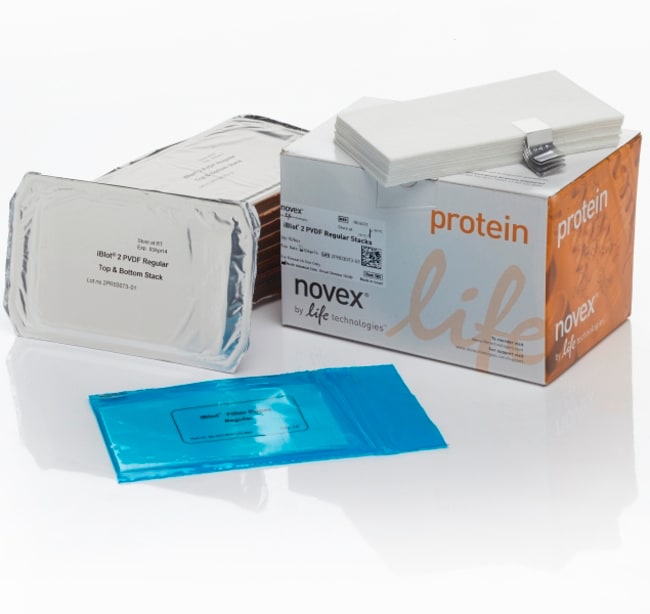
Pilas de transferencia iBlot™ 2, PVDF, tamaño normal
Invitrogen™

Pilas de transferencia iBlot™ 2, PVDF, tamaño normal

Green features
Las pilas de transferencia iBlot 2 se utilizan para transferir proteínas mediante el dispositivo de transferencia de gel iBlot 2.Más información
Have Questions?
Número de catálogoCantidad
IB2400110 pileup
Número de catálogo IB24001
Precio (MXN)
-
Cantidad:
10 pileup
Las pilas de transferencia iBlot 2 se utilizan para transferir proteínas mediante el dispositivo de transferencia de gel iBlot 2. Las pilas de transferencia iBlot 2 son pilas de consumibles con una membrana de transferencia de PVDF preactivada integrada para la transferencia en seco de proteínas. Cada pila de transferencia iBlot 2 contiene un electrodo revestido de cobre y tampones de cátodo y ánodo adecuados en la matriz de gel para permitir transferencias rápidas y fiables de proteínas. Esta pila de tamaño normal (13 cm x 8,3 cm) se puede utilizar con geles de tamaño medio o con dos geles de tamaño mini o con geles E-PAGE 48 o 96.

Más información sobre el sistema iBlot 2

Membrana de PVDF
La membrana de PVDF (tamaño de poro de 0,2 µm, baja fluorescencia) de esta pila tiene mayor capacidad de unión que la nitrocelulosa. Está preactivada y lista para su uso sin ningún tratamiento previo con alcohol. La membrana es compatible con los métodos de detección más utilizados como tinción, inmunodetección, fluorescencia y marcado radiactivo. Las proteínas se unen a la membrana debido a interacciones hidrófobas. La capacidad de unión de proteínas es de 240 μg/cm2.

Para uso exclusivo en investigación. No apto para uso en procedimientos diagnósticos.

Especificaciones
Características ecológicasEliminación sostenible
Cantidad10 pileup
Dimensions (LxW)Normal, 13,5 cm x 8 cm
FormatoPila de transferencia
Longitud (métrico)13,5 cm
MaterialPVDF
Tamaño de poro0,2 μm
Línea de productosiBlot
Suficiente para10 transferencias
Anchura (métrico)8 cm
Unit SizeEach
Contenido y almacenamiento
Almacenar a temperatura ambiente.

Preguntas frecuentes

If a green color appears on the membrane after the transfer using the iBlot 2 Dry Blotting System, will it affect the results?

The green discoloration is copper deposits from the transfer stack, and it does not affect the results. To minimize this effect, shake excess water off the filter paper and buffer from the gel before placing each on the stack. The current formulation of stacks minimizes the green discoloration.

Find additional tips, troubleshooting help, and resources within our Protein Electrophoresis and Western Blotting Support Center.

Can I cut the bottom stack of my iBlot 2 Transfer Stack to fit my separating gel?

No. Do not trim the iBlot 2 Transfer Stacks to fit your gel size.

Find additional tips, troubleshooting help, and resources within our Protein Electrophoresis and Western Blotting Support Center.

Is the PVDF membrane in the iBlot 2 PVDF Gel Transfer Stack pre-activated?

The PVDF membrane is pre-activated and ready for use without any pre-treatment with alcohol.

Find additional tips, troubleshooting help, and resources within our Protein Electrophoresis and Western Blotting Support Center.

Can I use the stack and/or absorbent pad more than once when using the iBlot 2 Dry Blotting System?

No. The transfer stacks have a finite amount of ions to drive the transfer and are depleted after a single use.

Find additional tips, troubleshooting help, and resources within our Protein Electrophoresis and Western Blotting Support Center.

Can I perform multiple transfers, with a new transfer starting immediately after the previous one when using the iBlot 2 Dry Blotting System?

Yes. The device is designed to do so with no impact on performance.

Find additional tips, troubleshooting help, and resources within our Protein Electrophoresis and Western Blotting Support Center.