Search
 Búsqueda por elementos
 Búsqueda por estructura


Thermo Scientific Chemicals
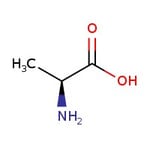
L-alanina, reactivo de cultivo celular
CAS: 56-41-7 | C3H7NO2 | 89.09 g/mol
Have Questions?
Cambiar vista


Número de catálogo J60279.22
también denominado J60279-22
Precio (EUR)
105,00
Each
Cantidad:
100 g
Precio (EUR)
105,00
Each
Identificadores químicos
CAS56-41-7
IUPAC Name(2S)-2-aminopropanoic acid
Molecular FormulaC3H7NO2
InChI KeyQNAYBMKLOCPYGJ-REOHCLBHSA-N
SMILESC[C@H](N)C(O)=O
Ver más
Especificaciones Hoja de especificaciones
Hoja de especificacionesLoss on Drying≤0.5%
Appearance (Color)White
Assay from Suppliers CofA≥98.0%
FormPowder or crystals or crystalline powder
Residue on ignition≤0.2%
It is a key player in the Glucose-Alanine cycle, which enables the removal of pyruvate and glutamate from muscle to the liver. The Glucose-Alanine cycle aides to conserve ATP in muscle for muscle contraction, while the energy burden of gluconeogenesis is imposed upon the liver.
This Thermo Scientific Chemicals brand product was originally part of the Alfa Aesar product portfolio. Some documentation and label information may refer to the legacy brand. The original Alfa Aesar product / item code or SKU reference has not changed as a part of the brand transition to Thermo Scientific Chemicals.
Aplicaciones
Es un elemento clave en el ciclo de glucosa-alanina, que permite la eliminación del piruvato y el glutamato del músculo al hígado. El ciclo de glucosa-alanina ayuda a conservar el ATP en el músculo para la contracción muscular, mientras que la carga energética de la gluconeogénesis se impone al hígado.
Solubilidad
Soluble en agua 166,5 g/l.
Notas
Almacenar en un lugar fresco y seco, en un recipiente herméticamente sellado. Almacenar lejos de agentes oxidantes.
Es un elemento clave en el ciclo de glucosa-alanina, que permite la eliminación del piruvato y el glutamato del músculo al hígado. El ciclo de glucosa-alanina ayuda a conservar el ATP en el músculo para la contracción muscular, mientras que la carga energética de la gluconeogénesis se impone al hígado.
Solubilidad
Soluble en agua 166,5 g/l.
Notas
Almacenar en un lugar fresco y seco, en un recipiente herméticamente sellado. Almacenar lejos de agentes oxidantes.
RUO – Research Use Only
General References:
- Aubérie Parent; Xavier Elduque; David Cornu; Laura Belot; Jean-Pierre Le Caer; Anna Grandas; Michel B Toledano; Benoit D'Autréaux. Mammalian frataxin directly enhances sulfur transfer of NFS1 persulfide to both ISCU and free thiols. Nature Communications. 2015, 6 5686.
- Heidi Turkia; Heli Sirén, Merja Penttilä; Juha-Pekka Pitkänen. Capillary electrophoresis with laser-induced fluorescence detection for studying amino acid uptake by yeast during beer fermentation. Talanta. 2015, 131, 366-371.