Search
 Element Search
 Structure Search


Thermo Scientific Chemicals
Novobiocin sodium salt
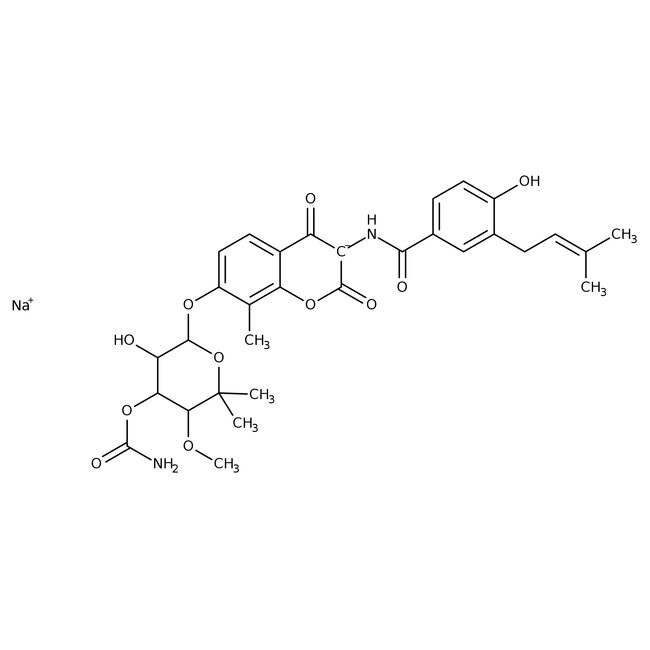
Novobiocin sodium salt, CAS # 1476-53-5, is a topoisomerase II inhibitor capable of inhibiting DNA synthesis. This compound is produced by Streptomyces nieveus and shows antibiotic activity. | CAS: 1476-53-5 | C31H35N2NaO11 | 634.61 g/mol
Have Questions?
Change view


Price (EUR)
302,00
Each
Chemical Identifiers
CAS1476-53-5
Specifications Specification Sheet
Specification SheetAppearance (Color)White to pale cream to yellow
FormPowder
Assay≥90.0%
Assay (unspecified)≥90.0%
Loss on Drying≤6%
View more
Topoisomerase II inhibitorNovobiocin sodium salt is effective an antistaphylococcal agent used in the treatment of Methicillin-resistant Staphylococcus aureus (MRSA). It is also used to inhibit the activity of retroviral RNA-dependent DNA polymerase as well as inhibitor of bacterial DNA gyrase and eukaryotic DNA topoisomerase.
This Thermo Scientific Chemicals brand product was originally part of the Alfa Aesar product portfolio. Some documentation and label information may refer to the legacy brand. The original Alfa Aesar product / item code or SKU reference has not changed as a part of the brand transition to Thermo Scientific Chemicals.
General Description
• Novobiocin sodium salt, first isolated from Streptomyces nieveus, is a topoisomerase II inhibitor. It is a coumarin compound showing antibiotic activity
• Novobiocin sodium salt can inhibit DNA synthesis by inhibiting the topoisomerase II enzyme. Its antibacterial activity arises from competitive inhibition of the ATPase reaction catalyzed by the GyrB subunit
Application
• Novobiocin sodium salt is used to inhibit the activity of retroviral RNA-dependent DNA polymerase in laboratory experiments
• It is also used as an inhibitor of bacterial DNA gyrase and eukaryotic DNA topoisomerase.
• Novobiocin sodium salt shows anti-staphylococcal activity against methicillin-resistant Staphylococcus aureus, a gram-positive bacterium
• It permits the relaxation of negative DNA supercoils and has been used to generate positively supercoiled DNA
• This compound inhibits the chaperone activity of Hsp90
RUO – Research Use Only
General References:
- Lockshon, D., and Morris, D.R. Positively supercoiled plasmid DNA is produced by treatment of Escherichia coli with DNA gyrase inhibitors. Nucleic Acids Res. 1983, 11, (10), 2999-3017.
- Allan, R., Mok, D., Ward, B.K., et al. Modulation of chaperone function and cochaperone interaction by novobiocin in the C-terminal domain of Hsp90: Evidence that coumarin antibiotics disrupt Hsp90 dimerization. J. Biol. Chem. 2006, 281, (11), 7161-7171.
- Collin, F., Karkare, S., and Maxwell, A. Exploiting bacterial DNA gyrase as a drug target: Current state and perspectives. Appl. Microbiol. Biotechnol. 2011, 92, (3), 479-497.
- Aguirre-Martínez, G. V.; DelValls, A. T.; Martín-Díaz, M. L. Yes, caffeine, ibuprofen, carbamazepine, novobiocin and tamoxifen have an effect on Corbicula fluminea (Müller, 1774). Ecotox. Environ. Safe. 2015, 120, 142-154.
- Rymer, J. K.; Hauser, M.; Bourdon, A. K.; Campagna, S. R.; Naider, F.; Becker, J. M. Novobiocin and peptide analogs of alfa-factor are positive allosteric modulators of the yeast G protein-coupled receptor Ste2p. Biochim. Biophys. Acta 2015, 1848 (4), 916-924.