Search

Invitrogen™
TA Cloning™ Kit, with pCR™2.1 Vector, without competent cells
El kit TA Cloning™ con vector pCR™2.1 proporciona una estrategia de clonación rápida y de un paso para insertar directamenteMás información
Have Questions?
Cambiar vista

| Número de catálogo | N.º de reacciones |
|---|---|
| K202040 | 40 reacciones |
| K202020 | 20 reacciones |
Número de catálogo K202040
Precio (MXN)
-
N.º de reacciones:
40 reacciones
El kit TA Cloning™ con vector pCR™2.1 proporciona una estrategia de clonación rápida y de un paso para insertar directamente un producto de PCR amplificada con Taq en un vector plasmídico. El kit TA Cloning™ usa el vector de clonación pCR™2.1 y ligasa de ADN T4 ExpressLink™ para generar un producto de ligadura en un paso de ligadura de quince minutos a temperatura ambiente. Las reacciones suelen producir > 80 % de recombinantes que contienen insertos.
Características del kit TA Cloning™ con vector 2.1 pCR™:
• Rápido y cómodo: ligación de 15 minutos a temperatura ambiente
• Eficaz: detección azul/blanco y > 80 % de los clones con inserto adecuado
• Flexible: elección de resistencia a kanamicina o ampicilina para la selección flexible de antibióticos
• Sin complicaciones: elimina cualquier modificación enzimática del producto de PCR
• Optimizado: no requiere el uso de primers de PCR que contengan sitios de restricción
El vector pCR™2.1 proporciona:
• Salientes 3'-T para la ligación directa de productos de PCR amplificados con Taq
• Promotor T7 para transcripción y secuenciación de ARN in vitro
• Un poliligador versátil con sitios EcoR I flanqueados para facilitar la escisión de insertos
• Sitios de primer directo e inverso M13 para secuenciación
Cómo funciona TA Cloning™
La polimerasa Taq tiene una actividad independiente de plantilla que añade una sola desoxiadenosina (A) a los extremos 3' de los productos PCR. El vector linealizado suministrado en este kit tiene residuos de una sola desoxiadenosina 3' (T). Esto permite a los insertos de PCR ligar eficazmente con el vector.
Configuraciones del kit
El kit TA Cloning™ se ofrece en una variedad de configuraciones: sin células competentes (K2020-20 y K2020-40), con E. coli competente químicamente One Shot™ INVF' (K2000-01 y K2000-40), con E. coli competente químicamente One Shot™ TOP10F' (K2030-01 y K2030-40) y con E. coli competente químicamente One Shot™ TOP10 (K2040-01 y K2040-40) en tamaños de kit de 20 y 40 reacciones.
Características del kit TA Cloning™ con vector 2.1 pCR™:
• Rápido y cómodo: ligación de 15 minutos a temperatura ambiente
• Eficaz: detección azul/blanco y > 80 % de los clones con inserto adecuado
• Flexible: elección de resistencia a kanamicina o ampicilina para la selección flexible de antibióticos
• Sin complicaciones: elimina cualquier modificación enzimática del producto de PCR
• Optimizado: no requiere el uso de primers de PCR que contengan sitios de restricción
El vector pCR™2.1 proporciona:
• Salientes 3'-T para la ligación directa de productos de PCR amplificados con Taq
• Promotor T7 para transcripción y secuenciación de ARN in vitro
• Un poliligador versátil con sitios EcoR I flanqueados para facilitar la escisión de insertos
• Sitios de primer directo e inverso M13 para secuenciación
Cómo funciona TA Cloning™
La polimerasa Taq tiene una actividad independiente de plantilla que añade una sola desoxiadenosina (A) a los extremos 3' de los productos PCR. El vector linealizado suministrado en este kit tiene residuos de una sola desoxiadenosina 3' (T). Esto permite a los insertos de PCR ligar eficazmente con el vector.
Configuraciones del kit
El kit TA Cloning™ se ofrece en una variedad de configuraciones: sin células competentes (K2020-20 y K2020-40), con E. coli competente químicamente One Shot™ INVF' (K2000-01 y K2000-40), con E. coli competente químicamente One Shot™ TOP10F' (K2030-01 y K2030-40) y con E. coli competente químicamente One Shot™ TOP10 (K2040-01 y K2040-40) en tamaños de kit de 20 y 40 reacciones.
Para uso exclusivo en investigación. No apto para uso en procedimientos diagnósticos.
Especificaciones
Cepa bacteriana o de levaduraNo incluida
Método de clonaciónTA Cloning
Para utilizar con (aplicación)Clonación PCR
N.º de reacciones40 reacciones
Línea de productosTA Cloning
Tipo de productoKit de clonación
PromotorT7
Cantidad40 rxns
VectorpCR2.1
FormatoKit
Unit SizeEach
Contenido y almacenamiento
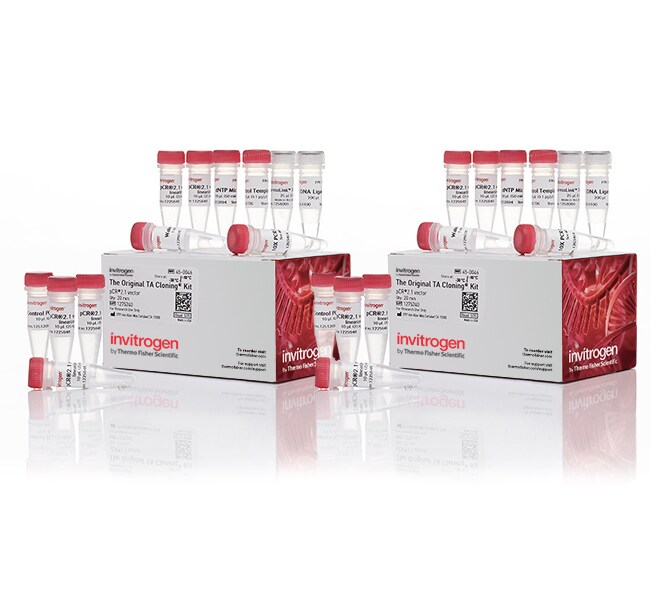
Los kits TA Cloning™ contienen el vector pCR™2.1 linealizado, la ligasa de ADN T4 ExpressLink™, el tampón de ligación de ADN T4 5X ExpressLink™, dNTPs, el tampón de PCR 10X, agua esterilizada y controles.
Almacene todos los componentes a - 20 °C. Se garantiza la estabilidad de todos los reactivos durante 6 meses si se almacenan correctamente.
Almacene todos los componentes a - 20 °C. Se garantiza la estabilidad de todos los reactivos durante 6 meses si se almacenan correctamente.