Search


Citations & References (1)
Invitrogen™
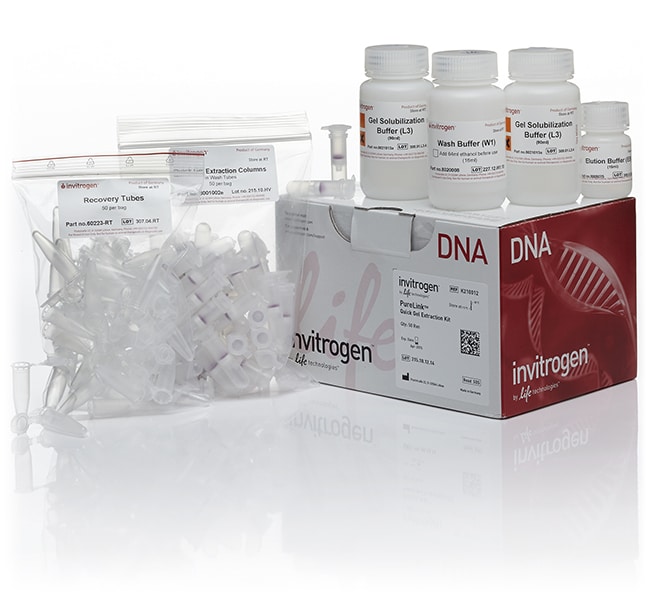
PureLink™ Quick Gel Extraction Kit
The PureLink™ Quick Gel Extraction Kit allows you to rapidly and efficiently purify DNA fragments from TAE or TBE agarose gels of various percentages.
Have Questions?
Change view

| Catalog Number | Quantity |
|---|---|
| K210012 | 50 Preps |
| K210025 | 250 Preps |
Catalog number K210012
Price (KRW)
162,000
Online offer
Ends: 31-Dec-2026
185,000Save 23,000
Each
Quantity:
50 Preps
Price (KRW)
162,000
Online offer
Ends: 31-Dec-2026
185,000Save 23,000
Each
The PureLink™ Quick Gel Extraction Kit allows you to rapidly and efficiently purify DNA fragments from TAE or TBE agarose gels of various percentages. DNA can be extracted and purified from agarose gels with different melting points in ∼30 minutes using PureLink™ silica membrane-based quick gel extraction columns. For your convenience, purification protocols are provided for centrifugation and for vacuum.
Advantages of using PureLink™ Quick Gel Extraction Kit:
- Purify DNA fragments from TAE and TBE agarose gels of various percentages and melting points
- Complete the procedure in ∼30 minutes
- Easily purify DNA fragments from 40 bp to 10 kb from gels
- Obtain high recovery of DNA fragments
- Bind and purify up to 15 μg DNA with one column
- Purify DNA fragments that are high quality and show reliable performance in PCR, restriction enzyme digestion, cloning, and labeling
Note: The PureLink™ Quick Gel Extraction Kit is not designed to purify supercoiled plasmid DNA or genomic DNA from agarose gels. Only linear DNA fragments may be purified from gels using this kit.
For Research Use Only. Not for use in diagnostic procedures.
Specifications
Elution Volume50 μL
Final Product TypeDNA
For Use With (Application)PCR, Southern blotting, sequencing, nucleic acid labeling, hybridization
High-throughput CompatibilityNot High-throughput Compatible (Manual)
Label or DyeEthidium Bromide, SYBR Safe
Quantity50 Preps
Sample TypeAgarose Gels, Gel Samples
Shipping ConditionRoom Temperature
Starting Material Amount≤400 mg
Test Time30 min.
Yield15 μg (Binding capacity)
Isolation TechnologySilica Spin Column
Unit SizeEach
Contents & Storage
PureLink Elution Tubes
For better long-term performance, it is recommended to store the purification columns at 2°C to 8°C.
For better long-term performance, it is recommended to store the purification columns at 2°C to 8°C.
Frequently asked questions (FAQs)
My downstream enzymatic reactions are not working after purifying my DNA with your PureLink Quick Gel Extraction Kit. What should I do?
What types and concentrations of agarose are compatible with the PureLink Quick Gel Extraction Kit (Cat. No. K210012)?
Can I use water to elute my sample using the PureLink Quick Gel Extraction Kit?
I'm running an agarose gel with TAE or TBE. Can I use your gel extraction kits?
Why did I get multiple bands on post-extraction gel analysis after using the PureLink Quick Gel Extraction Kit (Cat. No. K210012)?
Citations & References (1)
Citations & References
Abstract
A naturally occurring splice variant of CXCL12/stromal cell-derived factor 1 is a potent human immunodeficiency virus type 1 inhibitor with weak chemotaxis and cell survival activities.
Journal:J Virol
PubMed ID:17507482
CXCL12/stromal cell-derived factor 1 is a member of the CXC family of chemokines that plays an important role in hematopoiesis and signals through CXCR4 and CXCR7. Two splice variants of human CXCL12 (CXCL12alpha and CXCL12beta) induce chemotaxis of CXCR4(+) cells and inhibit X4 infection. Recent studies described four other novel