Search
 Element Search
 Structure Search


Thermo Scientific Chemicals
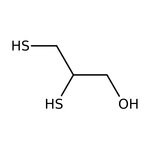
2,3-Dimercaptopropanol, 97%
CAS: 59-52-9 | C3H8OS2 | 124.216 g/mol
Have Questions?
Change view



Catalog number L03953.03
also known as L03953-03
Price (EUR)
53,40
Each
Quantity:
1 g
Price (EUR)
53,40
Each
Chemical Identifiers
CAS59-52-9
IUPAC Name2,3-disulfanylpropan-1-ol
Molecular FormulaC3H8OS2
InChI KeyWQABCVAJNWAXTE-UHFFFAOYNA-N
SMILESOCC(S)CS
View more
Specifications Specification Sheet
Specification SheetAppearance (Color)Clear colorless to pale yellow
Assay (Iodometric Titration)≥96.0% to ≤104.0%
FormLiquid
Refractive Index1.5700-1.5750 @ 20°C
British Anti-Lewisite. A chelator that inhibits sugar nucleotide degradation.2,3-Dimercaptopropanol is used as a chelating agent involved in the treatment of arsenic, antimony, lead, gold and mercury poisoning. It is also used as an antidote to the warfare agent Lewisite. Further, it is used for the treatment of Wilson's disease. In addition to this, it is used as an adjunct in the treatment of the acute encephalopathy of lead toxicity.
This Thermo Scientific Chemicals brand product was originally part of the Alfa Aesar product portfolio. Some documentation and label information may refer to the legacy brand. The original Alfa Aesar product / item code or SKU reference has not changed as a part of the brand transition to Thermo Scientific Chemicals.
Solubility
Miscible with water, ether, ethanol, vegetable oils and acetone. Slightly miscible with chloroform.
Notes
Air sensitive. Store in a cool place. Incompatible with bases, oxidizing agents, reducing agents and alkali metals.
Miscible with water, ether, ethanol, vegetable oils and acetone. Slightly miscible with chloroform.
Notes
Air sensitive. Store in a cool place. Incompatible with bases, oxidizing agents, reducing agents and alkali metals.
RUO – Research Use Only
General References:
- Chio, C. M.; Cheng, K. W.; Bishop, A. C. Direct Chemical Activation of a Rationally Engineered Signaling Enzyme. ChemBioChem 2015, 16 (12), 1735-1739.
- Andries, C.; Manea, M.; Drochioiu, G.; Gradinaru, R. New insights into coenzyme A interaction with mercury ions provided by mass spectrometric and circular dichroism spectroscopic approaches. Eur. J. Mass Spectrom. 2015, 21 (2), 97-102.