Search
 Element Search
 Structure Search
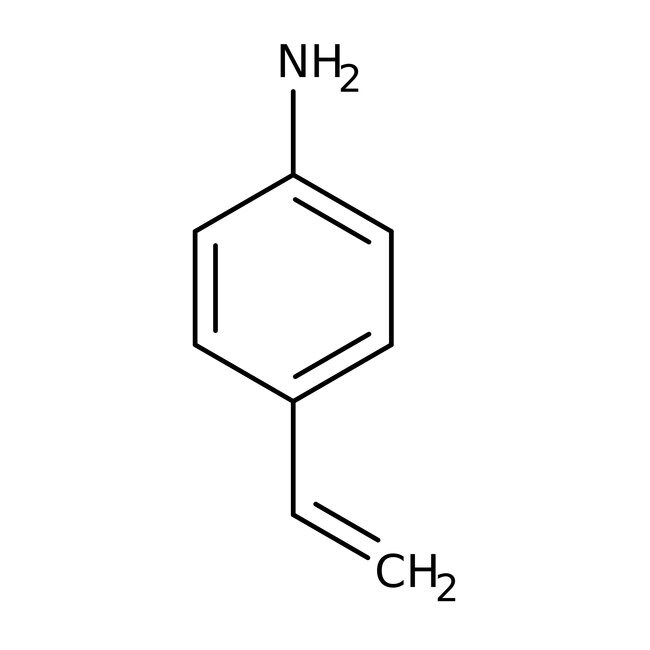

Thermo Scientific Chemicals
4-Aminostyrene, 97%, stab.
CAS: 1520-21-4 | C8H9N | 119.167 g/mol
Have Questions?
Change view


Catalog number L11845.03
also known as L11845-03
Price (USD)
59.65
Online Exclusive
66.20Save 6.55 (10%)
Each
Quantity:
1 g
Price (USD)
59.65
Online Exclusive
66.20Save 6.55 (10%)
Each
Chemical Identifiers
CAS1520-21-4
IUPAC Name4-ethenylaniline
Molecular FormulaC8H9N
InChI KeyLBSXSAXOLABXMF-UHFFFAOYSA-N
SMILESNC1=CC=C(C=C)C=C1
View more
Specifications Specification Sheet
Specification SheetFormLow-melting fused solid (clear liquid as melt)
Solution Test(10% w/v in methanol) : Clear
Assay (GC)≥96.0%
Refractive Index1.6255-1.6315 @ 20?C
Appearance (Color)White (or colorless) to yellow to yellow-orange or orange-red
View more
4-Aminostyrene undergoes graft copolymerization with poly(tetrafluoroethylene) (PTFE)1 and Si surface,2 followed by oxidative copolymerization with aniline. Thus, it renders PTFE and Si surface conductive.1 4-VAn is coupled with hydrogen terminated Si surfaces for electroless metal and synthetic metal deposition.3 Palladium(II) schiff base complexes derived from Allylamine and vinylaniline has been reported.4 It also acts as a second surfactant for coating nanomagnetic particles.5 It is used in functionalization of single-walled carbon nanotube through solvent free functionalization.
This Thermo Scientific Chemicals brand product was originally part of the Alfa Aesar product portfolio. Some documentation and label information may refer to the legacy brand. The original Alfa Aesar product / item code or SKU reference has not changed as a part of the brand transition to Thermo Scientific Chemicals.
Applications
4-Aminostyrene undergoes graft copolymerization with poly(tetrafluoroethylene) (PTFE)1 and Si surface,2 followed by oxidative copolymerization with aniline. Thus, it renders PTFE and Si surface conductive.1 4-VAn is coupled with hydrogen terminated Si surfaces for electroless metal and synthetic metal deposition.3 Palladium(II) schiff base complexes derived from Allylamine and vinylaniline has been reported.4 It also acts as a second surfactant for coating nanomagnetic particles.5 It is used in functionalization of single-walled carbon nanotube through solvent free functionalization.
Solubility
Soluble in benzene, acetone and methanol.
Notes
Keep container tightly sealed. Store in cool, dry conditions in well sealed containers. Incompatible with oxidizing agents.
4-Aminostyrene undergoes graft copolymerization with poly(tetrafluoroethylene) (PTFE)1 and Si surface,2 followed by oxidative copolymerization with aniline. Thus, it renders PTFE and Si surface conductive.1 4-VAn is coupled with hydrogen terminated Si surfaces for electroless metal and synthetic metal deposition.3 Palladium(II) schiff base complexes derived from Allylamine and vinylaniline has been reported.4 It also acts as a second surfactant for coating nanomagnetic particles.5 It is used in functionalization of single-walled carbon nanotube through solvent free functionalization.
Solubility
Soluble in benzene, acetone and methanol.
Notes
Keep container tightly sealed. Store in cool, dry conditions in well sealed containers. Incompatible with oxidizing agents.
RUO – Research Use Only
General References:
- Ken Suzuki.; Kazuo Yamaguchi.; Akira Hirao.; Seiichi Nakahama. Protection and polymerization of functional monomers. 12. Synthesis of well-defined poly(4-aminostyrene) by means of anionic living polymerization of 4-(N,N-bis(trimethylsilyl)amino)styrene. Macromolecules. 1989, 22 (6), 2607-2611.
- Jody E. Beecher.; James F. Cameron.; Jean M. J. Frechet. Photogeneration of polymeric amines: synthesis, photocrosslinking and photoimaging of copolymers containing photoactive carbamate pendant groups. J. Mater. Chem. 19925, 2 (8), 811-816.