Search


Citas y referencias (5)
Invitrogen™
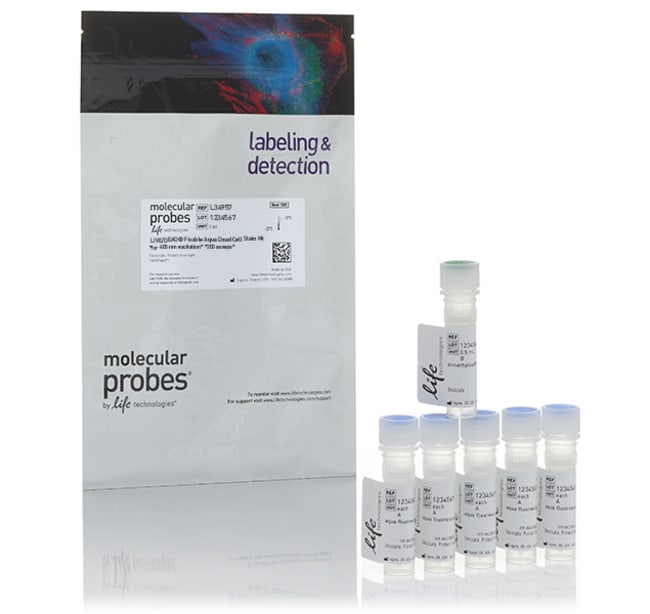
Kit de tinción de células muertas LIVE/DEAD™ Fixable Aqua, para 405nm de excitación
El kit de tinción de células muertas LIVE/DEAD™ Fixable Aqua se utiliza para determinar la viabilidad de las células antesMás información
Have Questions?
Cambiar vista

| Número de catálogo | Cantidad |
|---|---|
| L34957 | 200 ensayos |
| L34966 | 400 ensayos |
| L34965 | 80 ensayos |
Número de catálogo L34957
Precio (MXN)
-
Cantidad:
200 ensayos
El kit de tinción de células muertas LIVE/DEAD™ Fixable Aqua se utiliza para determinar la viabilidad de las células antes de la fijación y la permeabilización necesaria para la tinción de anticuerpos intracelulares o antes de la eliminación de materiales biopeligrosos mediante fijación con formaldehído. Este kit se ha optimizado y validado para su uso con un citómetro de flujo de láser violeta.
• Estable: los colorantes se han liofilizado en viales separados para mantener la estabilidad
•Resistente: mismo patrón de tinción antes y después de la fijación
• Baja
Consulte una guía de selección para todos los colorantes de viabilidad con fijación para comprobar la citometría de flujo.
Estable
A diferencia de los productos que se venden en forma de solución, el tinte LIVE/DEAD™ Fixable Aqua se ha envasado cómodamente en 40 viales de ensayo para ayudar a garantizar la estabilidad y el rendimiento del colorante a largo plazo. Al introducirse en la solución, los colorantes de reactivos de amina perderán su eficacia tras un corto periodo de tiempo; por lo tanto, se recomienda utilizar el total del vial una vez que se haya rehidratado. Si esto no es posible, divida los viales en pequeños volúmenes y almacénelos a -80 °C; evite someterlos a ciclos de congelación y descongelación.
Sólido
Los tintes del discriminador de células muertas pueden ver reducida su sensibilidad tras un tratamiento con fijadores, como los métodos de fijación basados en formaldehído o etanol que resultan necesarios para llevar a cabo estudios de fosforilación intracelular. El tinte LIVE/DEAD™ Fixable Aqua es un tinte de reactivos de amina que se une de forma covalente a las aminas intra y extracelulares. El patrón de tinción se mantiene después de la fijación con formaldehído.
Baja compensación
El tinte LIVE/DEAD™ Fixable Aqua se ha seleccionado en función de sus propiedades fluorescentes para minimizar la compensación entre otros tintes violetas y colorantes que se excitan mediante el láser azul a 488 nm. El colorante de reactivos fluorescente en agua tiene una excitación máxima de ∼ 375 nm, pero se excita bien con el láser violeta a 405 nm. Tiene una emisión máxima de ∼ 512 nm, por lo que se puede recoger en el segundo canal de la mayoría de citómetros de flujo de láser violeta.
Funcionamiento
En células con membranas comprometidas, el colorante reacciona con aminas libres tanto en el interior de la célula como en su superficie, lo que provoca una intensa tinción fluorescente. En células viables, la reactividad del colorante está limitada a las aminas de la superficie celular, lo que se traduce en una fluorescencia menos intensa. La diferencia de intensidad suele ser 50 veces mayor entre células vivas y muertas, lo que facilita la discriminación.
Colores disponibles
Los tintes de células muertas con fijación LIVE/DEAD™ están disponibles en una amplia variedad de colores para satisfacer sus necesidades de paneles de varios colores.
• Estable: los colorantes se han liofilizado en viales separados para mantener la estabilidad
•Resistente: mismo patrón de tinción antes y después de la fijación
• Baja
Consulte una guía de selección para todos los colorantes de viabilidad con fijación para comprobar la citometría de flujo.
Estable
A diferencia de los productos que se venden en forma de solución, el tinte LIVE/DEAD™ Fixable Aqua se ha envasado cómodamente en 40 viales de ensayo para ayudar a garantizar la estabilidad y el rendimiento del colorante a largo plazo. Al introducirse en la solución, los colorantes de reactivos de amina perderán su eficacia tras un corto periodo de tiempo; por lo tanto, se recomienda utilizar el total del vial una vez que se haya rehidratado. Si esto no es posible, divida los viales en pequeños volúmenes y almacénelos a -80 °C; evite someterlos a ciclos de congelación y descongelación.
Sólido
Los tintes del discriminador de células muertas pueden ver reducida su sensibilidad tras un tratamiento con fijadores, como los métodos de fijación basados en formaldehído o etanol que resultan necesarios para llevar a cabo estudios de fosforilación intracelular. El tinte LIVE/DEAD™ Fixable Aqua es un tinte de reactivos de amina que se une de forma covalente a las aminas intra y extracelulares. El patrón de tinción se mantiene después de la fijación con formaldehído.
Baja compensación
El tinte LIVE/DEAD™ Fixable Aqua se ha seleccionado en función de sus propiedades fluorescentes para minimizar la compensación entre otros tintes violetas y colorantes que se excitan mediante el láser azul a 488 nm. El colorante de reactivos fluorescente en agua tiene una excitación máxima de ∼ 375 nm, pero se excita bien con el láser violeta a 405 nm. Tiene una emisión máxima de ∼ 512 nm, por lo que se puede recoger en el segundo canal de la mayoría de citómetros de flujo de láser violeta.
Funcionamiento
En células con membranas comprometidas, el colorante reacciona con aminas libres tanto en el interior de la célula como en su superficie, lo que provoca una intensa tinción fluorescente. En células viables, la reactividad del colorante está limitada a las aminas de la superficie celular, lo que se traduce en una fluorescencia menos intensa. La diferencia de intensidad suele ser 50 veces mayor entre células vivas y muertas, lo que facilita la discriminación.
Colores disponibles
Los tintes de células muertas con fijación LIVE/DEAD™ están disponibles en una amplia variedad de colores para satisfacer sus necesidades de paneles de varios colores.
Para uso exclusivo en investigación. No apto para uso en procedimientos diagnósticos.
Especificaciones
Permeabilidad celularImpermeable
Tipo de célulaCélulas eucariotas
DescripciónKit de tinción de células muertas LIVE/DEAD™ Fixable Aqua, para 405nm de excitación
Método de detecciónFluorescente
Tipo de coloranteTinción de células muertas LIVE/DEAD™ Fixable Aqua
Longitud de onda de emisión526 nm
Longitud de onda de excitación375 nm
FormularioSólido
FormatoTubo(s)
Cantidad200 ensayos
Condiciones de envíoTemperatura ambiente
ColorVerde agua
Para utilizar con (aplicación)Ensayo de viabilidad
Para utilizar con (equipo)Citómetro de flujo
Línea de productosLIVE/DEAD
Tipo de productoTinción
Unit SizeEach
Contenido y almacenamiento
Contiene 5 viales de tinción de células muertas con fijación LIVE/DEAD™ y 500 μl de DMSO.
Almacenar a -20 °C.
Almacenar a -20 °C.
Preguntas frecuentes
I need to use a dead cell control for my viability assay. Do you have a protocol for killing cells for this?
Regarding the LIVE/DEAD Fixable Dead Cell Stain Kits, which can discriminate between live and dead cells using flow cytometry with one emission wavelength. Can these kits be used with microscopy?
How do I prepare dead cell controls for LIVE/DEAD cell viability assays?
Which cell viability kits are compatible with fixation?
Why do I need to include a viability stain in my assays?
Citations & References (5)
Citations & References
Abstract
Antibody to Langerin/CD207 localizes large numbers of CD8alpha+ dendritic cells to the marginal zone of mouse spleen.
Journal:Proc Natl Acad Sci U S A
PubMed ID:19168629
Dendritic cells (DCs) are strategically positioned to take up antigens and initiate adaptive immunity. One DC subset expresses CD8alphaalpha in mice and is specialized to capture dying cells and process antigens for MHC class I
Rapid up-regulation and granule-independent transport of perforin to the immunological synapse define a novel mechanism of antigen-specific CD8+ T cell cytotoxic activity.
Journal:J Immunol
PubMed ID:19380804
CTL are endowed with the ability to eliminate pathogens through perforin-mediated cytotoxic activity. The mechanism for perforin-mediated Ag-specific killing has been solely attributed to cytotoxic granule exocytosis from activated CD8(+) T cells. In this study, we redefine this mechanism, demonstrating that virus-specific CD8(+) T cells rapidly up-regulate perforin in response
?d T Cells Recognize a Microbial Encoded B Cell Antigen to Initiate a Rapid Antigen-Specific Interleukin-17 Response.
Journal:Immunity
PubMed ID:22960222
?d T cells contribute uniquely to immune competence. Nevertheless, how they function remains an enigma. It is unclear what most ?d T cells recognize, what is required for them to mount an immune response, and how the ?d T cell response is integrated into host immune defense. Here, we report that a noted
The microbial mimic poly IC induces durable and protective CD4+ T cell immunity together with a dendritic cell targeted vaccine.
Journal:Proc Natl Acad Sci U S A
PubMed ID:18256187
CD4(+) Th1 type immunity is implicated in resistance to global infectious diseases. To improve the efficacy of T cell immunity induced by human immunodeficiency virus (HIV) vaccines, we are developing a protein-based approach that directly harnesses the function of dendritic cells (DCs) in intact lymphoid tissues. Vaccine proteins are selectively
Increased mucosal CD4+ T cell activation following vaccination with an adenoviral vector in rhesus macaques.
Journal:
PubMed ID:24829340
The possibility that vaccination with adenoviral (AdV) vectors increased mucosal T-cell activation remains a central hypothesis to explain the potential enhancement of HIV acquisition within the Step trial. Modeling this within rhesus macaques is complicated because human adenoviruses, including adenovirus type 5 (HAdV-5), are not endogenous to macaques. Here, we