Search


Citations & References (7)
Invitrogen™
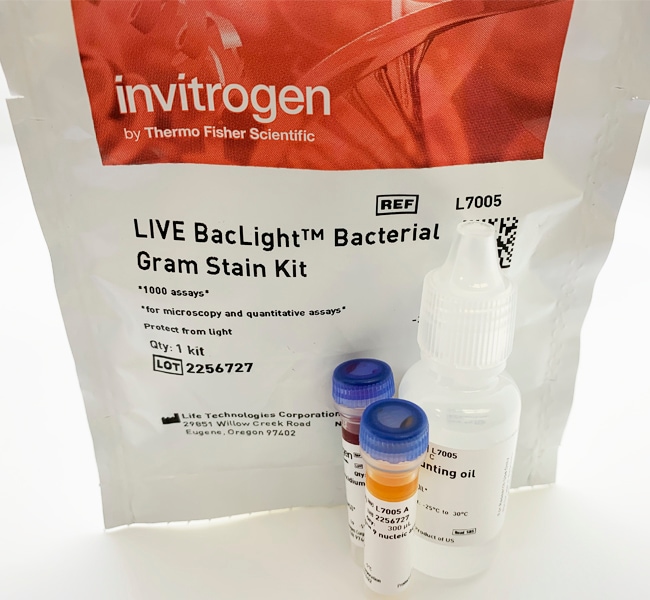
LIVE BacLight™ Bacterial Gram Stain Kit, for microscopy & quantitative assays
One step assay
| Catalog Number | Quantity |
|---|---|
| L7005 | 1 kit |
Catalog number L7005
Price (USD)
650.00
Each
Quantity:
1 kit
Price (USD)
650.00
Each
The LIVE BacLight™ Bacterial Gram Stain Kit provides a novel one-step fluorescence assay for the determination of gram sign in living bacteria. When gram negative and gram-positive bacterial are simultaneously stained with the membrane-permeant SYTO 9 dye and hexidium iodide, gram-negative bacteria fluoresce green and gram-positive bacteria fluoresce red.
Any physiological buffer between pH 7.0–8.0, including PBS, can be used to dilute the SYTO dyes for the staining solution.
For Research Use Only. Not for use in diagnostic procedures.
Specifications
DescriptionLIVE BacLight™ Bacterial Gram Stain Kit, for microscopy and quantitative assays
Detection MethodFluorescence
Dye TypeOther Label(s) or Dye(s)
Emission Wavelength480 to 700
Excitation Wavelength470 nm
FormatTube(s), 96-well plate, Slide(s)
Quantity1 kit
Shipping ConditionRoom Temperature
ColorGreen, Red
For Use With (Application)Viability Assay
For Use With (Equipment)Fluorescence Microscope, Fluorometer, Flow Cytometer, Microplate Reader
Product LineBacLight
Product TypeBacterial Stain Kit
Unit SizeEach
Contents & Storage
Store in freezer at -5°C to -30°C and protect from light.
Frequently asked questions (FAQs)
What bacterial parameters can I look at by flow cytometry?
What is the excitation/emission maxima for SYTO 9 stain and hexidium iodide?
Citations & References (7)
Citations & References
Abstract
Persistence and cell culturability of biocontrol strain Pseudomonas fluorescens CHA0 under plough pan conditions in soil and influence of the anaerobic regulator gene anr.
Journal:Environ Microbiol
PubMed ID:12558593
'Certain fluorescent pseudomonads can protect plants from soil-borne pathogens, and it is important to understand how these biocontrol agents survive in soil. The persistence of the biocontrol strain Pseudomonas fluorescens CHA0-Rif under plough pan conditions was assessed in non-sterile soil microcosms by counting total cells (immunofluorescence microscopy), intact cells (BacLight
Comparison of blue nucleic acid dyes for flow cytometric enumeration of bacteria in aquatic systems.
Journal:Appl Environ Microbiol
PubMed ID:9572943
'Seven blue nucleic acid dyes from Molecular Probes Inc. (SYTO-9, SYTO-11, SYTO-13, SYTO-16, SYTO-BC, SYBR-I and SYBR-II) were compared with the DAPI (4'',6-diamidino-2-phenylindole) method for flow cytometric enumeration of live and fixed bacteria in aquatic systems. It was shown that SYBR-II and SYTO-9 are the most appropriate dyes for bacterial
Determination of cell viability in single or mixed samples using capillary electrophoresis laser-induced fluorescence microfluidic systems.
Journal:Anal Chem
PubMed ID:11605830
The advent of high-efficiency microbial separations will have a profound effect on both chemistry and microbiology. For the first time, it appears that it may be possible to obtain qualitative and quantitative information on microbial systems with the accuracy, precision, speed, and throughput that currently is found for chemical systems.
Increased sensitivity of bacterial detection in cerebrospinal fluid by fluorescent staining on low-fluorescence membrane filters.
Journal:J Med Microbiol
PubMed ID:16091435
A membrane-filter-based, fluorescent Gram stain method for bacterial detection in cerebrospinal fluid samples was developed and evaluated as a rapid, sensitive alternative to standard Gram stain protocols. A recently developed, modified version of the aluminium oxide membrane Anopore with low-fluorescence optical properties showed superior performance in this application. Other aspects
Simultaneous fluorescent gram staining and activity assessment of activated sludge bacteria.
Journal:Appl Environ Microbiol
PubMed ID:12324319
Wastewater treatment is one of the most important commercial biotechnological processes, and yet the component bacterial populations and their associated metabolic activities are poorly understood. The novel fluorescent dye hexidium iodide allows assessment of Gram status by differential absorption through bacterial cell walls. Differentiation between gram-positive and gram-negative wastewater bacteria