Search


Citations & References (5)
Gibco™
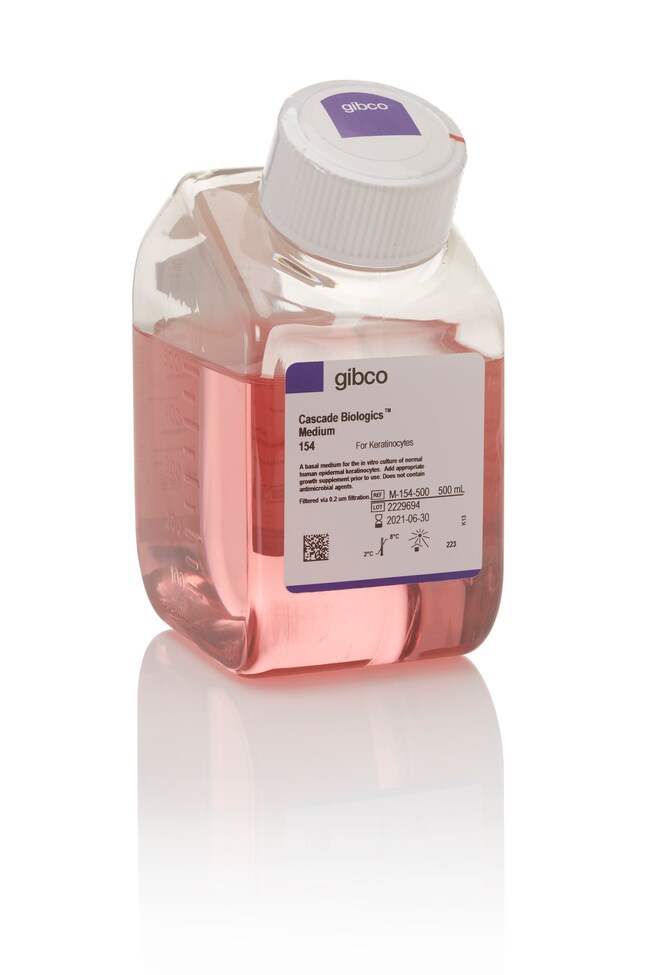
Medium 154
A sterile, liquid medium prepared with 200 μM calcium chloride for the culture of human epidermal keratinocytes. This basal mediumRead more
| Catalog Number | Quantity |
|---|---|
| M154500 | 500 mL |
Catalog number M154500
Price (USD)
100.65
Online exclusive
112.00Save 11.35
Each
Quantity:
500 mL
Price (USD)
100.65
Online exclusive
112.00Save 11.35
Each
A sterile, liquid medium prepared with 200 μM calcium chloride for the culture of human epidermal keratinocytes. This basal medium requires the addition of HKGS (S-001-5) or HKGS Kit (S-001-K) prior to use.
For Research Use Only. Not for use in diagnostic procedures.
Specifications
Cell TypeKeratinocyte Cells
Inorganic SaltsCalcium
Product LineCascade Biologics
Product TypeMedium 154
Quantity500 mL
Shipping ConditionRoom Temperature
ClassificationSerum-free
Culture TypeMammalian Cell Culture
FormLiquid
Serum LevelSerum-free
SterilitySterile-filtered
Sterilization MethodSterile-filtered
With AdditivesPhenol Red
Unit SizeEach
Contents & Storage
Store at 4°C.
Citations & References (5)
Citations & References
Abstract
MART-1 is required for the function of the melanosomal matrix protein PMEL17/GP100 and the maturation of melanosomes.
Journal:J Biol Chem
PubMed ID:15695812
More than 125 genes that regulate pigmentation have been identified to date. Of those, MART-1 has been widely studied as a melanoma-specific antigen and as a melanosome-specific marker. Whereas the functions of other melanosomal proteins, such as tyrosinase, tyrosinase-related protein-1, dopachrome tautomerase, and Pmel17, are known, the function of MART-1
Src family kinase inhibitors block amphiregulin-mediated autocrine ErbB signaling in normal human keratinocytes.
Journal:Mol Pharmacol
PubMed ID:15615697
c-Src potentiates proliferation, survival, and invasiveness in response to epidermal growth factor (EGF) in human mammary carcinoma cells. Tyrosine (Tyr) 845 of ErbB1 is phosphorylated by Src and has been implicated in control of malignant behavior. Although several lines of evidence also suggest important interactions of ErbB and Src family
Biochemical characterization of S100A2 in human keratinocytes: subcellular localization, dimerization, and oxidative cross-linking.
Journal:J Invest Dermatol
PubMed ID:10951287
S100A2 is a calmodulin-like protein of unknown function, whose transcription is positively regulated in response to ErbB and p53 signaling. Expression of S100A2 is markedly increased in the context of ErbB-driven reactive epidermal hyperplasia, and decreased in the context of hypofunctional p53 mutations in carcinoma cell lines and tumors. This
Interferon-gamma reduces melanosomal antigen expression and recognition of melanoma cells by cytotoxic T cells.
Journal:Am J Pathol
PubMed ID:11839572
In malignant melanoma, tumor-infiltrating lymphocytes are frequently reactive with melanosomal antigens. Achieving complete remissions by peptide therapy is frequently hampered by metastases evading immune recognition. The tumor microenvironment seems to favor reduced expression of target antigens by melanoma cells. Among candidate factors, interferon-gamma (IFN-gamma) (10(2) to 10(3) U/ml) suppressed expression
Genetic analysis of the human papillomavirus type 31 differentiation-dependent late promoter.
Journal:J Virol
PubMed ID:15731225
Human papillomaviruses infect stratifying squamous epithelia, causing benign and malignant lesions. Upon differentiation of the host keratinocyte, the virus undergoes a dramatic increase in both DNA replication and transcription from the late promoter, leading to expression of late genes and virion morphogenesis. In human papillomavirus type 31 (HPV31), the late