Search


Citations & References (56)
Invitrogen™
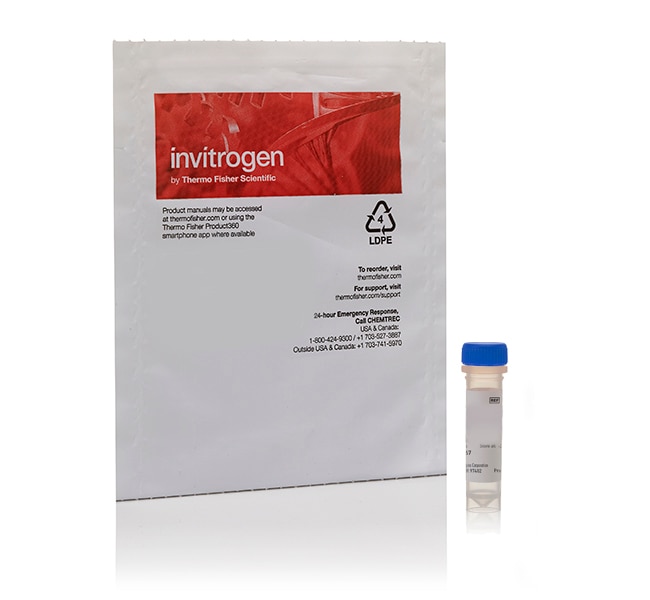
Phospholipase C Protein, Phosphatidylinositol-Specific (from Bacillus cereus)
This phosphatidylinositol-specific phospholipase C is a highly purified enzyme preparation from Bacillus cereus which cleaves phospholipid phosphatidylinositol (PI) into 2Read more
| Catalog Number | Quantity |
|---|---|
| P6466 | 50 μL |
Catalog number P6466
Price (USD)
210.00
Each
Quantity:
50 μL
Price (USD)
210.00
Each
This phosphatidylinositol-specific phospholipase C is a highly purified enzyme preparation from Bacillus cereus which cleaves phospholipid phosphatidylinositol (PI) into 2 molecules. This preparation is suitable for both enzymology and cell biology applications.
For Research Use Only. Not for use in diagnostic procedures.
Specifications
Concentration100 U⁄ml
Protein SubtypeOther Proteins
Quantity50 μL
Research CategorySignal Transduction
Shipping ConditionWet Ice
SourceBacillus cereus
For Use With (Application)Assay Standard
FormSolution
SpeciesB. cereus
Unit SizeEach
Contents & Storage
Store in freezer (-5 to -30°C).
Citations & References (56)
Citations & References
Abstract
Mechanism and structure based inhibitors of phospholipase C enzymes.
Journal:Adv Enzyme Regul
PubMed ID:8869740
'PI-specific PLC enzymes are a key component of phosphatidylinositol-mediated signaling pathways since the hydrophobic product, diacylglycerol, activates protein kinase C and the water-soluble product, inositol trisphosphate, is involved in Ca2+ mobilization. Nonspecific, or PC-PLC, enzymes can generate diacylglycerol without Ca2+ mobilization. A series of inhibitors, both lipophilic and water-soluble, have
Diacylglycerol induces fusion of nuclear envelope membrane precursor vesicles.
Journal:J Biol Chem
PubMed ID:16216883
'Purified membrane vesicles isolated from sea urchin eggs form nuclear envelopes around sperm nuclei following GTP hydrolysis in the presence of cytosol. A low density subfraction of these vesicles (MV1), highly enriched in phosphatidylinositol (PtdIns), is required for nuclear envelope formation. Membrane fusion of MV1 with a second fraction that
A turbidometric assay for phospholipase C and sphingomyelinase.
Journal:Anal Biochem
PubMed ID:7864373
'We describe a simple turbidometric assay for phosphatidylcholine-specific phospholipase C (PC-PLC) (EC 3.1.4.3), phosphatidylinositol-specific phospholipase C (PI-PLC) (EC 3.1.4.10), and sphingomyelinase (SMase) (EC 3.1.4.12), suitable for high-volume screening using unmodified substrates. Under the conditions described, 1 to 10 U/ml of PC-PLC (Bacillus cereus) induces a rapid and continuous increase in
Design, synthesis, and evaluation of water-soluble phospholipid analogues as inhibitors of phospholipase C from Bacillus cereus.
Journal:J Org Chem
PubMed ID:12968879
'The rate of hydrolysis of natural phospholipids by the phosphatidylcholine-preferring phospholipase C from Bacillus cereus (PLC(Bc)) follows the order phosphatidylcholine > phosphatidylethanolamine >> phosphatidyl-l-serine. To probe the structural basis for this substrate specificity, a series of water-soluble, nonhydrolyzable substrate analogues were needed so their complexes with the enzyme could be
Internalization of exogenously added memapsin 2 (beta-secretase) ectodomain by cells is mediated by amyloid precursor protein.
Journal:J Biol Chem
PubMed ID:15197182
'Memapsin 2 (beta-secretase) is the protease that initiates cleavage of amyloid precursor protein (APP) leading to the production of amyloid-beta (Abeta) peptide and the onset of Alzheimer''s disease. Both APP and memapsin 2 are Type I transmembrane proteins and are endocytosed into endosomes where APP is cleaved by memapsin 2.