Search


Citations & References (18)
Invitrogen™
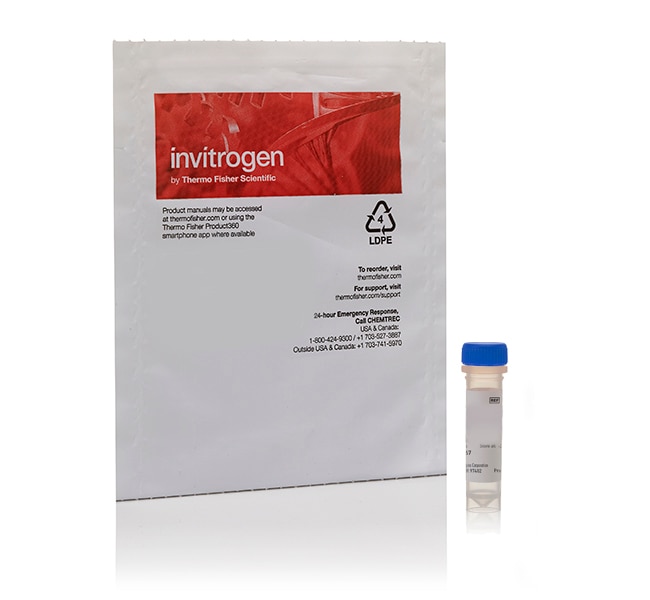
Qdot™ 585 Streptavidin Conjugate
Qdot™ 585 streptavidin conjugate comprises a biotin-binding protein (streptavidin) covalently attached to a fluorescent label (Qdot™ nanocrystal). Streptavidin has aRead more
Have Questions?
Change view

| Catalog Number | Quantity |
|---|---|
| Q10111MP | 200 μL |
| Q10113MP | 50 μL |
Catalog number Q10111MP
Price (USD)
922.00
Each
Quantity:
200 μL
Price (USD)
922.00
Each
Qdot™ 585 streptavidin conjugate comprises a biotin-binding protein (streptavidin) covalently attached to a fluorescent label (Qdot™ nanocrystal). Streptavidin has a very high binding affinity for biotin, and a conjugate of streptavidin is commonly used together with a conjugate of biotin for specific detection of a variety of proteins, protein motifs, nucleic acids, and other molecules (for example, a biotinylated primary antibody bound to a protein target can be detected with a fluorescently labeled streptavidin). Strategies similar to this are used in many detection protocols including western blots, flow cytometry, imaging and microscopy, and microplate assays, and are also used in purification workflows to achieve targeted fractionation. Qdot™ nanocrystal conjugates are provided as 1 μM solutions.
Important Features of Qdot™ Streptavidin Conjugates:
• Streptavidin Qdot™ 585 conjugate has emission maxima of ∼585 nm
• Approximately 5 to 10 streptavidins per Qdot™ nanocrystal
• Extremely photostable and bright fluorescence
• Efficiently excited with single-line excitation sources
• Narrow emission, large Stokes shift
• Available in multiple colors
• Ideal for western blots, flow cytometry, imaging and microscopy, microplate assays and more
Properties of Qdot™ Nanocrystals
The Qdot™ streptavidin conjugate is the size of a large macromolecule or protein (∼15–20 nm) and represents the brightest class of streptavidin detection reagents. Qdot™ streptavidin conjugates are made from a nanometer-scale crystal of a semiconductor material (CdSe), which is coated with an additional semiconductor shell (ZnS) to improve the optical properties of the material. The Qdot™ 705 and Qdot™ 800 streptavidin conjugates, which include CdSeTe, are made in a similar fashion. This core-shell material is further coated with a polymer shell that allows the materials to be conjugated to biological molecules and to retain their optical properties.
Other Fluorescent Conjugates of Streptavidin are Available
We offer several other Qdot™ colors or try the Qdot™ Streptavidin Sampler Kit, containing Qdot™ streptavidin conjugates in six colors 525, 565, 585, 605, 655, and 705. In addition to nanocrystal conjugates, we offer a wide range of streptavidins conjugated to Alexa Fluor™ dyes, Oregon Green™ dye, enzyme conjugates, and traditional fluorophores like Texas Red™ dye, fluorescein (FITC) and more.
Find Biotinylated Conjugates
We offer an extensive line of biotinylated conjugates for use in biotin-streptavidin detection strategies.
• Use the primary antibody search tool to find biotinylated primary antibodies
• Use the secondary antibody selector tool to find biotinylated secondary antibodies and biotinylated anti-dye and anti-hapten antibodies
Blocking Endogenous Biotin
Naturally occurring biotins can interfere with biotin-streptavidin detection schemes. For experiments involving fixed and permeabilized cells, try our Endogenous Biotin-Blocking Kit to minimize this interference.
For Research Use Only. Not intended for any animal or human therapeutic or diagnostic use.
Related Links:
Learn more about Avidin-Biotin Detection
To learn more about Qdot™ Nanocrystals
Important Features of Qdot™ Streptavidin Conjugates:
• Streptavidin Qdot™ 585 conjugate has emission maxima of ∼585 nm
• Approximately 5 to 10 streptavidins per Qdot™ nanocrystal
• Extremely photostable and bright fluorescence
• Efficiently excited with single-line excitation sources
• Narrow emission, large Stokes shift
• Available in multiple colors
• Ideal for western blots, flow cytometry, imaging and microscopy, microplate assays and more
Properties of Qdot™ Nanocrystals
The Qdot™ streptavidin conjugate is the size of a large macromolecule or protein (∼15–20 nm) and represents the brightest class of streptavidin detection reagents. Qdot™ streptavidin conjugates are made from a nanometer-scale crystal of a semiconductor material (CdSe), which is coated with an additional semiconductor shell (ZnS) to improve the optical properties of the material. The Qdot™ 705 and Qdot™ 800 streptavidin conjugates, which include CdSeTe, are made in a similar fashion. This core-shell material is further coated with a polymer shell that allows the materials to be conjugated to biological molecules and to retain their optical properties.
Other Fluorescent Conjugates of Streptavidin are Available
We offer several other Qdot™ colors or try the Qdot™ Streptavidin Sampler Kit, containing Qdot™ streptavidin conjugates in six colors 525, 565, 585, 605, 655, and 705. In addition to nanocrystal conjugates, we offer a wide range of streptavidins conjugated to Alexa Fluor™ dyes, Oregon Green™ dye, enzyme conjugates, and traditional fluorophores like Texas Red™ dye, fluorescein (FITC) and more.
Find Biotinylated Conjugates
We offer an extensive line of biotinylated conjugates for use in biotin-streptavidin detection strategies.
• Use the primary antibody search tool to find biotinylated primary antibodies
• Use the secondary antibody selector tool to find biotinylated secondary antibodies and biotinylated anti-dye and anti-hapten antibodies
Blocking Endogenous Biotin
Naturally occurring biotins can interfere with biotin-streptavidin detection schemes. For experiments involving fixed and permeabilized cells, try our Endogenous Biotin-Blocking Kit to minimize this interference.
For Research Use Only. Not intended for any animal or human therapeutic or diagnostic use.
Related Links:
Learn more about Avidin-Biotin Detection
To learn more about Qdot™ Nanocrystals
For Research Use Only. Not for use in diagnostic procedures.
Specifications
Concentration1 μM
Product TypeStreptavidin Conjugate (fluorescent)
Quantity200 μL
Shipping ConditionRoom Temperature
ConjugateQdot 585
FormLiquid
Product LineQdot
Unit SizeEach
Contents & Storage
Store in refrigerator (2–8°C).
Frequently asked questions (FAQs)
I am getting very high background with my Qdot streptavidin conjugate. Do you have any suggestions?
I am getting no signal with my Qdot streptavidin conjugate. What should I do?
What is the best way to remove white precipitate from my ITK Qdot nanocrystals?
I see a white precipitate in my ITK Qdot nanocrystals; should I be concerned?
Why do my Qdot nanocrystals appear to be blinking?
Citations & References (18)
Citations & References
Abstract
Parallel detection of antigen-specific T-cell responses by multidimensional encoding of MHC multimers.
Journal:Nat Methods
PubMed ID:19543285
'The use of fluorescently labeled major histocompatibility complex multimers has become an essential technique for analyzing disease- and therapy-induced T-cell immunity. Whereas classical major histocompatibility complex multimer analyses are well-suited for the detection of immune responses to a few epitopes, limitations on human-subject sample size preclude a comprehensive analysis of
Single-molecule quantum-dot fluorescence resonance energy transfer.
Journal:Chemphyschem
PubMed ID:15884082
'Colloidal semiconductor quantum dots are promising for single-molecule biological imaging due to their outstanding brightness and photostability. As a proof of concept for single-molecule fluorescence resonance energy transfer (FRET) applications, we measured FRET between a single quantum dot and a single organic fluorophore Cy5. DNA Holliday junction dynamics measured with
Analysis of UV-excited fluorochromes by flow cytometry using near-ultraviolet laser diodes.
Journal:Cytometry A
PubMed ID:15351984
'INTRODUCTION: Violet laser diodes have become common and reliable laser sources for benchtop flow cytometers. While these lasers are very useful for a variety of violet and some ultraviolet-excited fluorochromes (e.g., DAPI), they do not efficiently excite most UV-stimulated probes. In this study, the next generation of InGaN near-UV laser
The development of quantum dot calibration beads and quantitative multicolor bioassays in flow cytometry and microscopy.
Journal:Anal Biochem
PubMed ID:17397793
'The use of fluorescence calibration beads has been the hallmark of quantitative flow cytometry. It has enabled the direct comparison of interlaboratory data as well as quality control in clinical flow cytometry. In this article, we describe a simple method for producing color-generalizable calibration beads based on streptavidin functionalized quantum
Quantum dot self-assembly for protein detection with sub-picomolar sensitivity.
Journal:Langmuir
PubMed ID:18335969
'A novel approach to sensitive and rapid antigen detection is described. In the presence of a specific antigen, quantum dot-antibody conjugates rapidly self-assemble into agglomerates that are typically more than 1 order of magnitude larger than their individual components. The size distribution of the agglomerated colloids depends on, among other