Search


Citations & References (19)
Invitrogen™
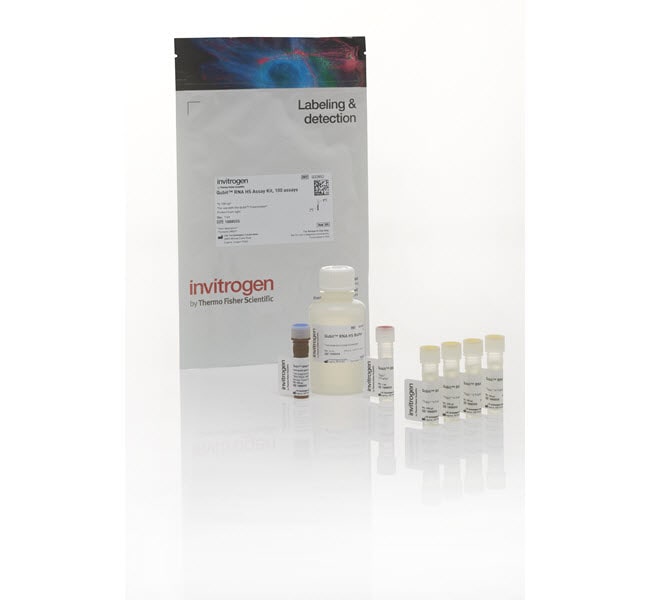
Qubit™ RNA High Sensitivity (HS), Broad Range (BR), and Extended Range (XR) Assay Kits
Kits enable quick and sensitive detection of low and high abundance RNA, and can distinguish between RNA and DNA, protein, and free nucleotides.
Have Questions?
Change view

| Catalog Number | Quantity | Assay |
|---|---|---|
| Q32852 | 100 assays | RNA Quantification, HS |
| Q10210 also known as 23456 | 100 assays | RNA Quantification, BR |
| Q10211 | 500 assays | RNA Quantification, BR |
| Q33223 | 100 assays | RNA Quantification, ext range |
| Q33224 | 500 assays | RNA Quantification, ext range |
| Q32855 | 500 assays | RNA Quantification, HS |
Catalog number Q32852
Price (USD)
142.65
Online exclusive
153.00Save 10.35
Each
Quantity:
100 assays
Assay:
RNA Quantification, HS
Price (USD)
142.65
Online exclusive
153.00Save 10.35
Each
Achieve accurate and precise quantification of RNA with Qubit RNA HS, BR, and XR Assay Kits. These RNA quantification kits enable quick and selective detection of low and high abundance RNA samples, and can distinguish RNA from DNA, protein, and free nucleotides. Contaminants such as salts, solvents, or detergents are well-tolerated.
Qubit RNA HS, BR, and XR Assay Kits, designed for use with Qubit Fluorometers, are highly selective for RNA over DNA, protein, and free nucleotides. All kits provide concentrated assay reagent, dilution buffer, and pre-diluted RNA standards. Simply dilute the reagent using the buffer provided, add your sample (any volume between 1 μL and 20 μL is acceptable), and read the concentration using a Qubit Fluorometer.
Qubit RNA HS Assay Kit
The Qubit RNA HS (High Sensitivity) Assay Kit, when used with the Qubit Fluorometer, provides an accurate and selective method for the quantitation of low-abundance RNA samples. Depending on sample volume, the assay kit is designed to be accurate for initial RNA sample concentrations of 0.2 to 200 ng/μL, providing a detection range of 4−200 ng.
Qubit RNA BR Assay Kit
The Qubit RNA BR (Broad-Range) Assay Kit, when used with the Qubit Fluorometer, provides an accurate and selective method for the quantitation of RNA samples. Depending on sample volume, the assay kit is designed to be accurate for initial RNA sample concentrations of 0.5 to 1,200 ng/μL, providing a detection range of 10−1,200 ng.
Qubit RNA XR Assay Kit
The Qubit RNA XR (Extended Range) Assay Kit, designed for use with Qubit 4 and Qubit Flex Fluorometers, provides an accurate and selective method for the quantitation of high-abundance RNA samples. Depending on sample volume, the assay kit is designed to be accurate for initial RNA sample concentrations of 5 to 20,000 ng/μL, providing a detection range of 100−20,000 ng.
Notes
• Qubit RNA HS and BR Assay kits can be used with any Qubit Fluorometer
• Qubit RNA XR Assay Kits are designed to be used only with Qubit 4 or Qubit Flex Fluorometers
• Use with thin-wall, clear, 0.5-mL PCR tubes (Cat. No. Q32856) for the Qubit 4 Fluorometer and 8 x 200-μL tube strips (Cat. No. Q33252) for the Qubit Flex Fluorometer
Qubit RNA HS Assay Kit
The Qubit RNA HS (High Sensitivity) Assay Kit, when used with the Qubit Fluorometer, provides an accurate and selective method for the quantitation of low-abundance RNA samples. Depending on sample volume, the assay kit is designed to be accurate for initial RNA sample concentrations of 0.2 to 200 ng/μL, providing a detection range of 4−200 ng.
Qubit RNA BR Assay Kit
The Qubit RNA BR (Broad-Range) Assay Kit, when used with the Qubit Fluorometer, provides an accurate and selective method for the quantitation of RNA samples. Depending on sample volume, the assay kit is designed to be accurate for initial RNA sample concentrations of 0.5 to 1,200 ng/μL, providing a detection range of 10−1,200 ng.
Qubit RNA XR Assay Kit
The Qubit RNA XR (Extended Range) Assay Kit, designed for use with Qubit 4 and Qubit Flex Fluorometers, provides an accurate and selective method for the quantitation of high-abundance RNA samples. Depending on sample volume, the assay kit is designed to be accurate for initial RNA sample concentrations of 5 to 20,000 ng/μL, providing a detection range of 100−20,000 ng.
Notes
• Qubit RNA HS and BR Assay kits can be used with any Qubit Fluorometer
• Qubit RNA XR Assay Kits are designed to be used only with Qubit 4 or Qubit Flex Fluorometers
• Use with thin-wall, clear, 0.5-mL PCR tubes (Cat. No. Q32856) for the Qubit 4 Fluorometer and 8 x 200-μL tube strips (Cat. No. Q33252) for the Qubit Flex Fluorometer
For Research Use Only. Not for use in diagnostic procedures.
Specifications
AssayRNA Quantification, HS
Excitation/Emission644/673
For Use With (Equipment)Qubit Fluorometer
No. of Reactions100 Reactions
Product LineQuant-iT, Qubit
Quantitation Range4 to 200 ng
Quantity100 assays
Shipping ConditionRoom Temperature
Detection MethodFluorescence
Unit SizeEach
Frequently asked questions (FAQs)
I'm seeing other kit-related problems besides the "Standards incorrect" message with my Qubit assay. What do you suggest I try?
The value is decreasing over time when using the Qubit Fluorometer. What could be causing this?
What are the excitation/emission wavelengths for dyes in the Qubit Assays?
Can I make my own assay for the Qubit Fluorometer?
I have a crude lysate. Will the Quant-iT and Qubit assays work?
Citations & References (19)
Citations & References
Abstract
Expression Analysis on Archival Material Revisited: Isolation and Quantification of RNA Extracted From FFPE Samples.
Journal:Diagn Mol Pathol
PubMed ID:23370428
'BACKGROUND:: Formalin-fixed paraffin-embedded (FFPE) tissue is the most readily available source of RNA for the gene expression studies. The main disadvantage is the poor quality of isolated RNA. Our group recently compared 5 commercially available RNA isolation kits and concluded that the RNeasy FFPE kit from Qiagen was the most
Analysis of in vivo expressed genes in Mannheimia haemolytica A1.
Journal:FEMS Microbiol Lett
PubMed ID:16984402
'The expression of Mannheimia haemolytica A1 genes during in vivo growth was examined by reverse transcriptase-polymerase chain reaction (RT-PCR) using total RNA extracted directly from M. haemolytica A1 recovered from pneumonic lungs of cattle. Primers specific for three groups of genes were used. Group 1 includes virulence-related genes: lktC, tbpB,
High transcript level of fatty acid-binding protein 11 but not of very low-density lipoprotein receptor is correlated to ovarian follicle atresia in a teleost fish (Solea senegalensis).
Journal:Biol Reprod
PubMed ID:17554079
'Transcripts encoding a fatty acid-binding protein (FABP), Fabp11, and two isoforms of very low-density lipoprotein receptor (Vldlr; vitellogenin receptor) were characterized from the ovary of Senegalese sole (Solea senegalensis). Phylogenetic analyses of vertebrate FABPs demonstrated that Senegalese sole Fabp11, as zebrafish (Danio rerio) homologous sequences, is part of a newly
Comparative expression analysis of rpf-like genes of Mycobacterium tuberculosis H37Rv under different physiological stress and growth conditions.
Journal:Microbiology
PubMed ID:20522500
'Mycobacterium tuberculosis H37Rv possesses five resuscitation-promoting factors, RpfA-E, which are required for the resuscitation of dormancy in mycobacteria induced by prolonged incubation of the culture in stationary phase. This study explores the transcriptional profile of all the rpf-like genes of M. tuberculosis H37Rv in the exponential phase, stationary phase, non-culturable
Bioreactor environment-sensitive sentinel genes as novel metrics for cell culture scale-down comparability.
Journal:Biotechnol Prog
PubMed ID:22848039
Scale-down of bioreactors is currently done based on matching one or more measurable parameters such as k(L) a and P/V, which could result in insufficient process comparability. Currently, there is a lack of genomic translational studies in cell culture scale-down, which could help delineate measurable cellular attributes for improved scale-down.