Search


Citations & References (23)
Invitrogen™
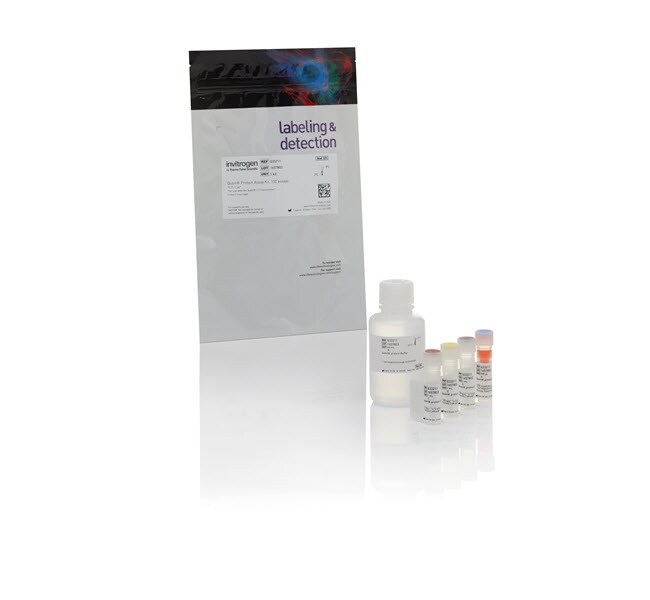
Qubit™ Protein and Protein Broad Range (BR) Assay Kits
蛍光ベースのタンパク質定量アッセイ用のQubitタンパク質およびタンパク質BRアッセイキットを使用すると、タンパク質の高感度検出のほか、タンパク質間の低変動を実現します。


製品番号(カタログ番号) Q33211
価格(JPY)
17,700
Each
アッセイ:
タンパク質定量アッセイ
定量範囲:
12.5 μg/mL~5 mg/mL
対応可能対象:
100 Reactions
当社独自の2種類のQubitタンパク質定量キット:Qubitタンパク質アッセイは12.5 μg/mL∼5 mg/mLのタンパク質を、Qubitタンパク質BRアッセイキットは0.1∼20 mg/mLのタンパク質をそれぞれ定量します。どちらのアッセイも、多くの一般的な汚染物質に対応しており、試薬、塩、核酸を低減します。タンパク質BRアッセイキットは、界面活性剤にも耐性があります。
Qubit Protein Assay Kit
Qubit Protein Assay Kitは、各種のQubit蛍光光度計で使用できるように専用設計されています。このアッセイでは、1~20 μL範囲にあるサンプルを使用する場合、タンパク質間のばらつきが少ない12.5 μg⁄mL~5 mg⁄mLのサンプルを定量できます。
Qubit Protein Assay Kitは、タンパク質に対して高い選択性を有し、還元試薬の存在下でも高い精度を示しますが、多量の界面活性剤の存在下での精度は高くありません。還元試薬(DTT、β-メルカプトエタノールなど)、塩、遊離ヌクレオチド、アミノ酸、溶媒、またはDNAなどの一般的な汚染物質は、界面活性剤ではなく、アッセイで十分に耐性があります。その他の汚染物質の場合には、若干のプロトコル変更が必要です。
このキットには、濃縮アッセイ試薬、希釈バッファー、希釈済みBSA標準液が付属します。希釈バッファーでアッセイ試薬を希釈し、サンプル(許容量範囲は1 μL~20 μL)を添加した後、濃度を読み取ります
蛍光タンパク質の定量にはどの製品を選べばよいでしょうか?
•1~20サンプル:このQubit Protein Assay KitとQubit Fluorometerを併用します
• 20~2,000サンプル:Quant-iT Protein Assay Kitとマイクロプレートリーダーを併用します
Qubit Protein BR Assay Kit
Qubit Protein BR Assay Kitは、Qubit 4 Fluorometerを用いて、精製タンパク質、ライセート、血清、血漿、複合タンパク質のタンパク質濃度を迅速かつ簡便に信頼性の高い方法で測定します。このタンパク質キットは、幅広い範囲(0.1~20 mg/mL)で正確なタンパク質定量を実現し、ほとんどのサンプルを効率的に(希釈なしで)使用できるため、従来のタンパク質定量法に伴う推測作業や希釈手順が不要となります。このアッセイは、界面活性剤、還元試薬(DTT、β-メルカプトエタノールなど)、塩、核酸など、多くの一般的な汚染物質に対応します。
Qubit Protein BR Assay Kitの主な特長:
•広いダイナミックレンジ—0.1~20 mg/mL、希釈なしでサンプルを測定
• 2点標準曲線—時間のかかる標準的な調製を排除
• 自動濃度測定—タンパク質濃度を瞬時に取得;オフラインでの計算は不要
• 適合性—還元試薬、界面活性剤、その他の一般的なバッファー成分の存在下でも高精度
Qubit Protein BR Assay Kitには、2種類のキャリブレーション標準液、Protein BR Assay BufferおよびProtein BR Assay Reagentが付属します。150~160 μLのProtein BR Assay Bufferをサンプルの10または20 μLのサンプルに加え、さらに30 μLのProtein BR Assay Reagentを添加するだけです。室温で10分間インキュベートします。次に、サンプルをQubit 4機器に挿入し、濃度を読み取ります。
注:
1.Qubitアッセイキットは、Qubit 1.0、Qubit 2.0、Qubit 3、Qubit 4、Qubit Flexの各光度計で使用できます。
2.Qubit Protein BR Assay Kitは、Qubit 4 Fluorometer専用の蛍光ベースアッセイです。
3.500 μL薄壁透明PCRチューブ(カタログ番号Q32856)が必要ですが、Protein AssayおよびBR Assay Kitには含まれていません。
Qubit Protein Assay Kitは、各種のQubit蛍光光度計で使用できるように専用設計されています。このアッセイでは、1~20 μL範囲にあるサンプルを使用する場合、タンパク質間のばらつきが少ない12.5 μg⁄mL~5 mg⁄mLのサンプルを定量できます。
Qubit Protein Assay Kitは、タンパク質に対して高い選択性を有し、還元試薬の存在下でも高い精度を示しますが、多量の界面活性剤の存在下での精度は高くありません。還元試薬(DTT、β-メルカプトエタノールなど)、塩、遊離ヌクレオチド、アミノ酸、溶媒、またはDNAなどの一般的な汚染物質は、界面活性剤ではなく、アッセイで十分に耐性があります。その他の汚染物質の場合には、若干のプロトコル変更が必要です。
このキットには、濃縮アッセイ試薬、希釈バッファー、希釈済みBSA標準液が付属します。希釈バッファーでアッセイ試薬を希釈し、サンプル(許容量範囲は1 μL~20 μL)を添加した後、濃度を読み取ります
蛍光タンパク質の定量にはどの製品を選べばよいでしょうか?
•1~20サンプル:このQubit Protein Assay KitとQubit Fluorometerを併用します
• 20~2,000サンプル:Quant-iT Protein Assay Kitとマイクロプレートリーダーを併用します
Qubit Protein BR Assay Kit
Qubit Protein BR Assay Kitは、Qubit 4 Fluorometerを用いて、精製タンパク質、ライセート、血清、血漿、複合タンパク質のタンパク質濃度を迅速かつ簡便に信頼性の高い方法で測定します。このタンパク質キットは、幅広い範囲(0.1~20 mg/mL)で正確なタンパク質定量を実現し、ほとんどのサンプルを効率的に(希釈なしで)使用できるため、従来のタンパク質定量法に伴う推測作業や希釈手順が不要となります。このアッセイは、界面活性剤、還元試薬(DTT、β-メルカプトエタノールなど)、塩、核酸など、多くの一般的な汚染物質に対応します。
Qubit Protein BR Assay Kitの主な特長:
•広いダイナミックレンジ—0.1~20 mg/mL、希釈なしでサンプルを測定
• 2点標準曲線—時間のかかる標準的な調製を排除
• 自動濃度測定—タンパク質濃度を瞬時に取得;オフラインでの計算は不要
• 適合性—還元試薬、界面活性剤、その他の一般的なバッファー成分の存在下でも高精度
Qubit Protein BR Assay Kitには、2種類のキャリブレーション標準液、Protein BR Assay BufferおよびProtein BR Assay Reagentが付属します。150~160 μLのProtein BR Assay Bufferをサンプルの10または20 μLのサンプルに加え、さらに30 μLのProtein BR Assay Reagentを添加するだけです。室温で10分間インキュベートします。次に、サンプルをQubit 4機器に挿入し、濃度を読み取ります。
注:
1.Qubitアッセイキットは、Qubit 1.0、Qubit 2.0、Qubit 3、Qubit 4、Qubit Flexの各光度計で使用できます。
2.Qubit Protein BR Assay Kitは、Qubit 4 Fluorometer専用の蛍光ベースアッセイです。
3.500 μL薄壁透明PCRチューブ(カタログ番号Q32856)が必要ですが、Protein AssayおよびBR Assay Kitには含まれていません。
For Research Use Only. Not for use in diagnostic procedures.
仕様
アッセイタンパク質定量アッセイ
使用対象 (装置)Qubit蛍光光度計、マイクロプレートリーダー
製品ラインQuant-iT、Qubit
製品タイプProtein Quantification Assay
定量範囲12.5 μg/mL~5 mg/mL
数量100反応
出荷条件室温
対応可能対象100 Reactions
検出法蛍光
Unit SizeEach
よくあるご質問(FAQ)
How does the accuracy and sensitivity of the Qubit quantitation assays using the Qubit fluorometer compare to a microplate reader?
Can the Qubit kits give an indication of sample quality in nucleic acid samples?
Can I use the Quant-iT and Qubit Kits with other fluorometers?
Can I use the original Quant-iT Kits with the Qubit Fluorometer?
Is 1X RIPA buffer (50 mM Tris-HCl, 150 mM NaCl, 0.25% deoxycholic acid, 1% NP-40, 1mM EDTA, pH 7.4) compatible with the Qubit Protein Assay (Cat. No. Q33211/Q33212)?
引用および参考文献 (23)
引用および参考文献
Abstract
Post-training disruption of Arc protein expression in the anterior cingulate cortex impairs long-term memory for inhibitory avoidance training.
Journal:Neurobiol Learn Mem
PubMed ID:21315825
'The activity-regulated-cytoskeletal-associated protein (Arc) has a well established role in memory consolidation and synaptic plasticity in the hippocampus and amygdala. However the role of Arc within the anterior cingulate cortex (ACC), an area of the brain involved in processing memory for pain, has yet to be examined. Here we sought
Investigation of the involvement of P-glycoprotein and multidrug resistance-associated protein 2 in the efflux of ximelagatran and its metabolites by using short hairpin RNA knockdown in Caco-2 cells.
Journal:Drug Metab Dispos
PubMed ID:20023051
'Liver and bile secretion can be an important first-pass and clearance route for drug compounds and also the site of several drug-drug interactions. In the clinical program for ximelagatran development, an unexpected effect of erythromycin on the pharmacokinetics of the direct thrombin inhibitor ximelagatran and its metabolites was detected. This
Synthesis and optimization of lectin functionalized nanoprobes for the selective recovery of glycoproteins from human body fluids.
Journal:Anal Chem
PubMed ID:21809823
'Biomedical sciences, and in particular biomarker research, demand efficient glycoprotein enrichment platforms. Herein magnetic nanoprobes (MNP), after being coated with three broad-spectrum lectins-concanavalin A (ConA), wheat germ agglutinin (WGA), and Maackia amurensis lectin (MA)-were utilized to selectively capture glycoproteins from human body fluids. Additionally, a new methodology, based on protection
Active and total transforming growth factor-ß1 are differentially regulated by dopamine and estradiol in the pituitary.
Journal:Endocrinology
PubMed ID:21521749
'Dopamine, acting through the dopamine type 2 receptor (Drd2), is the main inhibitor of pituitary prolactin (PRL) secretion and lactotroph proliferation. TGF-ß1 is involved, at least in part, in mediating these actions. It was described that TGF-ß1 synthesis in rat pituitary lactotrophs is up-regulated by dopamine and down-regulated by estradiol.
Silencing of NHE-1 blunts the slow force response to myocardial stretch.
Journal:J Appl Physiol (1985)
PubMed ID:21659487
'Myocardial stretch induces a biphasic force response: a first abrupt increase followed by a slow force response (SFR), believed to be the in vitro manifestation of the Anrep effect. The SFR is due to an increase in Ca²? transient of unclear mechanism. We proposed that Na?/H? exchanger (NHE-1) activation is