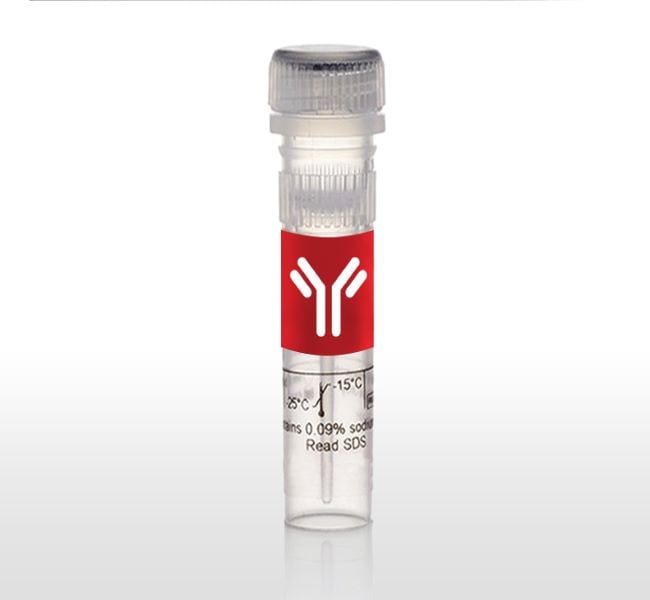
Positope™ Control Protein
Invitrogen™

Positope™ Control Protein

The Positope™ Control Protein is designed to be used as a positive control in western blotting for a variety ofMás información
Have Questions?
Número de catálogoCantidad
R900505 μg
Número de catálogo R90050
Precio (MXN)
-
Cantidad:
5 μg
The Positope™ Control Protein is designed to be used as a positive control in western blotting for a variety of antibodies. The control protein is a 53 kDa highly purified (>95%) recombinant protein that contains seven epitope tags. Validated applications for the Positope Control Protein are Western Blot against the primary antibodies listed in the manual. By using Positope™ Protein as a positive control, you can assess the performance of your western blots, no matter which of the epitopes you are using.
Control Protein Attributes:
Applications: Validated applications for Positope™ Control Protein are Western blotting using the primary antibodies mentioned in the manual. Recommended loading amount for Western blotting: 100 ng per lane.
Protein Subtype: Tagged Protein Control
Product Size: Positope™ Control Protein is supplied as a 5 μg pack size.
For Research Use Only. Not for use in diagnostic procedures.
Especificaciones
Línea de productosPositope
Familia de proteínasOther Proteins
Forma de proteínaRecombinant
Subtipo de proteínaTagged Protein Controls
Cantidad5 μg
Para utilizar con (aplicación)Assay Standard
Unit SizeEach
Contenido y almacenamiento
Each vial contains 5 μg of Positope™ Control Protein at a concentration of 25 ng/μl in reducing SDS-PAGE sample buffer. Store the protein at +4°C. For long-term storage, store at -20°C. The protein is guaranteed stable for 6 months when stored properly.

Preguntas frecuentes

What do I need to consider when designing a peptide for antibody production?

We recommend that hydrophobic residues comprise 50% or less of all the residues in your sequence. Make sure there is at least one charged residue for every five amino acids: this is generally known to enhance the solubility of the peptide. Peptides (compared to polypeptides, which fold and bury the hydrophobic amino acids) are too small to fold, so just a few hydrophobic amino acids may leave them insoluble.

Other guidelines include:
Peptides containing multiple Cys, Met, and Trp can be hard to synthesize.
Some sequences are problematic in solid-phase peptide synthesis or cleavage and are best avoided; these include Asp-Pro sequences or stretches of amino acids that require bulky protecting groups on their side chains during synthesis.
Glycine is often good for antigenicity as it has only a hydrogen side chain; this allows for complete rotation.
Please note that we offer a Custom Antibody Production service (https://www.thermofisher.com/us/en/home/life-science/antibodies/custom-antibodies/custom-antibody-production.html) that includes the use of our proprietary Antigen Profiler and Antigen Preparation tool (https://www.thermofisher.com/us/en/home/life-science/antibodies/custom-antibodies/custom-antibody-production/antigen-profiler-antigen-preparation.html).

What is the optimal peptide length for antibody production?

Most peptide antigens range in length from 12 to 16 residues and are relatively easy to synthesize. Peptides of 9 residues or shorter have been effective antigens for antibody production, but peptides longer than 16 amino acids may contain several epitopes and form secondary structures. Peptides in excess of 18 residues begin to present more synthetic challenges. Before you synthesize your peptide, we recommend doing a BLASTP search using your peptide sequence. This is to make sure that the peptide is not homologous or identical to a sequence in a completely unrelated protein in the host animal.

Please note that we offer a Custom Antibody Production service (https://www.thermofisher.com/us/en/home/life-science/antibodies/custom-antibodies/custom-antibody-production.html) that includes the use of our proprietary Antigen Profiler and Antigen Preparation tool (https://www.thermofisher.com/us/en/home/life-science/antibodies/custom-antibodies/custom-antibody-production/antigen-profiler-antigen-preparation.html).

What can I use as a positive control or marker on my western blots?

The Positope control protein (Cat. No. R90050) is designed to be used as a positive control in western blotting for a variety of antibodies. The control protein is a 53 kDa highly purified recombinant protein that contains seven epitope tags including the Xpress, c-myc, V5, His(C-term), HisG(N-term), Thioredoxin, and GFP.

The MagicMark XP Western Protein Standard (Cat. No. LC5602) consists of peptides that contain an IgG binding domain. These peptides can be detected with your regular antibodies and provide a way for you to get good molecular weight estimations without having to rely on transferred pre-stained standards.

Find additional tips, troubleshooting help, and resources within our Protein Electrophoresis and Western Blotting Support Center.

What happens if antibodies are stored improperly?

Improper storage of antibodies can lead to:
- Degradation: Loss of activity and specificity
- Aggregation: Formation of precipitates or clumps
- Reduced performance: Poor results in assays or experiments

Find additional tips, troubleshooting help, and resources within our Antibodies and Immunoassays Support Center.

What do antibody pair kits contain, how many samples can I process, and how can I find a list of antibody pair kits by target?

Antibody pair kits contain capture antibody, detection antibody, recombinant standard and HRP conjugate. Each contains enough reagents to process forty 96-well plates. A list of Antibody Pair Kits (https://www.thermofisher.com/us/en/home/life-science/protein-biology/protein-assays-analysis/elisa/antibody-pair-kits.html) is available by target.

Find additional tips, troubleshooting help, and resources within our Antibodies and Immunoassays Support Center.

Citations & References (1)

Citations & References
Abstract
Cleavage of von Willebrand Factor Requires the Spacer Domain of the Metalloprotease ADAMTS13.
Authors:Zheng X, Nishio K, Majerus EM, Sadler JE,
Journal:J Biol Chem
PubMed ID:12791682
ADAMTS13 consists of a reprolysin-type metalloprotease domain followed by a disintegrin domain, a thrombospondin type 1 motif (TSP1), Cys-rich and spacer domains, seven more TSP1 motifs, and two CUB domains. ADAMTS13 limits platelet accumulation in microvascular thrombi by cleaving the Tyr1605-Met1606 bond in von Willebrand factor, and ADAMTS13 deficiency causes ... More