Search


Citations & References (25)
Invitrogen™
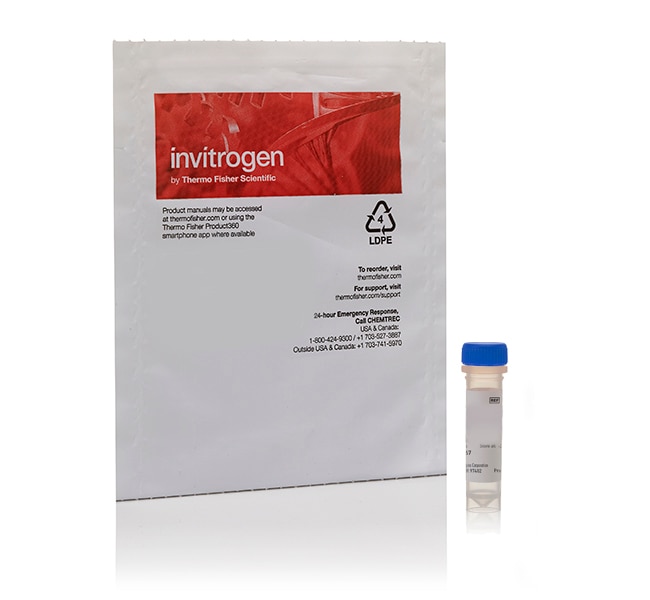
SYTO™ 60 Red Fluorescent Nucleic Acid Stain - 5 mM Solution in DMSO
For use with fluorescence microscopy and flow cytometry
| Catalog Number | Quantity |
|---|---|
| S11342 | 250 μL |
Catalog number S11342
Price (USD)
359.65
Online exclusive
379.00Save 19.35
Each
Quantity:
250 μL
Price (USD)
359.65
Online exclusive
379.00Save 19.35
Each
The cell-permeant SYTO 60 red fluorescent nucleic acid stain exhibits bright, red fluorescence upon binding to nucleic acids. Because the staining pattern of the SYTO dyes in live cells may vary between cell types, we offer the SYTO Red Fluorescent Nucleic Acid Stain Sampler Kit (Cat. No. S-11340) to enable researchers to find the most appropriate red-fluorescent SYTO stain for their system.
Any physiological buffer between pH 7.0–8.0, including PBS, can be used to dilute the SYTO dyes for the staining solution.
For Research Use Only. Not for use in diagnostic procedures.
Specifications
ColorRed
DescriptionSYTO™ 60 Red Fluorescent Nucleic Acid Stain - 5 mM Solution in DMSO
Detection MethodFluorescence
Dye TypeCell-Permeant
Emission678 nm
Excitation Wavelength Range652 nm
For Use With (Equipment)Fluorescence Microscope
Product LineSYTO
Quantity250 μL
Shipping ConditionRoom Temperature
Volume (Metric)250 μL
Label TypeFluorescent Dye
Product TypeNucleic Acid Stain
Sub Cellular LocalizationNucleic Acids
Unit SizeEach
Contents & Storage
Store in freezer at -5°C to -30°C and protect from light.
Frequently asked questions (FAQs)
How do SYTO dyes bind to DNA?
Citations & References (25)
Citations & References
Abstract
The protein tyrosine phosphatase PTP-BL associates with the midbody and is involved in the regulation of cytokinesis.
Journal:Mol Biol Cell
PubMed ID:12529439
'PTP-BL is a highly modular protein tyrosine phosphatase of unknown function. It consists of an N-terminal FERM domain, five PDZ domains, and a C-terminally located tyrosine phosphatase domain. Here we show that PTP-BL is involved in the regulation of cytokinesis. We demonstrate localization of endogenous PTP-BL at the centrosomes during
Nucleic acid binding agents exert local toxic effects on neurites via a non-nuclear mechanism.
Journal:J Neurochem
PubMed ID:16441515
'The mechanism by which drugs that target nucleic acids cause neurotoxicity is not well described. We characterized the neurotoxicity of Hoechst 33342 (bis-benzimide), a common cell permeable nuclear dye, in primary neuronal cultures. The mechanism of cell death was not apoptotic, as death is rapid, not accompanied by typical nuclear
Multiparameter detection of apoptosis using red-excitable SYTO probes.
Journal:Cytometry A
PubMed ID:18431792
'Functional assays allowing phenotypic characterization of different cell death parameters at a single-cell level are important tools for preclinical anticancer drug screening. Currently, the selection of cytometric assays is limited by the availability of fluorescent probes with overlapping spectral characteristics. Following on our earlier reports on green and orange fluorescent
Liver fatty acid-binding protein colocalizes with peroxisome proliferator activated receptor alpha and enhances ligand distribution to nuclei of living cells.
Journal:Biochemistry
PubMed ID:14992586
'Although it is hypothesized that long-chain fatty acyl CoAs (LCFA-CoAs) and long-chain fatty acids (LCFAs) regulate transcription in the nucleus, little is known regarding factors that determine the distribution of these ligands to nuclei of living cells. Immunofluorescence colocalization showed that liver fatty acid-binding protein (L-FABP; binds LCFA-CoA as well
Cytoplasmic and nuclear delivery of a TAT-derived peptide and a beta-peptide after endocytic uptake into HeLa cells.
Journal:J Biol Chem
PubMed ID:14517218
'Several short, highly cationic peptides are able to enter the cytoplasm and nucleus of cells from the extracellular medium. The mechanism of entry is unknown. A number of fluorescence-based studies suggested that these molecules cross the plasma membrane by an energy-independent process, directly gaining access to the cytoplasm. Recent reports