Search


Citations & References (8)
Invitrogen™
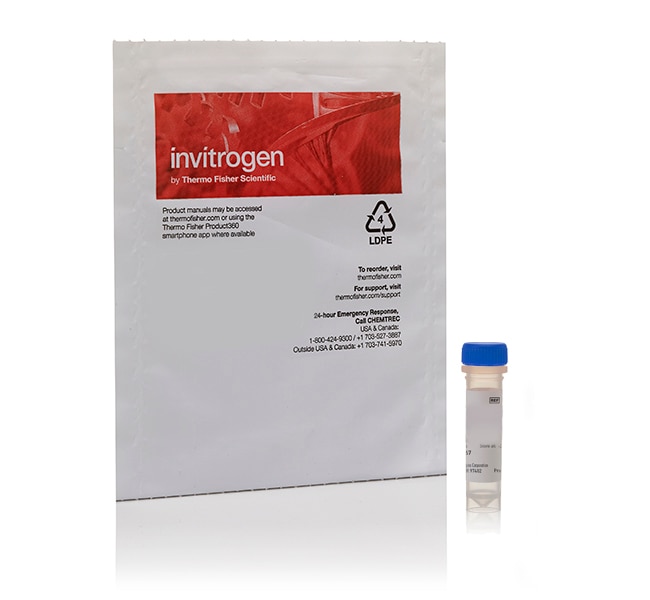
SYTO™ 63 Red Fluorescent Nucleic Acid Stain - 5 mM Solution in DMSO
For use with fluorescence microscopy and flow cytometry
| Catalog Number | Quantity |
|---|---|
| S11345 | 250 μL |
Catalog number S11345
Price (USD)
365.00
Each
Quantity:
250 μL
Price (USD)
365.00
Each
The cell-permeant SYTO 63 red fluorescent nucleic acid stain exhibits bright, red fluorescence upon binding to nucleic acids. Because the staining pattern of the SYTO dyes in live cells may vary between cell types, we offer the SYTO Red Fluorescent Nucleic Acid Stain Sampler Kit (Cat. No. S-11340) to enable researchers to find the most appropriate red-fluorescent SYTO stain for their system.
Any physiological buffer between pH 7.0–8.0, including PBS, can be used to dilute the SYTO dyes for the staining solution.
For Research Use Only. Not for use in diagnostic procedures.
Specifications
ColorRed
DescriptionSYTO™ 63 Red Fluorescent Nucleic Acid Stain - 5 mM Solution in DMSO
Detection MethodFluorescence
Dye TypeCell-Permeant
Emission673 nm
Excitation Wavelength Range657 nm
For Use With (Equipment)Fluorescence Microscope
Product LineSYTO
Quantity250 μL
Shipping ConditionRoom Temperature
Volume (Metric)250 μL
Label TypeFluorescent Dye
Product TypeNucleic Acid Stain
Sub Cellular LocalizationNucleic Acids
Unit SizeEach
Contents & Storage
Store in freezer at -5°C to -30°C and protect from light.
Frequently asked questions (FAQs)
How do SYTO dyes bind to DNA?
Citations & References (8)
Citations & References
Abstract
Nucleic acid binding agents exert local toxic effects on neurites via a non-nuclear mechanism.
Journal:J Neurochem
PubMed ID:16441515
'The mechanism by which drugs that target nucleic acids cause neurotoxicity is not well described. We characterized the neurotoxicity of Hoechst 33342 (bis-benzimide), a common cell permeable nuclear dye, in primary neuronal cultures. The mechanism of cell death was not apoptotic, as death is rapid, not accompanied by typical nuclear
Multiparameter detection of apoptosis using red-excitable SYTO probes.
Journal:Cytometry A
PubMed ID:18431792
'Functional assays allowing phenotypic characterization of different cell death parameters at a single-cell level are important tools for preclinical anticancer drug screening. Currently, the selection of cytometric assays is limited by the availability of fluorescent probes with overlapping spectral characteristics. Following on our earlier reports on green and orange fluorescent
Differentiation of Phytophthora infestans sporangia from other airborne biological particles by flow cytometry.
Journal:Appl Environ Microbiol
PubMed ID:11772606
'The ability of two different flow cytometers, the Microcyte (Optoflow) and the PAS-III (Partec), to differentiate sporangia of the late-blight pathogen Phytophthora infestans from other potential airborne particles was compared. With the PAS-III, light scatter and intrinsic fluorescence parameters could be used to differentiate sporangia from conidia of Alternaria or
High throughput single molecule detection for monitoring biochemical reactions.
Journal:Analyst
PubMed ID:19082181
The design, performance and application of a novel optical system for high throughput single molecule detection (SMD) configured in a continuous flow format using microfluidics is reported. The system consisted of a microfabricated polymer-based multi-channel fluidic network situated within the optical path of a laser source (lambda(ex) = 660 nm)
Cytoplasmic O-glycosylation prevents cell surface transport of E-cadherin during apoptosis.
Journal:EMBO J
PubMed ID:11689440
Cellular adhesion is regulated by members of the cadherin family of adhesion receptors and their cytoplasmic adaptor proteins, the catenins. Adhesion complexes are regulated by recycling from the plasma membrane and proteolysis during apoptosis. We report that in MCF-7, MDA-MB-468 and MDCK cells, induction of apoptosis by agents that cause