Search


Citations & References (8)
Invitrogen™
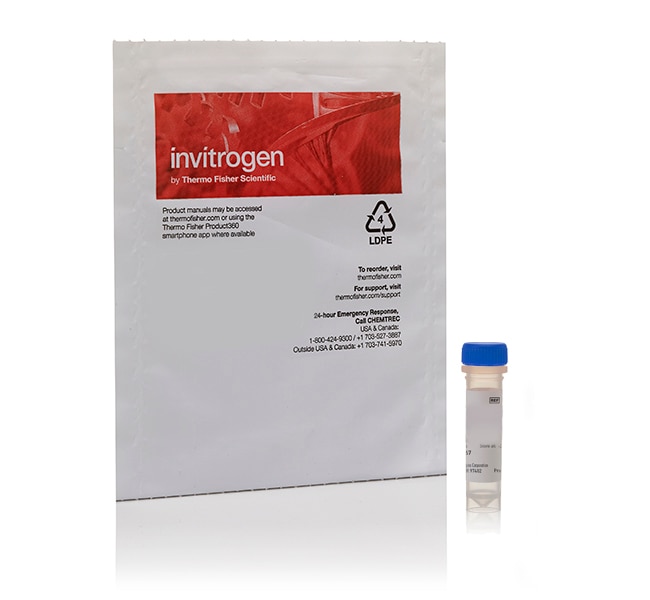
SYTO™ 41 Blue Fluorescent Nucleic Acid Stain - 5 mM Solution in DMSO
For use with fluorescence microscopy and flow cytometry
| Catalog Number | Quantity |
|---|---|
| S11352 | 250 μL |
Catalog number S11352
Price (USD)
366.00
Each
Quantity:
250 μL
Price (USD)
366.00
Each
The cell-permeant SYTO 41 blue fluorescent nucleic acid stain exhibits bright, blue fluorescence upon binding to nucleic acids. Because the staining pattern of the SYTO dyes in live cells may vary from one cell type to another, we offer the SYTO Blue Fluorescent Nucleic Acid Stain Sampler Kit (Cat. No. S-11350) to enable researchers to find the dye that works best for a particular application.
Any physiological buffer between pH 7.0–8.0, including PBS, can be used to dilute the SYTO dyes for the staining solution.
For Research Use Only. Not for use in diagnostic procedures.
Specifications
ColorBlue
DescriptionSYTO™ 41 Blue Fluorescent Nucleic Acid Stain - 5 mM Solution in DMSO
Detection MethodFluorescence
Dye TypeCell-Permeant
Emission454 nm
Excitation Wavelength Range430 nm
For Use With (Equipment)Fluorescence Microscope
Product LineSYTO
Quantity250 μL
Shipping ConditionRoom Temperature
Volume (Metric)250 μL
Label TypeFluorescent Dye
Product TypeNucleic Acid Stain
Sub Cellular LocalizationNucleic Acids
Unit SizeEach
Contents & Storage
Store in freezer at -5°C to -30°C and protect from light.
Frequently asked questions (FAQs)
How do SYTO dyes bind to DNA?
Citations & References (8)
Citations & References
Abstract
Nucleic acid binding agents exert local toxic effects on neurites via a non-nuclear mechanism.
Journal:J Neurochem
PubMed ID:16441515
'The mechanism by which drugs that target nucleic acids cause neurotoxicity is not well described. We characterized the neurotoxicity of Hoechst 33342 (bis-benzimide), a common cell permeable nuclear dye, in primary neuronal cultures. The mechanism of cell death was not apoptotic, as death is rapid, not accompanied by typical nuclear
Imaging collagen in intact viable healthy and atherosclerotic arteries using fluorescently labeled CNA35 and two-photon laser scanning microscopy.
Journal:Mol Imaging
PubMed ID:17711780
We evaluated CNA35 as a collagen marker in healthy and atherosclerotic arteries of mice after both ex vivo and in vivo administration and as a molecular imaging agent for the detection of atherosclerosis. CNA35 conjugated with fluorescent Oregon Green 488 (CNA35/OG488) was administered ex vivo to mounted viable muscular (uterine),
Two pathways converge at CED-10 to mediate actin rearrangement and corpse removal in C. elegans.
Journal:Nature
PubMed ID:15744306
The removal of apoptotic cells is essential for the physiological well being of the organism. In Caenorhabditis elegans, two conserved, partially redundant genetic pathways regulate this process. In the first pathway, the proteins CED-2, CED-5 and CED-12 (mammalian homologues CrkII, Dock180 and ELMO, respectively) function to activate CED-10 (Rac1). In
Two-photon microscopy of vital murine elastic and muscular arteries. Combined structural and functional imaging with subcellular resolution.
Journal:J Vasc Res
PubMed ID:17192719
Understanding vascular pathologies requires insight in the structure and function, and, hence, an imaging technique combining subcellular resolution, large penetration depth, and optical sectioning. We evaluated the applicability of two-photon laser-scanning microscopy (TPLSM) in large elastic and small muscular arteries under physiological conditions. Elastic (carotid) and muscular (uterine, mesenteric) arteries
Loss of α-gal during primate evolution enhanced antibody-effector function and resistance to bacterial sepsis.
Journal:Cell Host Microbe
PubMed ID:33497603