Search


Citations & References (65)
Invitrogen™
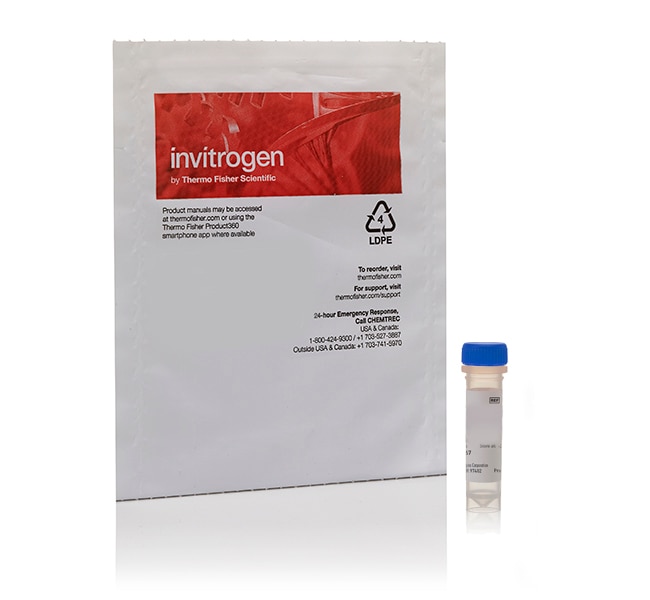
Texas Red™ 1,2-Dihexadecanoyl-sn-Glycero-3-Phosphoethanolamine, Triethylammonium Salt (Texas Red™ DHPE)
The phospholipid, Texas Red™ 1,2-dihexadecanoyl-sn-glycero-3-phosphoethanolamine, triethylammonium salt (Texas Red™ DHPE) is labeled on the head group with the bright, red-fluorescent Texas Red™ dye.
| Catalog Number | Quantity |
|---|---|
| T1395MP | 1 mg |
Catalog number T1395MP
Price (USD)
280.00
1 mg
Quantity:
1 mg
Price (USD)
280.00
1 mg
The phospholipid, Texas Red™ 1,2-dihexadecanoyl-sn-glycero-3-phosphoethanolamine, triethylammonium salt (Texas Red™ DHPE) is labeled on the head group with the bright, red-fluorescent Texas Red™ dye (excitation/emission maxima ∼595/615 nm).
To make a concentrated stock solution from 1–2 mg/mL, dissolve in 100% ethanol. Sonication may be necessary to aid dispersion. Store frozen, desiccated and protected from light. The gradual accumulation of moisture from the atmosphere may promote aggregation of the reagent over time.
For Research Use Only. Not for use in diagnostic procedures.
Specifications
Chemical Name or MaterialPhospholipids
Excitation/Emission583/601 nm
Recommended StorageStore in freezer (-5°C to -30°C) and protect from light.
Molecular Weight (g/mol)1381.85
Physical FormSolid
Product LineTexas Red
Quantity1 mg
Unit Size1 mg
Citations & References (65)
Citations & References
Abstract
Fabrication of phospholipid bilayer-coated microchannels for on-chip immunoassays.
Journal:Anal Chem
PubMed ID:11199961
'Herein we describe a new class of microfluidic immunoassays based upon solid supported lipid bilayers. Two-dimensionally fluid bilayer material, which can accommodate multivalent binding between surface-bound ligands and aqueous receptors, was coated on the surface of poly(dimethylsiloxane) microchannels. The bilayers contained dinitrophenyl (DNP)-conjugated lipids for binding with bivalent anti-DNP antibodies.
Restriction of receptor movement alters cellular response: physical force sensing by EphA2.
Journal:Science
PubMed ID:20223987
'Activation of the EphA2 receptor tyrosine kinase by ephrin-A1 ligands presented on apposed cell surfaces plays important roles in development and exhibits poorly understood functional alterations in cancer. We reconstituted this intermembrane signaling geometry between live EphA2-expressing human breast cancer cells and supported membranes displaying laterally mobile ephrin-A1. Receptor-ligand binding,
Formation of supported phospholipid bilayers on molecular surfaces: role of surface charge density and electrostatic interaction.
Journal:Biophys J
PubMed ID:16449198
'Electrostatic interaction is known to play important roles in the adsorption of charged lipids on oppositely charged surfaces. Here we show that, even for charge neutral (zwitterionic) lipids, electrostatic interaction is critical in controlling the adsorption and fusion of lipid vesicles to form supported phospholipid bilayers (SPBs) on surfaces. We
Optical detection of ion-channel-induced proton transport in supported phospholipid bilayers.
Journal:Nano Lett
PubMed ID:17629349
'The integration of ion-channel transport functions with responses derived from nanostructured and nanoporous silica mesophase materials is demonstrated. Patterned thin-film mesophases consisting of alternating hydrophilic nanoporous regions and hydrophobic nanostructured regions allow for spatially localized proton transport via selective dimerization of gramicidin in lipid bilayers formed on the hydrophilic regions.
The location of fluorescence probes with charged groups in model membranes.
Journal:Biochim Biophys Acta
PubMed ID:9814853
'The location of commonly used charged fluorescent membrane probes in membranes was determined in order to: (1) investigate the relationship between the structure of hydrophobic molecules and their depth within membranes; and (2) aid interpretation of experiments in which these fluorescent probes are used to examine membrane structure. Membrane depth