Search


Citations & References (2)
Invitrogen™
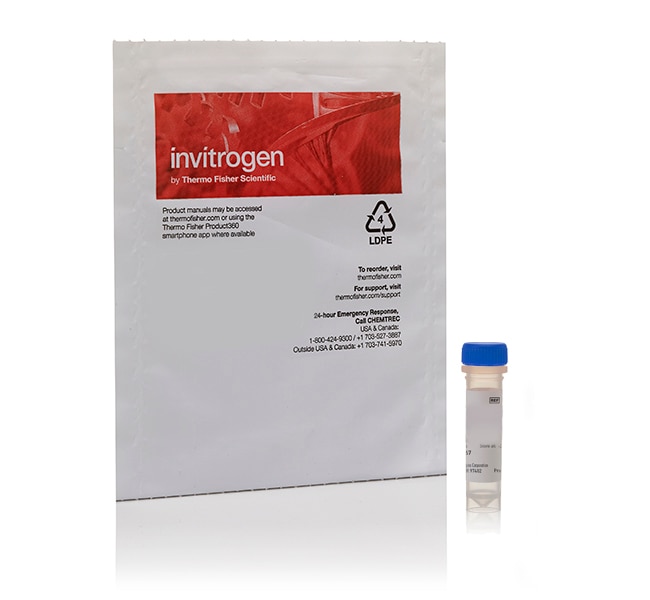
TransFluoSpheres™ Carboxylate-Modified Microspheres, 0.04 μm (488/560), 2% solids
Microspheres (also called latex beads or latex particles) are spherical particles in the colloidal size range that are formed fromRead more
| Catalog Number | Quantity |
|---|---|
| T8864 also known as T-8864 | 0.5 mL |
Catalog number T8864
also known as T-8864
Price (USD)
670.00
0.5 mL
Quantity:
0.5 mL
Price (USD)
670.00
0.5 mL
Microspheres (also called latex beads or latex particles) are spherical particles in the colloidal size range that are formed from an amorphous polymer such as polystyrene. Our Molecular Probes™ TransFluoSpheres™ beads are manufactured using high-quality, ultraclean polystyrene and are loaded with two (or more) fluorescent dyes to produce a microspheres that can be excited by the 488 nm or the 514 nm spectral lines of the argon-ion laser but emit at much longer wavelengths, facilitating multicolor experiments and allowing the use of broadband excitation and emission filters. TransFluoSpheres™ microspheres typically show little or no photobleaching, even when excited with the intense illumination required for fluorescence microscopy.
TransFluoSpheres™ Microsphere Specifications:
• Label (Ex/Em): Red-orange fluorescent (488/560)
• Nominal bead diameter: 0.04 μm
• Coupling surface: Carboxylate
• Solids: 2%
Characteristics of the Carboxylate Coupling Surface
Carboxylate-modified FluoSpheres™ beads have a high density of pendent carboxylic acids on their surface, making them suitable for covalent coupling of proteins and other amine-containing biomolecules using water-soluble carbodiimide reagents such as EDAC.
Key Applications of Microspheres:
• Instrument calibration (flow cytometry, microscopy, HTS, HCS)
• Flow testing (microfluidics, blood flow, water flow, and air flow)
• Cell biology tracers (cell differentiation and cell tracing)
• Immunoassays (agglutination tests, ELISA, particle capture, and contrast reagents)
Choices for Fluorescent Microspheres
Among our complete offering of fluorescent microspheres products, you’ll find beads with these variations:
• Ten fluorescent colors
• Ten nominal bead diameters: 0.02 μm, 0.04 μm, 0.1 μm, 0.2 μm, 0.5 μm, 1.0 μm, 2.0 μm, 4.0 μm, 10.0 μm, and 15.0 μm
• Four surface modifications for protein coupling: carboxylate, sulfate, aldehyde-sulfate, amine
• Microspheres that are additionally precoupled with streptavidin, NeutrAvidin, biotin, europium, and platinum
Choices for Unstained Microspheres
We also offer hundreds of choices for UltraClean™ surfactant-free microspheres for research and commercial applications.
We’ll Make a Custom Microsphere Product for You
We will prepare custom orders upon request. Our custom conjugation service is efficient and confidential, and we stand by the quality of our work. We are ISO 13485:2000 certified.
For Research Use Only. Not intended for animal or human therapeutic or diagnostic use.
TransFluoSpheres™ Microsphere Specifications:
• Label (Ex/Em): Red-orange fluorescent (488/560)
• Nominal bead diameter: 0.04 μm
• Coupling surface: Carboxylate
• Solids: 2%
Characteristics of the Carboxylate Coupling Surface
Carboxylate-modified FluoSpheres™ beads have a high density of pendent carboxylic acids on their surface, making them suitable for covalent coupling of proteins and other amine-containing biomolecules using water-soluble carbodiimide reagents such as EDAC.
Key Applications of Microspheres:
• Instrument calibration (flow cytometry, microscopy, HTS, HCS)
• Flow testing (microfluidics, blood flow, water flow, and air flow)
• Cell biology tracers (cell differentiation and cell tracing)
• Immunoassays (agglutination tests, ELISA, particle capture, and contrast reagents)
Choices for Fluorescent Microspheres
Among our complete offering of fluorescent microspheres products, you’ll find beads with these variations:
• Ten fluorescent colors
• Ten nominal bead diameters: 0.02 μm, 0.04 μm, 0.1 μm, 0.2 μm, 0.5 μm, 1.0 μm, 2.0 μm, 4.0 μm, 10.0 μm, and 15.0 μm
• Four surface modifications for protein coupling: carboxylate, sulfate, aldehyde-sulfate, amine
• Microspheres that are additionally precoupled with streptavidin, NeutrAvidin, biotin, europium, and platinum
Choices for Unstained Microspheres
We also offer hundreds of choices for UltraClean™ surfactant-free microspheres for research and commercial applications.
We’ll Make a Custom Microsphere Product for You
We will prepare custom orders upon request. Our custom conjugation service is efficient and confidential, and we stand by the quality of our work. We are ISO 13485:2000 certified.
For Research Use Only. Not intended for animal or human therapeutic or diagnostic use.
For Research Use Only. Not for use in diagnostic procedures.
Specifications
Product LineTransFluoSpheres
Quantity0.5 mL
Shipping ConditionRoom Temperature
Surface ModificationCarboxylate
ColorRed-Orange
Diameter (Metric)0.04 μm
MaterialPolystyrene
Product TypeCarboxylate-Modified Microsphere
Unit Size0.5 mL
Contents & Storage
Store in refrigerator (2–8°C) and protect from light.
Frequently asked questions (FAQs)
What is the warranty for FluoSpheres microspheres?
After washing and centrifugation, there was only a very small pellet left of my microsphere beads and the solution was transparent. Why is this?
I've had my microspheres for over a year, and I'm wondering if they're still good to use. What are some good ways to check their functionality?
I accidentally froze my microspheres; can I still use them?
My protein-coated microspheres appear to be non-specifically binding in my experimental system. Do you have a product that can help reduce these non-specific interactions?
Citations & References (2)
Citations & References
Abstract
Ultrahigh-resolution colocalization of spectrally separable point-like fluorescent probes.
Journal:Methods
PubMed ID:11559000
'An ultrahigh-resolution colocalization method based on the simultaneous acquisition and analysis of spectrally separated images of the excitation point-spread function of point-like fluorescent probes is reviewed. It is shown that molecular distances can be measured with accuracy better than 10 nm using conventional far-field optics. A detailed account of the
Ultrahigh-resolution multicolor colocalization of single fluorescent probes.
Journal:Proc Natl Acad Sci U S A
PubMed ID:10931959
An optical ruler based on ultrahigh-resolution colocalization of single fluorescent probes is described in this paper. It relies on the use of two unique families of fluorophores, namely energy-transfer fluorescent beads (TransFluoSpheres) and semiconductor nanocrystal quantum dots, that can be excited by a single laser wavelength but emit at different