Search


Citations & References (7)
Invitrogen™
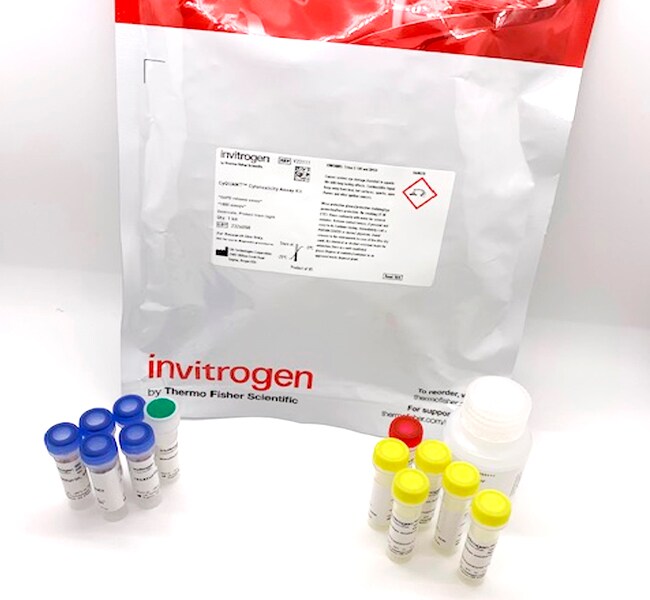
CyQUANT™ Cytotoxicity Assay Kit (G6PD Release Assay)
CyQUANT cytotoxicity assays measure cellular toxicity based on the release of cytosolic enzymes (LDH or G6PD) from damaged cells. These cytotoxicity assays utilize either colorimetric or fluorescence detection and allow continuous monitoring of cell death using microplate readers.
| Catalog Number | Quantity |
|---|---|
| V23111 | 1000 Assays |
Catalog number V23111
Price (MXN)
-
Quantity:
1000 Assays
CyQUANT cytotoxicity assays provide a simple and reliable method to assess chemical or cell-mediated cellular toxicity. The CyQUANT LDH Cytotoxicity Assays and the CyQUANT Cytotoxicity Assay (G6PD Release Assay) use colorimetric- or fluorescence-based detection to measure the release of cytosolic enzymes (LDH or G6PD) from damaged cells. These cytotoxicity assays are optimized for use on microplate readers and can be used for continuous monitoring of cell health over time since cell lysis is not required, making them versatile tools for high-throughput screening and drug discovery applications.
With the CyQuant G6PD Release Assay (V23111), damaged and dying cells release glucose 6-phosphate dehydrogenase (G6PD) into the surrounding medium. G6PD is detected through a two-step enzymatic process via oxidation of glucose 6-phosphate by G6PD to generate NADPH, which leads to the reduction of resazurin by diaphorase to red-fluorescent resorufin. This assay results in lower background signals than are typically observed in LDH assays, offering increased sensitivity. It can detect as few as 500 cells and is more sensitive than LDH release assays.
Features of the CyQUANT Cytotoxicity Assay Kit (G6PD Release Assay)
- High sensitivity—detects as few as 500 cells, offering greater sensitivity than LDH release assays
- Specific detection—measures glucose 6-phosphate dehydrogenase (G6PD) release from damaged and dying cells
- Low background signals—produces lower background fluorescence compared to LDH release assays
- Accurate and reliable—the fluorescence signal (ex/em 563/587 nm) is proportional to the number of dead cells, ensuring accurate cytotoxicity measurement
For Research Use Only. Not for use in diagnostic procedures.
Specifications
Cell PermeabilityCell-impermeant
Detection MethodFluorescence
Dye TypeResorufin
Emission Wavelength580 to 600 nm
Excitation Wavelength530 to 560 nm
Format96-well plate
Quantity1000 Assays
Shipping ConditionRoom Temperature
ColorRed
For Use With (Application)Cytotoxicity Assay
For Use With (Equipment)Microplate Reader
Product LineCyQUANT
Product TypeG6PD Release Cytotoxicity Assay
Unit Size1 kit
Contents & Storage
Store in freezer -5°C to -30°C and protect from light.
Frequently asked questions (FAQs)
What are the fluorescence excitation/emission maxima for Resorufin that is generated in the Vybrant Cytotoxicity Assay Kit (G6PD Release Assay)?
How many assays can I perform using the CyQUANT Cytotoxicity Assay Kit (G6PD Release Assay) (Cat. No. V23111)?
Can I use flash-frozen supernatant from the cell culture for the CyQUANT Cytotoxicity Assay (Cat. No. V23111)?
Citations & References (7)
Citations & References
Abstract
Use of cellular glucose-6-phosphate dehydrogenase for cell quantitation: applications in cytotoxicity and apoptosis assays.
Journal:Anal Biochem
PubMed ID:15136165
'A fluorescence-based microplate assay was developed to quantify cell death based upon the measurement of glucose-6-phosphate dehydrogenase (G6PD) activity. G6PD is a cytosolic enzyme and leaks from cells when plasma membrane integrity is compromised. In this assay, cell death is measured by correlating the activity of extracellular G6PD to the
Development of a comprehensive human immunodeficiency virus type 1 screening algorithm for discovery and preclinical testing of topical microbicides.
Journal:Antimicrob Agents Chemother
PubMed ID:18316528
'Topical microbicides are self-administered, prophylactic products for protection against sexually transmitted pathogens. A large number of compounds with known anti-human immunodeficiency virus type 1 (HIV-1) inhibitory activity have been proposed as candidate topical microbicides. To identify potential leads, an in vitro screening algorithm was developed to evaluate candidate microbicides in
In vivo imaging platform for tracking immunotherapeutic cells.
Journal:Nat Biotechnol
PubMed ID:16041364
Cellular therapeutics show great promise for the treatment of disease, but few noninvasive techniques exist for monitoring the cells after administration. Here we present a magnetic resonance imaging (MRI) technology that uses perfluoropolyether (PFPE) agents to track cells in vivo. Fluorine MRI selectively images only the labeled cells, and a
Kaposi's sarcoma-associated herpesvirus induces rapid release of angiopoietin-2 from endothelial cells.
Journal:J Virol
PubMed ID:23536671
Kaposi sarcoma-associated herpesvirus (KSHV) stimulates proliferation, angiogenesis, and inflammation to promote Kaposi sarcoma (KS) tumor growth, which involves various growth factors and cytokines. Previously, we found that KSHV infection of human umbilical vein endothelial cells (HUVECs) induces a transcriptional induction of the proangiogenic and proinflammatory cytokine angiopoietin-2 (Ang-2). Here, we
Extracellular DNA, Neutrophil Extracellular Traps, and Inflammasome Activation in Severe Asthma.
Journal:Am J Respir Crit Care Med
PubMed ID:30888839