Search


Citas y referencias (2)
Invitrogen™
ADN polimerasa Platinum™ Taq
La ADN polimerasa Invitrogen Platinum Taq es una ADN polimerasa termoestable de inicio en caliente, fiable y práctica, para PCRMás información
Have Questions?
Cambiar vista

| Número de catálogo | N.º de reacciones |
|---|---|
| 10966026 | 300 reacciones |
| 10966018 | 120 reacciones |
| 10966034 | 600 reacciones |
| 10966083 | 5000 reacciones |
Número de catálogo 10966026
Precio (USD)
631,40
Each
N.º de reacciones:
300 reacciones
Precio (USD)
631,40
Each
La ADN polimerasa Invitrogen Platinum Taq es una ADN polimerasa termoestable de inicio en caliente, fiable y práctica, para PCR que proporciona una especificidad mejorada en comparación con la de la ADN polimerasa Taq. La propiedad de inicio en caliente de la enzima viene conferida por los anticuerpos monoclonales termolábilos que hacen inactiva la ADN polimerasa Taq hasta el paso inicial de desnaturalización de la PCR. De esta forma se evita la extensión de cebadores no específicamente recocidos y se mejora la producción.
Uso de ADN polimerasa Platinum Taq
La propiedad de inicio en caliente de la ADN polimerasa Platinum Taq permite un ensamblaje de reacción conveniente a temperatura ambiente. Al igual que con la ADN polimerasa Platinum Taq, la ADN polimerasa Platinum Taq tiene una actividad transferasa terminal que no depende de moldes y que añade una desoxiadenosina 3’ a los extremos del producto y tiene una actividad exonucleasa 5’→3’. Los productos de PCR generados con la ADN polimerasa Platinum Taq se pueden utilizar en las mismas aplicaciones posteriores sin modificar los protocolos. Utilice la ADN polimerasa Platinum Taq para la amplificación de ADN de moldes genómicos complejos, virales y plasmídicos, así como en la RT-PCR.
Nota: Para un rendimiento superior de PCR, recomendamos la enzima de próxima generación ADN polimerada Platinum II Taq Hot-Start. La ADN polimerasa Platinum II Taq Hot-Start está diseñada para el recocido universal de cebadores y una PCR rápida y sencilla con su combinación única de tampón innovador, ADN polimerasa Taq de alto rendimiento y tecnología superior de inicio en caliente.
Uso de ADN polimerasa Platinum Taq
La propiedad de inicio en caliente de la ADN polimerasa Platinum Taq permite un ensamblaje de reacción conveniente a temperatura ambiente. Al igual que con la ADN polimerasa Platinum Taq, la ADN polimerasa Platinum Taq tiene una actividad transferasa terminal que no depende de moldes y que añade una desoxiadenosina 3’ a los extremos del producto y tiene una actividad exonucleasa 5’→3’. Los productos de PCR generados con la ADN polimerasa Platinum Taq se pueden utilizar en las mismas aplicaciones posteriores sin modificar los protocolos. Utilice la ADN polimerasa Platinum Taq para la amplificación de ADN de moldes genómicos complejos, virales y plasmídicos, así como en la RT-PCR.
Nota: Para un rendimiento superior de PCR, recomendamos la enzima de próxima generación ADN polimerada Platinum II Taq Hot-Start. La ADN polimerasa Platinum II Taq Hot-Start está diseñada para el recocido universal de cebadores y una PCR rápida y sencilla con su combinación única de tampón innovador, ADN polimerasa Taq de alto rendimiento y tecnología superior de inicio en caliente.
Para uso exclusivo en investigación. No apto para uso en procedimientos diagnósticos.
Especificaciones
Actividad exonucleasa5' - 3'
Fidelidad (frente a Taq)1 X
FormatoTubo
Inicio en calienteInicio en caliente integrado
N.º de reacciones300 reacciones
Sobrante3'-A
PolimerasaADN polimerasa Taq Platinum
Tipo de productoADN polimerasa
Cantidad300 reacciones
Formato de reacciónComponentes separados
Condiciones de envíoAprobado para su envío en hielo húmedo o seco
Tamaño (producto final)5 kb o menos
Material de partidaADN
Para utilizar con (aplicación)Hot-start PCR
GC-Rich PCR PerformanceBajo
Velocidad de reacciónEstándar
Unit SizeEach
Contenido y almacenamiento
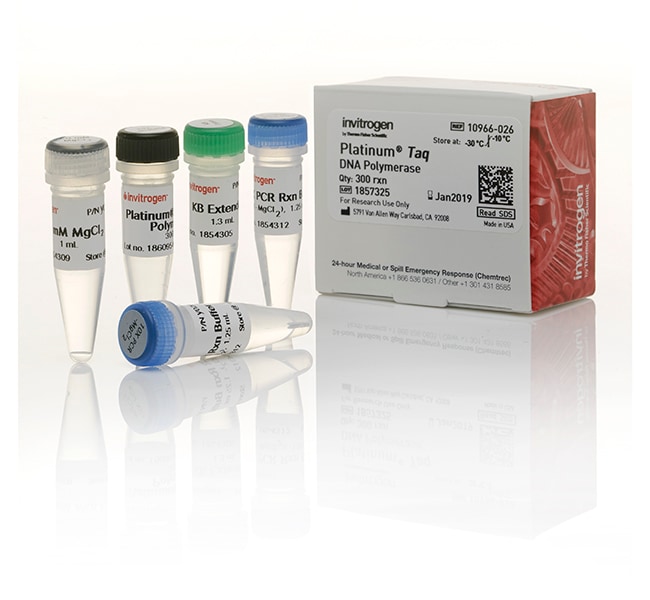
Cada caja contiene lo siguiente:
• 60 µl de ADN polimerasa Platinum™ Taq
• Dos tampones para PCR 10X de 1,25 ml (sin MgCl2)
• 1 ml de MgCl2 de 50 mm
• 1,25 ml de KB Extender
Almacenar a una temperatura de entre -30 °C y -10 °C en un congelador que no forme escarcha.
• 60 µl de ADN polimerasa Platinum™ Taq
• Dos tampones para PCR 10X de 1,25 ml (sin MgCl2)
• 1 ml de MgCl2 de 50 mm
• 1,25 ml de KB Extender
Almacenar a una temperatura de entre -30 °C y -10 °C en un congelador que no forme escarcha.
Preguntas frecuentes
Can I purchase just the 10X PCR buffer that comes with Platinum Taq?
My oligonucleotide does not appear to be the right length when I checked by gel electrophoresis. Why is this?
The primers I am using worked for PCR initially, but over time, have stopped working. What happened?
I don't see a pellet in my oligo tube order. Should I ask for a replacement?
There is a ball-shaped pellet at the bottom of my oligo tube. What is this and can I still use my oligo?
Citations & References (2)
Citations & References
Abstract
Dynamin 2 mutations associated with human diseases impair clathrin-mediated receptor endocytosis.
Journal:Hum Mutat
PubMed ID:19623537
Dynamin 2 (DNM2) is a large GTPase involved in the release of nascent vesicles during endocytosis and intracellular membrane trafficking. Distinct DNM2 mutations, affecting the middle domain (MD) and the Pleckstrin homology domain (PH), have been identified in autosomal dominant centronuclear myopathy (CNM) and in the intermediate and axonal forms
Utility and accuracy of template-directed dye-terminator incorporation with fluorescence-polarization detection for genotyping single nucleotide polymorphisms.
Journal:Biotechniques
PubMed ID:12019780
There are little independent data available about how well single nucleotide polymorphism (SNP) genotyping technologies perform in the typical molecular genetics laboratory. We evaluated the utility and accuracy of a widely used technology, template-directed dye-terminator incorporation with fluorescence-polarization detection (FP-TDI), in a sample of 177 SNPs selected solely on the