Search


Citas y referencias (2)
Invitrogen™
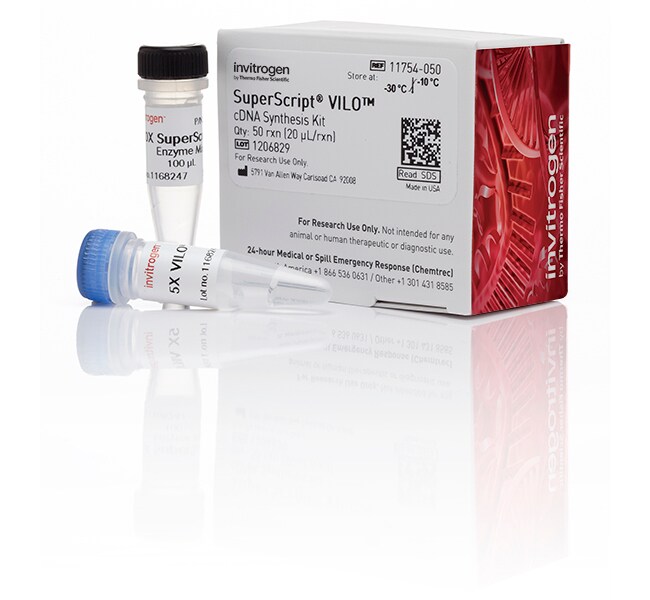
Kit de síntesis de ADNc SuperScript™ VILO™
El kit de síntesis de ADNc SuperScript VILO está diseñado para generar la primera cadena de ADNc para aplicaciones RT-qPCRMás información
Have Questions?
Cambiar vista

| Número de catálogo | N.º de reacciones |
|---|---|
| 11754250 | 250 reacciones |
| 11754050 | 50 reacciones |
Número de catálogo 11754250
Precio (USD)
5.143,50
Each
N.º de reacciones:
250 reacciones
Precio (USD)
5.143,50
Each
El kit de síntesis de ADNc SuperScript VILO está diseñado para generar la primera cadena de ADNc para aplicaciones RT-qPCR de dos pasos. El kit se suministra en un formato de 2 tubos con la mezcla de reacción VILO y una mezcla de enzimas en tubos separados. La mezcla enzimática contiene la transcriptasa inversa (RT) SuperScript III, una RT MMLV modificada genéticamente que ha reducido la actividad de la ARNasa H y ha mejorado la termoestabilidad para una síntesis de ADNc muy eficiente. El kit se puede utilizar para sintetizar ADNc desde un amplio intervalo de cantidades de ARN de entrada.
Nota: Para obtener un rendimiento superior de la síntesis de la primera cadena de ADNc en RT-qPCR de dos pasos, recomendamos la mezcla maestra SuperScript IV VILO o la mezcla maestra SuperScript IV VILO con enzima DNAasa ez. La mezcla maestra proporciona todos los componentes de reacción de síntesis de ADNc en un práctico formato de mezcla maestra de un tubo. Eleva la fiable tecnología VILO al siguiente nivel con la transcriptasa inversa altamente procesiva y termoestable SuperScript IV y un tampón aún más optimizado. La mezcla maestra permite una síntesis eficaz del ADNc a temperaturas más altas en menos tiempo y proporciona un rendimiento y sensibilidad superiores del ADNc incluso con una pureza subóptima o plantillas escasas.
Nota: Para obtener un rendimiento superior de la síntesis de la primera cadena de ADNc en RT-qPCR de dos pasos, recomendamos la mezcla maestra SuperScript IV VILO o la mezcla maestra SuperScript IV VILO con enzima DNAasa ez. La mezcla maestra proporciona todos los componentes de reacción de síntesis de ADNc en un práctico formato de mezcla maestra de un tubo. Eleva la fiable tecnología VILO al siguiente nivel con la transcriptasa inversa altamente procesiva y termoestable SuperScript IV y un tampón aún más optimizado. La mezcla maestra permite una síntesis eficaz del ADNc a temperaturas más altas en menos tiempo y proporciona un rendimiento y sensibilidad superiores del ADNc incluso con una pureza subóptima o plantillas escasas.
Para uso exclusivo en investigación. No apto para uso en procedimientos diagnósticos.
Especificaciones
Tipo de producto finalPrimera cadena de ADNc
FormatoKit
N.º de reacciones250 reacciones
Temperatura óptima de reacción42 °C
Cantidad250 reacciones
Formato de reacciónMezcla maestra o SuperMix
Tipo de reactivoTranscripción reversa
Transcriptasa inversaSuperScript III
Actividad de la ribonucleasa HReducido
Condiciones de envíoHielo seco
Tamaño (producto final)10 kb o menos
Material de partidaARN
TécnicaTranscripción reversa
Método de detecciónSonda de cebado
Para utilizar con (aplicación)Real Time PCR (qPCR)
GC-Rich PCR PerformanceAlto
Velocidad de reacción60 min
Unit SizeEach
Contenido y almacenamiento
• Mezcla de reacción VILO 5X que contiene cebadores aleatorios, dNTPs y MgCl2
• Mezcla de enzimas SuperScript III 10X que contiene Superscript III RT, inhibidor de ribonucleasa recombinante RNaseOUT y proteína auxiliar exclusiva
Almacenar en congelador (entre -5 a -30°C).
• Mezcla de enzimas SuperScript III 10X que contiene Superscript III RT, inhibidor de ribonucleasa recombinante RNaseOUT y proteína auxiliar exclusiva
Almacenar en congelador (entre -5 a -30°C).
Preguntas frecuentes
What is the difference between SuperScript III RT and the RT in the SuperScript VILO kit?
How much of the first-strand cDNA reaction should I load for PCR?
Citations & References (2)
Citations & References
Abstract
T cells modulate Epstein-Barr virus latency phenotypes during infection of humanized mice.
Journal:
PubMed ID:24390326
Human B cells, the main target of Epstein-Barr virus (EBV), can display several types of latent viral protein expression, denoted 0, I, IIa, IIb, or III. Of these, only type III expression induces proliferation of cells in vitro. These latency types are present at specific stages of infection and are
Decrease of miR-146b-5p in monocytes during obesity is associated with loss of the anti-inflammatory but not insulin signaling action of adiponectin.
Journal:PLoS One
PubMed ID:22393448
Low adiponectin, a well-recognized antidiabetic adipokine, has been associated with obesity-related inflammation, oxidative stress and insulin resistance. Globular adiponectin is an important regulator of the interleukin-1 receptor-associated kinase (IRAK)/NF?B pathway in monocytes of obese subjects. It protects against inflammation and oxidative stress by inducing IRAK3. microRNA (miR)-146b-5p inhibits NF?B-mediated inflammation