Search


Citas y referencias (14)
Invitrogen™
Mezcla maestra de PCR Platinum™ SuperFi II
La mezcla maestra para PCR Invitrogen Platinum SuperFi II Green (2X) contiene una mezcla de ADN lista para su usoMás información
Have Questions?
Cambiar vista

| Número de catálogo | Color | N.º de reacciones |
|---|---|---|
| 12369010 | Green | 100 reacciones |
| 12369050 | Green | 500 reacciones |
| 12369250 | Green | 5 x 500 reacciones |
| 12368010 | Colorless | 100 reacciones |
| 12368050 | Colorless | 500 reacciones |
| 12368250 | Colorless | 5 x 500 reacciones |
Número de catálogo 12369010
Precio (USD)
438,62
Each
Color:
Green
N.º de reacciones:
100 reacciones
Precio (USD)
438,62
Each
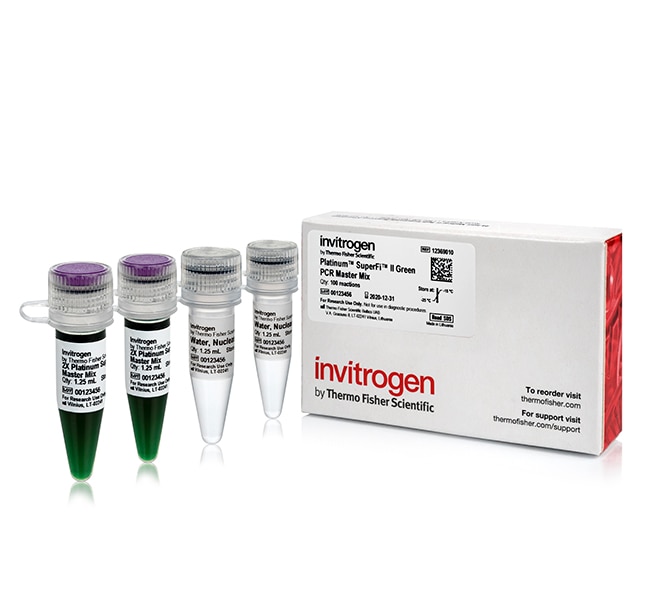
La mezcla maestra para PCR Invitrogen Platinum SuperFi II Green (2X) contiene una mezcla de ADN lista para su uso de ADN polimerasa Platinum SuperFi II, tampón Platinum SuperFi II y dNTP para una configuración de PCR cómoda, así como dos colorantes de seguimiento para la carga directa de productos de PCR en geles. La ADN polimerasa Platinum SuperFi II es una ADN polimerasa de corrección que combina una fidelidad superior con el innovador tampón SuperFi II, lo que permite el recocido de cebadores universal para obtener para obtener los mejores resultados con la PCR. Es ideal para clonación, mutagénesis y otras aplicaciones que se benefician de la precisión de secuencia suprema.
Las características de la mezcla maestra de PCR Platinum SuperFi II Green incluyen:
• Excepcional fidelidad > 300X Taq
• Hibridación del primer universal a 60 °C
• Especificidad, sensibilidad y rendimientos superiores
• Amplificación sólida de dianas difíciles de amplificar (por ejemplo, con pureza inferior a la óptima, contenido de GC ˃ 65 %, requisito de PCR grande)
Platinum SuperFi II DNA Polymerase es una enzima desarrollada con alta capacidad de procesos y mayor resistencia a los inhibidores de PCR. También permite protocolos de ciclo rápido y amplificación de dianas grandes (hasta 20 kb). La tecnología de inicio en caliente Platinum se basa en anticuerpos patentados que inhiben la actividad enzimática hasta el paso inicial de desnaturalización de PCR, evitando la amplificación no específica y la degradación de los cebadores. Esta tecnología también permite la configuración de la reacción a temperatura ambiente y proporciona una mayor sensibilidad y producción.
Debido a la composición única del tampón de PCR SuperFi II, la temperatura de recocido es de 60 °C para la mayoría de los pares de cebadores diseñados siguiendo las reglas generales de diseño. Las moléculas isoestabilizadoras del tampón aumentan la estabilidad dúplex del molde de cebadores durante el paso de recocido y contribuyen a mejorar la especificidad sin necesidad de optimizar la temperatura de recocido para cada par de cebadores. Con la ADN polimerasa Platinum SuperFi II, se pueden realizar ciclos de ensayos de PCR diferentes utilizando el mismo protocolo con una temperatura de recocido de cebadores universal y un paso de extensión seleccionado para el fragmento más largo que se va a amplificar.
Aplicaciones de la ADN polimerasa Platinum SuperFi II:
• PCR de alta fidelidad
• Clonación y subclonación
• Mutagénesis dirigida el sitio
• Amplificación de moldes con gran contenido en GC
• Generación de moldes para secuenciación
• PCR de alto rendimiento
• Amplificación de muestras con pureza subóptima
• PCR larga
• PCR rápida
La mezcla maestra para PCR Platinum SuperFi II también está disponible, que es la misma mezcla maestra sin los tintes de seguimiento.
Obtenga más información sobre los productos de ADN polimerasa Platinum SuperFi II ›
Las características de la mezcla maestra de PCR Platinum SuperFi II Green incluyen:
• Excepcional fidelidad > 300X Taq
• Hibridación del primer universal a 60 °C
• Especificidad, sensibilidad y rendimientos superiores
• Amplificación sólida de dianas difíciles de amplificar (por ejemplo, con pureza inferior a la óptima, contenido de GC ˃ 65 %, requisito de PCR grande)
Platinum SuperFi II DNA Polymerase es una enzima desarrollada con alta capacidad de procesos y mayor resistencia a los inhibidores de PCR. También permite protocolos de ciclo rápido y amplificación de dianas grandes (hasta 20 kb). La tecnología de inicio en caliente Platinum se basa en anticuerpos patentados que inhiben la actividad enzimática hasta el paso inicial de desnaturalización de PCR, evitando la amplificación no específica y la degradación de los cebadores. Esta tecnología también permite la configuración de la reacción a temperatura ambiente y proporciona una mayor sensibilidad y producción.
Debido a la composición única del tampón de PCR SuperFi II, la temperatura de recocido es de 60 °C para la mayoría de los pares de cebadores diseñados siguiendo las reglas generales de diseño. Las moléculas isoestabilizadoras del tampón aumentan la estabilidad dúplex del molde de cebadores durante el paso de recocido y contribuyen a mejorar la especificidad sin necesidad de optimizar la temperatura de recocido para cada par de cebadores. Con la ADN polimerasa Platinum SuperFi II, se pueden realizar ciclos de ensayos de PCR diferentes utilizando el mismo protocolo con una temperatura de recocido de cebadores universal y un paso de extensión seleccionado para el fragmento más largo que se va a amplificar.
Aplicaciones de la ADN polimerasa Platinum SuperFi II:
• PCR de alta fidelidad
• Clonación y subclonación
• Mutagénesis dirigida el sitio
• Amplificación de moldes con gran contenido en GC
• Generación de moldes para secuenciación
• PCR de alto rendimiento
• Amplificación de muestras con pureza subóptima
• PCR larga
• PCR rápida
La mezcla maestra para PCR Platinum SuperFi II también está disponible, que es la misma mezcla maestra sin los tintes de seguimiento.
Obtenga más información sobre los productos de ADN polimerasa Platinum SuperFi II ›
Especificaciones
ColorGreen
Fidelidad (frente a Taq)>300X
Inicio en calienteInicio en caliente integrado
N.º de reacciones100 reacciones
SobranteRomo
PolimerasaADN polimerasa Platinum SuperFi II
Tipo de productoMezcla maestra de PCR
Cantidad100 reactions
Formato de reacciónMezcla maestra o SuperMix
Condiciones de envíoHielo seco
Tamaño (producto final)20 kb o menos
Concentración2X
Para utilizar con (aplicación)Hot-start PCR, High-fidelity PCR
GC-Rich PCR PerformanceAlto
Velocidad de reacciónFast
Unit SizeEach
Contenido y almacenamiento
• 2 x 1,25 ml de mezcla máster de PCR Platinum SuperFi II Green
• 2 x 1,25 ml de agua, sin nucleasas
Suficiente para 100 reacciones de 50 µl
• 2 x 1,25 ml de agua, sin nucleasas
Suficiente para 100 reacciones de 50 µl
Preguntas frecuentes
How much volume of the Platinum SuperFi II PCR Master Mix (2X) or Platinum SuperFi II PCR Green Master Mix (2X) should I use per reaction?
What is the best way to quantify your PCR samples using the Platinum SuperFi II PCR Master Mix, Green (Cat, No. 12369250, 12369010, 12369050)? Is it possible to quantify using Tapestation or a Qubit fluorometer?
What are your recommendations when working with long amplicons using Platinum SuperFi II DNA Polymerase?
Can I use Platinum SuperFi DNA Polymerase cycling protocol and primer annealing temperature with Platinum SuperFi II DNA Polymerase?
Can I perform TA cloning with Platinum SuperFi II DNA Polymerase?
Citations & References (14)
Citations & References
Abstract
A PCR amplicon-based SARS-CoV-2 replicon for antiviral evaluation.
Journal:Sci Rep
PubMed ID:33500537
'The development of specific antiviral compounds to SARS-CoV-2 is an urgent task. One of the obstacles for the antiviral development is the requirement of biocontainment because infectious SARS-CoV-2 must be handled in a biosafety level-3 laboratory. Replicon, a non-infectious self-replicative viral RNA, could be a safe and effective tool for
Engineering SARS-CoV-2 using a reverse genetic system.
Journal:Nat Protoc
PubMed ID:33514944
'Reverse genetic systems are a critical tool for studying viruses and identifying countermeasures. In response to the ongoing COVID-19 pandemic, we recently developed an infectious complementary DNA (cDNA) clone for severe acute respiratory syndrome coronavirus 2 (SARS-CoV-2). The reverse genetic system can be used to rapidly engineer viruses with desired
The analysis of GSTA1 promoter genetic and functional diversity of human populations.
Journal:Sci Rep
PubMed ID:33658540
'GSTA1 encodes a member of a family of enzymes that function to add glutathione to target electrophilic compounds, including carcinogens, therapeutic drugs, environmental toxins, and products of oxidative stress. GSTA1 has several functional SNPs within its promoter region that are responsible for a change in its expression by altering promoter
Epigallocatechin-3-gallate Alleviates Vanadium-Induced Reduction of Antioxidant Capacity via Keap1-Nrf2-sMaf Pathway in the Liver, Kidney, and Ovary of Laying Hens.
Journal:Biol Trace Elem Res
PubMed ID:33405082
'This study evaluated the effect of epigallocatechin-3-gallate (EGCG) alleviating the reduction of antioxidant capacity induced by dietary vanadium (V) in the liver, kidney, and ovary of laying hens. Furthermore, Kelch-like ECH-associated protein 1(Keap1)-nuclear factor erythroid 2-related factor 2 (Nrf2)-small Maf proteins (sMaf) pathway was explored to reveal the molecular mechanism.
Human Ubiquitin-Specific Peptidase 18 Is Regulated by microRNAs
Journal:Front Genet
PubMed ID:33633774
'Ubiquitin-specific peptidase 18 (USP18) acts as gatekeeper of type I interferon (IFN) responses by binding to the IFN receptor subunit IFNAR2 and preventing activation of the downstream JAK/STAT pathway. In any given cell type, the level of USP18 is a key determinant of the output of IFN-stimulated transcripts. How the