Search


Citas y referencias (33)
Gibco™
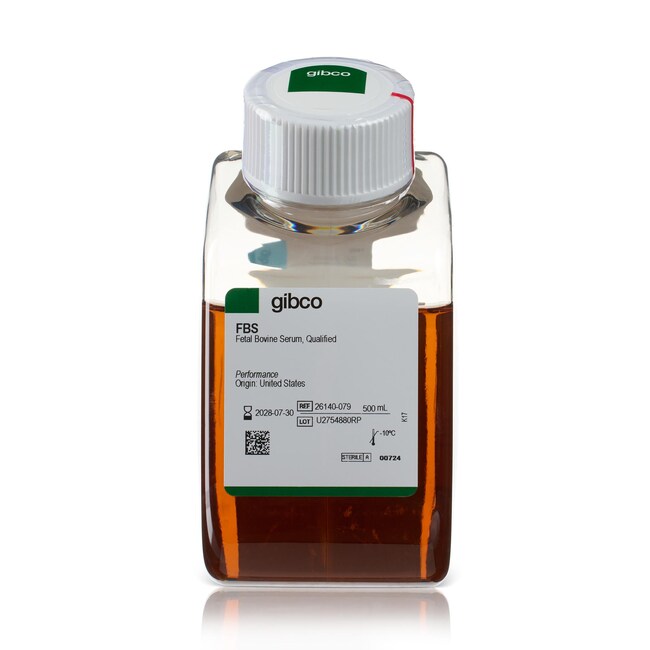
Suero fetal bovino, cualificado, Estados Unidos
Los sueros bovinos fetales Gibco ofrecen un excelente valor para el cultivo celular básico, la investigación especializada y los ensayosMás información
Have Questions?
Cambiar vista

| Número de catálogo | Cantidad | Formato |
|---|---|---|
| 26140079 | 500 mL | Frasco |
| A3160501 | 50 mL | One Shot |
| A3160502 | 10 x 50 mL | One Shot |
Our improved Premium Fetal Bovine Serum (FBS) features enhanced specifications with unchanged stability, manufacturing, storage, and transport processes.
Número de catálogo 26140079
Los sueros bovinos fetales Gibco ofrecen un excelente valor para el cultivo celular básico, la investigación especializada y los ensayos específicos, ganando la confianza de los investigadores con una calidad uniforme y un soporte galardonado que ayuda a satisfacer sus necesidades de investigación y presupuesto
Sueros Gibco: Calidad fiable para un rendimiento uniforme
Categoría de los sueros Gibco: Valor plus (rendimiento)
• Uso para cultivo celular general con líneas de células comunes
• Bajos niveles de endotoxina y hemoglobina
• Nivel de endotoxinas: <10 EU/ml
• Nivel de hemoglobina: <25 mg/dl
• Origen: Estados Unidos
El suero Gibco ofrece
• Certificación ISO 13485, procesado en instalaciones registradas de la FDA
• Etiquetado para uso diagnóstico in vitro (conforme con las pruebas de mayor nivel de esterilidad de la Farmacopea Estadounidense [USP])
• Triple filtrado a 0,1 µm
• El frasco Gibco es más fácil de usar en la campana, reduce el riesgo de contaminación y le ayuda a realizar más coherentemente el cultivo celular.
• El adhesivo extraíble de la etiqueta proporciona una referencia práctica del número de lote y la fecha de caducidad en el cuaderno electrónico de laboratorio
Sueros Gibco: Calidad fiable para un rendimiento uniforme
Categoría de los sueros Gibco: Valor plus (rendimiento)
• Uso para cultivo celular general con líneas de células comunes
• Bajos niveles de endotoxina y hemoglobina
• Nivel de endotoxinas: <10 EU/ml
• Nivel de hemoglobina: <25 mg/dl
• Origen: Estados Unidos
El suero Gibco ofrece
• Certificación ISO 13485, procesado en instalaciones registradas de la FDA
• Etiquetado para uso diagnóstico in vitro (conforme con las pruebas de mayor nivel de esterilidad de la Farmacopea Estadounidense [USP])
• Triple filtrado a 0,1 µm
• El frasco Gibco es más fácil de usar en la campana, reduce el riesgo de contaminación y le ayuda a realizar más coherentemente el cultivo celular.
• El adhesivo extraíble de la etiqueta proporciona una referencia práctica del número de lote y la fecha de caducidad en el cuaderno electrónico de laboratorio
For research use or further manufacturing use only. Serum and blood proteins are not for direct administration into humans or animals.
Especificaciones
Concentración de endotoxinas≤ 10 EU/mL
Concentración de hemoglobina≤25 mg/dL
Grado de pureza o calidadCualificado
Condiciones de envíoCongelado
EspecieGanado/bovino
AgeFetal
País de origenEstados Unidos
FormularioLíquido
FormatoFrasco
Tipo de productoSuero fetal bovino
Cantidad500 mL
Serum TreatmentEstándar (esterilizado mediante filtro)
EsterilidadEstéril
Sterilization MethodTriple filtrado, 0,1 μm
Unit SizeEach
Contenido y almacenamiento
Condiciones de almacenamiento: ≤10 °C
Condiciones de envío: Congelado
Condiciones de envío: Congelado
Preguntas frecuentes
What are the benefits and disadvantages of using heat-inactivated FBS in cell culture?
How long can I store Gibco Fetal Bovine Serum at 4 degrees C?
How should I thaw Gibco Fetal Bovine Serum?
How can I minimize lot-to-lot variability in serum?
Can I aliquot and refreeze serum?
Citations & References (33)
Citations & References
Abstract
A functional role for the B56 alpha-subunit of protein phosphatase 2A in ceramide-mediated regulation of Bcl2 phosphorylation status and function.
Journal:J Biol Chem
PubMed ID:11929874
'Recently it has been shown that the potent apoptotic agent ceramide activates a mitochondrial protein phosphatase 2A (PP2A) and promotes dephosphorylation of the anti-apoptotic molecule Bcl2 (Ruvolo, P. P., Deng, X., Ito, T., Carr, B. K., and May, W. S. (1999) J. Biol. Chem. 274, 20296-20300). In cells expressing Bcl2,
Metabolism of 4 beta -hydroxycholesterol in humans.
Journal:J Biol Chem
PubMed ID:12077124
'One of the major oxysterols in the human circulation is 4 beta-hydroxycholesterol formed from cholesterol by the drug-metabolizing enzyme cytochrome P450 3A4. Deuterium-labeled 4 beta-hydroxycholesterol was injected into two healthy volunteers, and the apparent half-life was found to be 64 and 60 h, respectively. We have determined earlier the half-lives
Activation of retinoic acid receptor-dependent transcription by all-trans-retinoic acid metabolites and isomers.
Journal:J Biol Chem
PubMed ID:12070176
'We have shown that four metabolites of all-trans-retinoic acid (ATRA) (4-oxo-, 4-OH-, 18-OH-, and 5,6-epoxy-RA) can induce maturation of NB4 promyelocytic leukemia cells (Idres, N., Benoit, G., Flexor, M. A., Lanotte, M., and Chabot, G. G. (2001) Cancer Res. 61, 700-705). To better understand the mechanism of action of ATRA
Interaction of human breast fibroblasts with collagen I increases secretion of procathepsin B.
Journal:J Biol Chem
PubMed ID:12072442
'Interactions of stromal and tumor cells with the extracellular matrix may regulate expression of proteases including the lysosomal proteases cathepsins B and D. In the present study, we determined whether the expression of these two proteases in human breast fibroblasts was modulated by interactions with the extracellular matrix component, collagen
A ligand-inducible epidermal growth factor receptor/anaplastic lymphoma kinase chimera promotes mitogenesis and transforming properties in 3T3 cells.
Journal:J Biol Chem
PubMed ID:11919185
'Oncogenic rearrangements of the anaplastic lymphoma kinase (ALK) gene, encoding a receptor type tyrosine kinase, are frequently associated with anaplastic large cell lymphomas. Such rearrangements juxtapose the intracellular domain of ALK to 5''-end sequences belonging to different genes and create transforming fusion proteins. To understand how the oncogenic versions of