Search
 Búsqueda por elementos
 Búsqueda por estructura
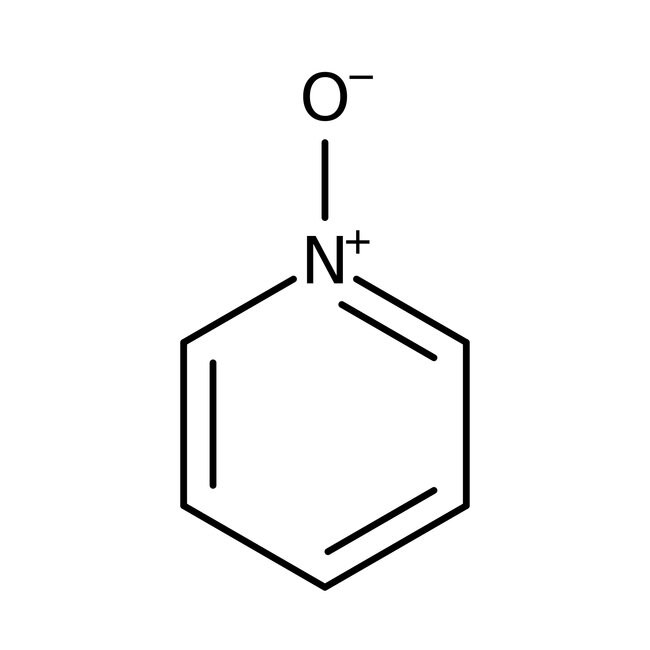

Thermo Scientific Chemicals
Óxido de N piridina, 95 %, Thermo Scientific Chemicals
CAS: 694-59-7 | C5H5NO | 95.101 g/mol
| Número de catálogo | Cantidad |
|---|---|
| A10419.22 también denominado A10419-22 | 100 g |
Número de catálogo A10419.22
también denominado A10419-22
Precio (USD)
-
Cantidad:
100 g
Identificadores químicos
CAS694-59-7
IUPAC Namepyridin-1-ium-1-olate
Molecular FormulaC5H5NO
InChI KeyILVXOBCQQYKLDS-UHFFFAOYSA-N
SMILES[O-][N+]1=CC=CC=C1
Ver más
Especificaciones Hoja de especificaciones
Hoja de especificacionesFormCrystals or powder or crystalline powder or lumps or chunks or fused solid
Melting Point (clear melt)57.0-69.0?C
Assay (GC)≥94.0%
Water Content (Karl Fischer Titration)≤2.5%
Appearance (Color)White to cream to yellow to pale brown
Ver más
Pyridine N-oxide is used in the treatment of Kayser's disease. It is widely used in chemical industry. It can act as catalytic agent.
This Thermo Scientific Chemicals brand product was originally part of the Alfa Aesar product portfolio. Some documentation and label information may refer to the legacy brand. The original Alfa Aesar product / item code or SKU reference has not changed as a part of the brand transition to Thermo Scientific Chemicals.
Solubilidad
Soluble en agua.
Notas
Higroscópico. Se ha recomendado el almacenamiento bajo una manta de nitrógeno. Almacenar por debajo de 2-8 °C.
Soluble en agua.
Notas
Higroscópico. Se ha recomendado el almacenamiento bajo una manta de nitrógeno. Almacenar por debajo de 2-8 °C.
RUO – Research Use Only
General References:
- J. V. Quagliano; J. Fujita; G. Franz; D. J. Phillips; J. A. Walmsley; S. Y. Tyree. The Donor Properties of Pyridine N-Oxide. J. Am. Chem. Soc.1961, 83, (18), 3770-3773.
- Mild oxidant for conversion of unactivated alkyl halides to aldehydes or ketones: J. Org. Chem., 22, 1135 (1957); 35, 244 (1970); Tetrahedron, 33, 1845 (1977). Substituted acetic acids and their anhydrides: J. Org. Chem., 38, 3737 (1973), as well as ɑ-bromo and ɑ-chloro acids: J. Org. Chem., 31, 3058 (1966); J. Am. Chem. Soc., 89, 4968 (1967), can undergo oxidative decarboxylation to aldehydes and ketones.