Search
 Búsqueda por elementos
 Búsqueda por estructura


Thermo Scientific Chemicals
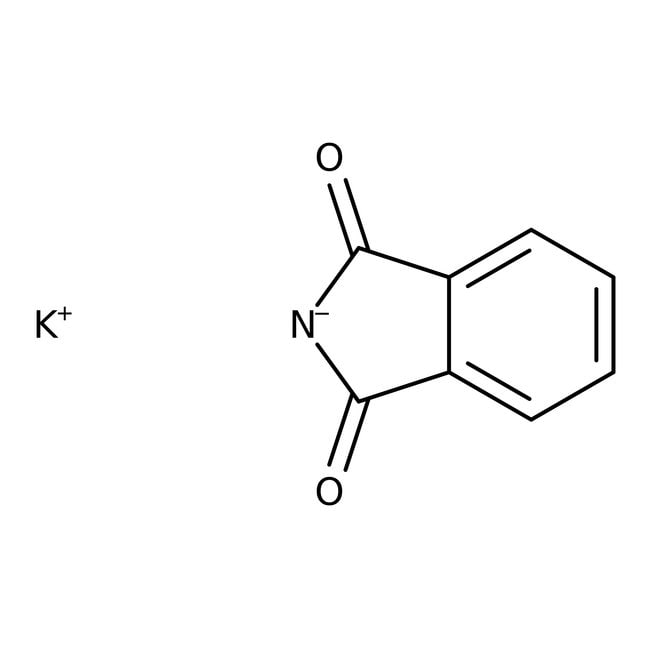
Ftalimida de potasio, + 98 %, Thermo Scientific Chemicals
CAS: 1074-82-4 | C8H4KNO2 | 185.22 g/mol
| Número de catálogo | Cantidad |
|---|---|
| A11134.36 también denominado A11134-36 | 500 g |
Número de catálogo A11134.36
también denominado A11134-36
Precio (USD)
-
Cantidad:
500 g
Identificadores químicos
CAS1074-82-4
IUPAC Namepotassium 1,3-dioxo-2,3-dihydro-1H-isoindol-2-ide
Molecular FormulaC8H4KNO2
InChI KeyFYRHIOVKTDQVFC-UHFFFAOYSA-M
SMILES[K+].O=C1[N-]C(=O)C2=CC=CC=C12
Ver más
Especificaciones Hoja de especificaciones
Hoja de especificacionesAppearance (Color)White to cream to yellow to green
FormCrystalline powder or powder
Assay (Non-aqueous acid-base Titration)≥98.0 to ≤102.0%
Identification (FTIR)Conforms
Water Content (Karl Fischer Titration)≤1%
Potassium phthalimide is used as an intermediate in the synthesis of N-alkylated phthalimides, which is involved in the preparation of primary amines (Gabriel synthesis) by the hydrolysis reaction. It is also used as an intermediate for synthetic indigo, pigments, dyes and pharmaceuticals. Further, it is employed as an organocatalyst for the cyanosilylation of various carbonyl compounds under extremely mild conditions. In addition to this, it serves as a reagent for the transformation of allyl- and alkyl halides into protected primary amines.
This Thermo Scientific Chemicals brand product was originally part of the Alfa Aesar product portfolio. Some documentation and label information may refer to the legacy brand. The original Alfa Aesar product / item code or SKU reference has not changed as a part of the brand transition to Thermo Scientific Chemicals.
Aplicaciones
La ftalimida potásica se utiliza como intermediario en la síntesis de ftalimidas N-alquiladas, que está implicada en la preparación de aminas primarias (síntesis Gabriel) por la reacción de hidrólisis. También se utiliza como intermediario para el índigo sintético, pigmentos, tintes y productos farmacéuticos. Además, se emplea como organocatalizador para la cianosilación de varios compuestos carbonilo en condiciones extremadamente suaves. Además de esto, sirve como un reactivo para la transformación de haluros de alilo y alquilo en aminas primarias protegidas.
Solubilidad
Soluble en agua.
Nota
Sensible a la humedad. Incompatible con agentes oxidantes fuertes y ácidos fuertes.
La ftalimida potásica se utiliza como intermediario en la síntesis de ftalimidas N-alquiladas, que está implicada en la preparación de aminas primarias (síntesis Gabriel) por la reacción de hidrólisis. También se utiliza como intermediario para el índigo sintético, pigmentos, tintes y productos farmacéuticos. Además, se emplea como organocatalizador para la cianosilación de varios compuestos carbonilo en condiciones extremadamente suaves. Además de esto, sirve como un reactivo para la transformación de haluros de alilo y alquilo en aminas primarias protegidas.
Solubilidad
Soluble en agua.
Nota
Sensible a la humedad. Incompatible con agentes oxidantes fuertes y ácidos fuertes.
RUO – Research Use Only
General References:
- For an example of the classical Gabriel synthesis of primary amines from an alkyl halide by alkylation of potassium phthalimide followed by hydrolysis, see: Org. Synth. Coll., 2, 25 (1943). For use of the Gabriel reaction on Merrifield resin as the first step of a synthesis of a polymer-supported carbodiimide, see: Org. Synth. Coll., 6, 951 (1988). The phthalimide alkylation is often carried out in DMF. A liquid-liquid phase-transfer method using (n-Hexadecyl) tri-n-butyl phosphonium bromide, L01335, as catalyst also gives excellent results: Synthesis, 389 (1976).
- The standard method for cleavage of the N-substituted phthalimide is with hydrazine hydrate, effective under milder conditions than acid or base hydrolysis. Other hydrazines and primary amines have also been successful, e.g. methylhydrazine or N,N-dimethylpropanediamine: Org. Synth. Coll., 9, 13, 16 (1998). Another technique involves borohydride reduction to the hydroxy amide, and liberation of the amine with acetic acid, with cyclization to phthalide: Tetrahedron Lett., 25, 2093 (1984). For suggested improvements to the cleavage conditions in the Gabriel synthesis, see: J. Org. Chem., 61, 8063 (1996). Review of the Gabriel reaction: Angew. Chem. Int. Ed., 7, 919 (1968).
- For an alternative approach to the formation of primary amines, see Dibenzyl amine, A11554.
- Kiyokawa, K.; Kosaka, T.; Kojima, T.; Minakata, S. Synthesis and Structure of Hypervalent Iodine(III) Reagents Containing Phthalimidate and Application to Oxidative Amination Reactions. Angew. Chem. Int. Ed. 2015, 127 (46), 13923-13927.
- Fesenko, A. A.; Trafimova, L. A.; Albov, D. V.; Shutalev, A. D. Nucleophile-dependent diastereoselectivity in the ring expansion of pyrimidines to give 1,3-diazepines. Tetrahedron Lett. 2015, 56 (11), 1317-1321.