Search
 Búsqueda por elementos
 Búsqueda por estructura


Thermo Scientific Chemicals
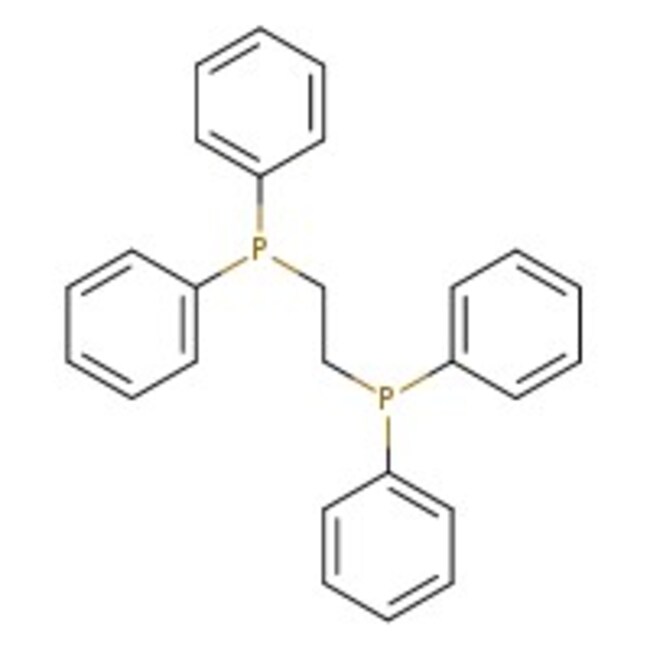
1,2-Bis(difenilfosfino)etano, + 97 %, Thermo Scientific Chemicals
CAS: 1663-45-2 | C26H24P2 | 398.43 g/mol
| Número de catálogo | Cantidad |
|---|---|
| A11419.14 también denominado A11419-14 | 25 g |
Número de catálogo A11419.14
también denominado A11419-14
Precio (USD)
-
Cantidad:
25 g
Identificadores químicos
CAS1663-45-2
IUPAC Name[2-(diphenylphosphanyl)ethyl]diphenylphosphane
Molecular FormulaC26H24P2
InChI KeyQFMZQPDHXULLKC-UHFFFAOYSA-N
SMILESC(CP(C1=CC=CC=C1)C1=CC=CC=C1)P(C1=CC=CC=C1)C1=CC=CC=C1
Ver más
Especificaciones Hoja de especificaciones
Hoja de especificacionesAppearance (Color)White to cream
FormCrystals or powder or crystalline powder
Assay (GC)≥97.0%
Melting Point137.5-146.5?C
Identification (FTIR)Conforms
1,2-Bis(diphenylphosphino)ethane is a bidendate ligand used in coordination chemistry to prepare metal complexes. It is involved in the metal-catalyzed allylic alkylation and decarboxylation of allylic esters. It is also used in 1,3-diene synthesis. Further, it is used in cycloaddition reactions and carbonylation reactions. In addition to this, it is used to prepare bis(dicyclohexylphosphino)ethane by hydrogenation.
This Thermo Scientific Chemicals brand product was originally part of the Alfa Aesar product portfolio. Some documentation and label information may refer to the legacy brand. The original Alfa Aesar product / item code or SKU reference has not changed as a part of the brand transition to Thermo Scientific Chemicals.
Aplicaciones
El 1,2-bis(difenilfosfino)etano es un ligando bidentado utilizado en la química de coordinación para preparar complejos metálicos. Está involucrado en la alquilación alílica catalizada por metal y la decarboxilación de los ésteres alílicos. También se utiliza en la síntesis del 1,3-dieno. Asimismo, se utiliza en las reacciones de cicloadición y las reacciones de carbonilación. Además de esto, se utiliza para preparar bis(diciclohexilfosfino)etano por hidrogenación.
Solubilidad
Soluble en acetona, metanol y ácido clorhídrico alcohólico.
Notas
Sensible al aire. Incompatible con agentes oxidantes fuertes.
El 1,2-bis(difenilfosfino)etano es un ligando bidentado utilizado en la química de coordinación para preparar complejos metálicos. Está involucrado en la alquilación alílica catalizada por metal y la decarboxilación de los ésteres alílicos. También se utiliza en la síntesis del 1,3-dieno. Asimismo, se utiliza en las reacciones de cicloadición y las reacciones de carbonilación. Además de esto, se utiliza para preparar bis(diciclohexilfosfino)etano por hidrogenación.
Solubilidad
Soluble en acetona, metanol y ácido clorhídrico alcohólico.
Notas
Sensible al aire. Incompatible con agentes oxidantes fuertes.
RUO – Research Use Only
General References:
- Chelating phosphorus ligand.
- The complex with NiCl2 catalyzes the coupling of haloaromatic compounds with Grignard reagents: J. Org. Chem., 49, 478 (1984).
- The catalyst prepared in situ with Sodium tetrachloropalladate(II) hydrate, 11886, catalyzes the carbonylation of allylic halides at atmospheric pressure: Chem. Lett., 1873 (1989):
- Useful replacement for Triphenyl phosphine, L02502, in the Staudinger and Mitsunobu reactions, with the advantage of easier separation of the by-product bis(phosphine oxide) due to its higher polarity compared with triphenylphosphine oxide: Tetrahedron Lett., 39, 7787 (1998). Has also been used as an alternative to PPh3 for the halodehydroxylation of alcohols, e.g. in combination with Hexachloroethane, L14297, alkyl chlorides are formed; the phosphine oxide by-product can readily be separated by filtration: Tetrahedron Lett., 42, 2459 (2001).
- Afonin, M. Y.; Smolentsev, A. I.; Konchenko, S. N.; Petrov, P. A. Cyanato- and thiocyanato-substituted triangular clusters of molybdenum, [Mo3S4(dppe)3X3]+ (X = NCO-, NCS-; dppe = 1,2-bis(diphenylphosphino)ethane). J. Coord. Chem. 2015, 68 (3), 422-431.
- Bloomfield, A. J.; Sheehan, S. W.; Collom, S. L.; Crabtree, R. H.; Anastas, P. T. A heterogeneous water oxidation catalyst from dicobalt octacarbonyl and 1,2-bis(diphenylphosphino)ethane. New J. Chem. 2014, 38 (4), 1540-1545.