Search
 Búsqueda por elementos
 Búsqueda por estructura


Thermo Scientific Chemicals
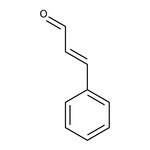
trans-Cinamaldehído, 98+ %, Thermo Scientific Chemicals
CAS: 14371-10-9 | C9H8O | 132.16 g/mol
Have Questions?
Cambiar vista

Número de catálogo A14689.22
también denominado A14689-22
Precio (USD)
-
Cantidad:
100 g
Identificadores químicos
CAS14371-10-9
Especificaciones Hoja de especificaciones
Hoja de especificacionesAppearance (Color)Clear colorless to yellow
FormLiquid
Assay (GC)≥98.0%
Identification (FTIR)Conforms
Refractive Index1.6200-1.6240 @ 20°C
trans-Cinnamaldehyde is used in the flavor and perfume industry. It is also used in medicine. It reacts with glutathione to get an adduct 1'-(glutathion-S-yl)-dihydrocinnamaldehyde. It is used to prepare cinnamylidene-bisacetamide by reacting with acetamide. Further, it inhibits xanthine oxidase.
This Thermo Scientific Chemicals brand product was originally part of the Alfa Aesar product portfolio. Some documentation and label information may refer to the legacy brand. The original Alfa Aesar product / item code or SKU reference has not changed as a part of the brand transition to Thermo Scientific Chemicals.
Aplicaciones
El trans-cinamaldehído se utiliza en la industria del sabor y el perfume. También se utiliza en medicina. Reacciona con glutatión para obtener un aducto 1′-(glutatión-S-il)-dihidrocinamaldehído. Se utiliza para preparar cinamilideno-bisacetamida reaccionando con acetamida. Además, inhibe la xantina oxidasa.
Solubilidad
Miscible con agua.
Notas
Almacenar en un lugar fresco. Incompatible con agentes oxidantes fuertes y bases fuertes. Sensible al aire.
El trans-cinamaldehído se utiliza en la industria del sabor y el perfume. También se utiliza en medicina. Reacciona con glutatión para obtener un aducto 1′-(glutatión-S-il)-dihidrocinamaldehído. Se utiliza para preparar cinamilideno-bisacetamida reaccionando con acetamida. Además, inhibe la xantina oxidasa.
Solubilidad
Miscible con agua.
Notas
Almacenar en un lugar fresco. Incompatible con agentes oxidantes fuertes y bases fuertes. Sensible al aire.
RUO – Research Use Only
General References:
- For details of the 1,2-addition of a functionalized Zn-Cu organometallic RCu(CN)ZnI to give an allylic alcohol, see; Org. Synth. Coll., 9, 502 (1998).
- For reaction with 1,2-Ethanedithiol, L12865 to give the dithiolane, followed by coupling with trimethylsilylmethyl magnesium chloride, catalyzed by Dichlorobis(triphenyl phosphine) nickel(II) , 13930, as an example of Ni catalyzed coupling of dithioacetals with Grignards, see: J. Org. Chem., 53, 5582 (1988); Org. Synth. Coll., 9, 727 (1998):
- Zinn, S.; Betz, T.; Medcraft, C.; Schnell, M. Structure determination of trans-cinnamaldehyde by broadband microwave spectroscopy. Phys. Chem. Chem. Phys. 2015, 17, 16080-16085.
- Loquercio, A.; Castell-Perez, E.; Gomes, C.; Moreira, R. G. Preparation of Chitosan-Alginate Nanoparticles for Trans-cinnamaldehyde Entrapment. J. Food Sci. 2015, 80 (10), N2305-N2315.