Search
 Búsqueda por elementos
 Búsqueda por estructura


Thermo Scientific Chemicals
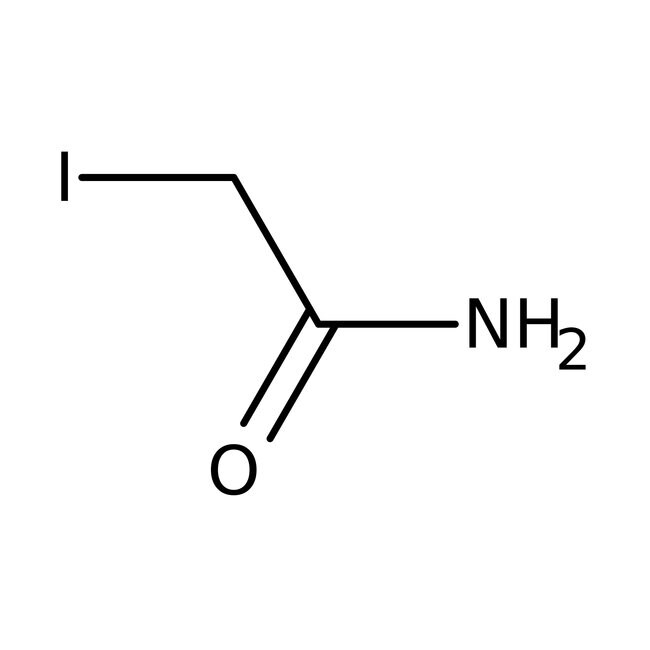
Iodoacetamida, 98 %, estabilizada con aprox. 5 % de agua, Thermo Scientific Chemicals
CAS: 144-48-9 | C2H4INO | 184.964 g/mol
Have Questions?
Cambiar vista

Número de catálogo A14715.22
también denominado A14715-22
Precio (USD)
-
Cantidad:
100 g
Identificadores químicos
CAS144-48-9
IUPAC Name2-iodoacetamide
Molecular FormulaC2H4INO
InChI KeyPGLTVOMIXTUURA-UHFFFAOYSA-N
SMILESNC(=O)CI
Ver más
Especificaciones Hoja de especificaciones
Hoja de especificacionesAppearance (Color)White to cream to yellow to pale brown
FormCrystals or powder or crystalline powder
Assay (Titration ex Iodide)≥97.5 to ≤102.5% (Dry wt. basis)
Assay (HPLC)≥97.5%
Identification (FTIR)Conforms
Ver más
Alkylating agent used in peptide mapping because it covalently binds with the thiols in cysteine to prevent disulfide bond formation2-Iodoacetamide is used as an electrophile for covalent modification of nucleophilic residues on proteins such as cysteine, methionine and histidine. It is used to bind with thiol group of cysteine, thereby it protects the formation disulfide bonds. It is involved as an inhibitor of deubiquitinase enzymes (DUBs). Further, it acts as an alkylating sulfhydryl reagent.
This Thermo Scientific Chemicals brand product was originally part of the Alfa Aesar product portfolio. Some documentation and label information may refer to the legacy brand. The original Alfa Aesar product / item code or SKU reference has not changed as a part of the brand transition to Thermo Scientific Chemicals.
Aplicaciones
Agente alquilante utilizado en el mapeo de péptidos porque se une covalentemente con los tioles de la cisteína para prevenir la formación de enlaces de disulfuro. La 2-iodoacetamida se utiliza como un electrófilo para la modificación covalente de los residuos nucleofílicos en proteínas como cisteína, metionina e histidina. Se utiliza para unirse con el grupo tiol de la cisteína, por lo tanto protege la formación de enlaces de disulfuro. Participa como inhibidor de las enzimas de deubiquitinasa (DUB). Además, actúa como reactivo de sulfhidrilo alquilante.
Solubilidad
Soluble en agua, dimetilformamida y etanol. Ligeramente soluble en metanol.
Notas
Almacenar en un lugar fresco. Sensible a la luz y la humedad. Mantenga el recipiente bien cerrado en un lugar seco y bien ventilado. Incompatible con ácidos fuertes, bases fuertes, agentes oxidantes fuertes y agentes reductores fuertes.
Agente alquilante utilizado en el mapeo de péptidos porque se une covalentemente con los tioles de la cisteína para prevenir la formación de enlaces de disulfuro. La 2-iodoacetamida se utiliza como un electrófilo para la modificación covalente de los residuos nucleofílicos en proteínas como cisteína, metionina e histidina. Se utiliza para unirse con el grupo tiol de la cisteína, por lo tanto protege la formación de enlaces de disulfuro. Participa como inhibidor de las enzimas de deubiquitinasa (DUB). Además, actúa como reactivo de sulfhidrilo alquilante.
Solubilidad
Soluble en agua, dimetilformamida y etanol. Ligeramente soluble en metanol.
Notas
Almacenar en un lugar fresco. Sensible a la luz y la humedad. Mantenga el recipiente bien cerrado en un lugar seco y bien ventilado. Incompatible con ácidos fuertes, bases fuertes, agentes oxidantes fuertes y agentes reductores fuertes.
RUO – Research Use Only
General References:
- Zbancioc, G.; Mangalagiu, I. I.; Moldoveanu, C. Ultrasound assisted synthesis of imidazolium salts: An efficient way to ionic liquids. Ultrason. Sonochem. 2015, 23, 376-384.
- Moriyama, M.; Metzger, S.; van der Vlies, A. J.; Uyama, H.; Ehrbar, M.; Hasegawa, U. Inhibition of Angiogenesis by Antioxidant Micelles. Adv. Healthcare Mater. 2013, 4 (4), 569-575.