Search

Invitrogen™
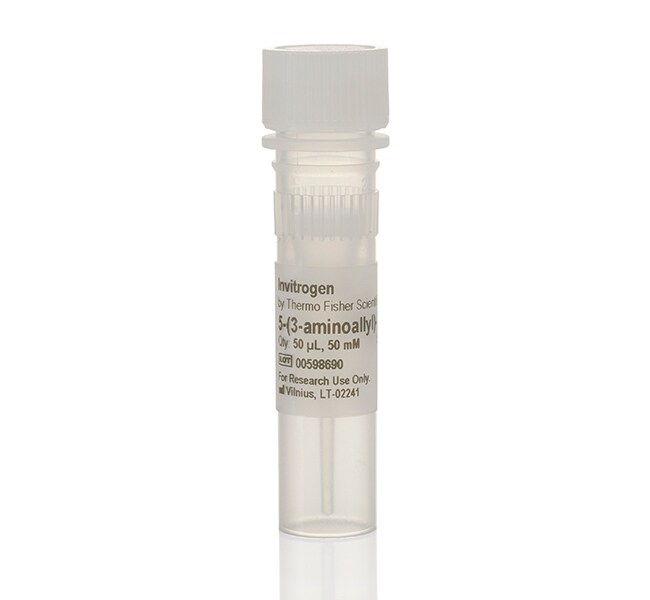
5-(3-Aminoallyl)-dUTP (50 mM)
Cuando se incorpora al ADN, el 5-(3-aminoalilo)-dUTP proporciona un grupo reactivo para la adición de otros grupos químicos
| Número de catálogo | Cantidad |
|---|---|
| AM8439 | 50 μL |
Número de catálogo AM8439
Precio (USD)
-
Cantidad:
50 μL
Cuando se incorpora al ADN, el 5-(3-aminoalilo)-dUTP proporciona un grupo reactivo para la adición de otros grupos químicos El dUTP modificado es incorporado fácilmente por la transcriptasa inversa. La modificación del aminoalilo permite la reacción posterior con compuestos amino-reactivos, como los ésteres de N-hidroxisuccinimida (NHS); por lo tanto, el ADNc modificado con aminoalilo puede etiquetarse con cualquier moiedad de grupoamino-reactivo.
Uso de este nucleótido modificado:
Utilice el 5-(3-aminoalilo)-dUTP como se recomienda en su protocolo de transcripción inversa. La sustitución del 30–80 % del dTTP por 5-(3-aminoalilo)-dUTP puede ser útil, pero la proporción exacta dependerá de los objetivos del experimento
Uso de este nucleótido modificado:
Utilice el 5-(3-aminoalilo)-dUTP como se recomienda en su protocolo de transcripción inversa. La sustitución del 30–80 % del dTTP por 5-(3-aminoalilo)-dUTP puede ser útil, pero la proporción exacta dependerá de los objetivos del experimento
Para uso exclusivo en investigación. No apto para uso en procedimientos diagnósticos.
Especificaciones
Línea de productosAmbion
Tipo de productoNucleótidos
Método de purificaciónHPLC
Cantidad50 μL
Condiciones de envíoHielo seco
Concentración50 mM
Para utilizar con (aplicación)Nucleic Acid Labeling
FormularioLíquido
Etiqueta o tinteAminoalil
Unit SizeEach
Contenido y almacenamiento
Almacenar a -70 °C o menos. Evite los ciclos múltiples de congelación/descongelación. Las alícuotas del producto pueden almacenarse a corto plazo a -20 °C. No almacenar en congeladores sin escarcha.