Search


Citas y referencias (40)
Invitrogen™
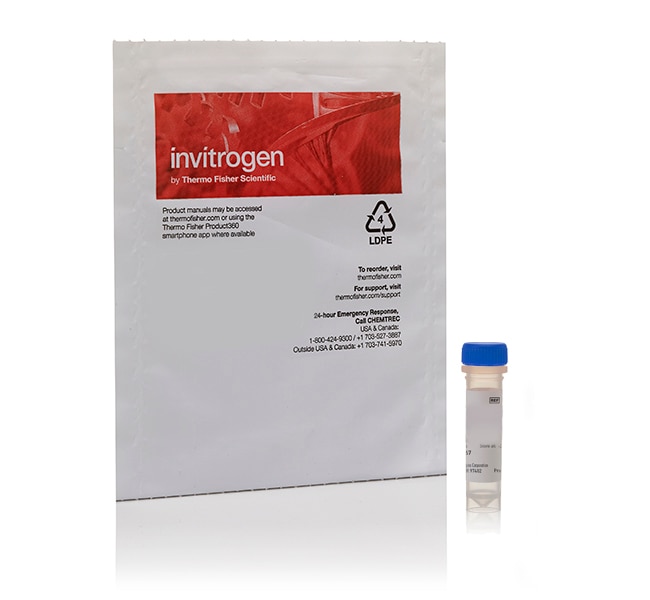
BOCILLIN™ FL penicilina, sal sódica
Detecte proteínas de unión a penicilina
| Número de catálogo | Cantidad |
|---|---|
| B13233 | 1 mg |
Número de catálogo B13233
Precio (USD)
696,73
Each
Cantidad:
1 mg
Precio (USD)
696,73
Each
Las proteínas de unión a penicilina, presentes en las membranas citoplásmicas de las eubacterias, se pueden detectar con nuestra penicilina BOCILLIN FL y penicilina BOCILLIN 650/665 (B-13234). La penicilina BOCILLIN FL, sintetizada a partir de penicilina V y el tinte BODIPY FL (que es espectralmente similar a la fluoresceína), se ha utilizado para determinar los perfiles de proteínas de unión a la penicilina de varios tipos de bacterias diferentes.
Para uso exclusivo en investigación. No apto para uso en procedimientos diagnósticos.
Especificaciones
Excitación/emisión504/511 nm
Tipo de etiquetaOtras etiquetas o colorantes
Fórmula molecularC30H31BF2N5NaO6S
Peso molecular661.46
Línea de productosBOCILLIN
Cantidad1 mg
Almacenamiento recomendadoAlmacenar en el congelador (de -5 °C a -30 °C) y proteger de la luz.
Condiciones de envíoTemperatura ambiente
Forma físicaSólido
Tipo de productoAntibiótico
Unit SizeEach
Citations & References (40)
Citations & References
Abstract
In vitro activities of piperacillin against beta-lactamase-negative ampicillin-resistant Haemophilus influenzae.
Journal:Antimicrob Agents Chemother
PubMed ID:15047524
'The in vitro activities of piperacillin (PIP) against beta-lactamase-negative ampicillin (AMP)-resistant (BLNAR) Haemophilus influenzae were compared with those of cefotaxime (CTX) and ceftriaxone (CRO), and the potency of PIP as therapy for meningitis caused by BLNAR is also discussed. PIP showed good activity (MIC at which 90% of strains are
Characterization of HMW-PBPs from the rod-shaped actinomycete Corynebacterium glutamicum: peptidoglycan synthesis in cells lacking actin-like cytoskeletal structures.
Journal:Mol Microbiol
PubMed ID:17877698
'Analysis of the complete genome sequence of Corynebacterium glutamicum indicated that, in addition to ftsI, there are eight proteins with sequence motifs that are strongly conserved in penicillin binding proteins (PBPs): four genes that code for high-molecular-weight (HMW)-PBPs (PBP1a, PBP1b, PBP2a and PBP2b), two genes encoding low-molecular-weight PBPs (PBP4 and
Penicillin-binding protein 2a of Streptococcus pneumoniae: expression in Escherichia coli and purification and refolding of inclusion bodies into a soluble and enzymatically active enzyme.
Journal:Protein Expr Purif
PubMed ID:10419829
'Penicillin-binding proteins (PBPs), targets of beta-lactam antibiotics, are membrane-bound enzymes essential for the biosynthesis of the bacterial cell wall. PBPs possess transpeptidase and transglycosylase activities responsible for the final steps of the bacterial cell wall cross-linking and polymerization, respectively. To facilitate our structural studies of PBPs, we constructed a 5''-truncated
The basis for resistance to beta-lactam antibiotics by penicillin-binding protein 2a of methicillin-resistant Staphylococcus aureus.
Journal:J Biol Chem
PubMed ID:15226303
'Penicillin-binding protein 2a (PBP2a) of Staphylococcus aureus is refractory to inhibition by available beta-lactam antibiotics, resulting in resistance to these antibiotics. The strains of S. aureus that have acquired the mecA gene for PBP2a are designated as methicillin-resistant S. aureus (MRSA). The mecA gene was cloned and expressed in Escherichia
The cysteine-rich protein A from Helicobacter pylori is a beta-lactamase.
Journal:J Biol Chem
PubMed ID:10748053
'Among the large number of hypothetical proteins within the genomes of Helicobacter pylori, there is a family of unique and highly disulfide-bridged proteins, designated family 12, for which no function could originally be assigned. Sequence analysis revealed that members of this family possess a modular architecture of alpha/beta-units and a