Search


Citas y referencias (8)
Invitrogen™
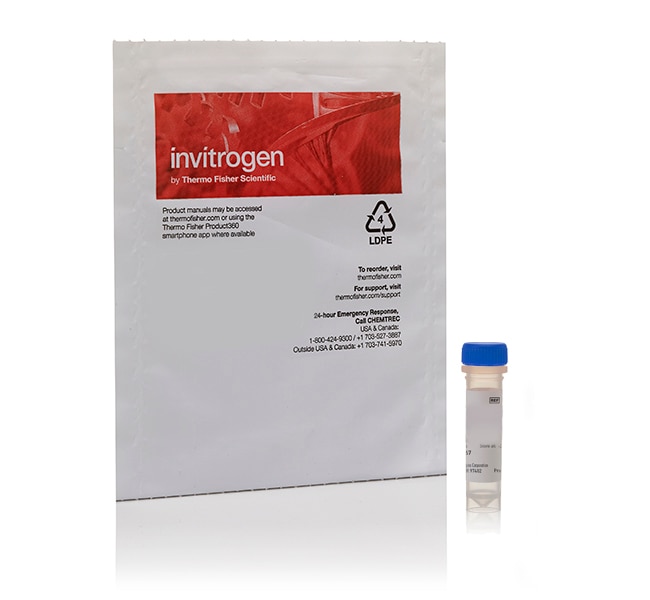
ChromaTide™ Texas Red™-12-dUTP
Pueden usarse nucleidos dUTP, OBEA-dCTP y UTP etiquetados con colorante Molecular Probes™ ChromaTide™ para sintetizar sondas de ADN etiquetadas sinMás información
| Número de catálogo | Cantidad |
|---|---|
| C7631 | 25 μl |
Número de catálogo C7631
Precio (USD)
1.102,20
Each
Cantidad:
25 μl
Precio (USD)
1.102,20
Each
Pueden usarse nucleidos dUTP, OBEA-dCTP y UTP etiquetados con colorante Molecular Probes™ ChromaTide™ para sintetizar sondas de ADN etiquetadas sin necesidad de nucleidos etiquetados con radioisótopos peligrosos y costosos. Estos nucleidos pueden incorporarse mediante técnicas estándar de biología molecular; a continuación, las sondas etiquetadas pueden utilizarse en protocolos de hibridación in situ, micromatrices o transferencia. Los nucleidos etiquetados con colorante ChromaTide™ están disponibles en diferentes colores fluorescentes para facilitar el análisis multicolor.
Especificaciones de los nucleidos etiquetados con ChromaTide™:
• Ex/Em del colorante: Texas Red™-12-dUTP (595/615 nm)
• Longitud del enlazador alquinilamino: 12 átomos
Métodos para incorporar nucleidos ChromaTide™ en sondas
• Translación de mellas (nick translation)
• Etiquetado de primers aleatorios
• Etiquetado final con desoxinucleotidil transferasa terminal
• Transcripción inversa
• Amplificación de PCR
Consulte Métodos para la incorporación enzimática de dUTP ChromaTide™ para obtener directrices específicas para cada uno de estos métodos.
Los colorantes fluorescentes Alexa Fluor™ y BODIPY™ generan excelentes sondas
Las sondas generadas con nucleidos etiquetados pueden usarse para técnicas multicolores como la hibridación in situ y la hibridación en matrices. Nuestros conjugados de colorantes patentados BODIPY™ y Alexa Fluor™ son excepcionalmente brillantes, fotoestables y esencialmente insensibles al pH. El estrecho perfil de emisión de los colorantes BODIPY™ ayuda a asegurar una superposición espectral mínima. Los colorantes Alexa Fluor™ son muy solubles en agua, al igual que las sondas de ADN fabricadas a partir de ellos, lo que los convierte en las etiquetas preferidas para la hibridación fluorescente in situ.
Los enlazadores largos mejoran el rendimiento
Los nucleidos dUTP y UTP ChromaTide™ se modifican en la posición C-5 de la uridina a través de un único enlazador alquinilamino, que proporciona un espaciador entre el nucleótido y el colorante para reducir las interacciones entre ellos. El número en el nombre del producto, por ejemplo, “12” en fluoresceína-12 dUTP, indica la longitud neta del separador, en átomos. Estos espaciadores dan como resultado conjugados más brillantes y una mayor accesibilidad a los reactivos de detección secundaria.
Para obtener una lista completa de nuestros reactivos ChromaTide™: Nucleidos etiquetados con aha y Molecular Probes ChromaTide™: Tabla 8.5.
Para obtener información adicional sobre estos reactivos de etiquetado, lea la Sección 8.2: Etiquetado de oligonucleótidos y ácidos nucleicos del Manual de Molecular Probes™.
Para uso exclusivo en investigación. No diseñado para uso diagnóstico o terapéutico en humanos ni en animales.
Especificaciones de los nucleidos etiquetados con ChromaTide™:
• Ex/Em del colorante: Texas Red™-12-dUTP (595/615 nm)
• Longitud del enlazador alquinilamino: 12 átomos
Métodos para incorporar nucleidos ChromaTide™ en sondas
• Translación de mellas (nick translation)
• Etiquetado de primers aleatorios
• Etiquetado final con desoxinucleotidil transferasa terminal
• Transcripción inversa
• Amplificación de PCR
Consulte Métodos para la incorporación enzimática de dUTP ChromaTide™ para obtener directrices específicas para cada uno de estos métodos.
Los colorantes fluorescentes Alexa Fluor™ y BODIPY™ generan excelentes sondas
Las sondas generadas con nucleidos etiquetados pueden usarse para técnicas multicolores como la hibridación in situ y la hibridación en matrices. Nuestros conjugados de colorantes patentados BODIPY™ y Alexa Fluor™ son excepcionalmente brillantes, fotoestables y esencialmente insensibles al pH. El estrecho perfil de emisión de los colorantes BODIPY™ ayuda a asegurar una superposición espectral mínima. Los colorantes Alexa Fluor™ son muy solubles en agua, al igual que las sondas de ADN fabricadas a partir de ellos, lo que los convierte en las etiquetas preferidas para la hibridación fluorescente in situ.
Los enlazadores largos mejoran el rendimiento
Los nucleidos dUTP y UTP ChromaTide™ se modifican en la posición C-5 de la uridina a través de un único enlazador alquinilamino, que proporciona un espaciador entre el nucleótido y el colorante para reducir las interacciones entre ellos. El número en el nombre del producto, por ejemplo, “12” en fluoresceína-12 dUTP, indica la longitud neta del separador, en átomos. Estos espaciadores dan como resultado conjugados más brillantes y una mayor accesibilidad a los reactivos de detección secundaria.
Para obtener una lista completa de nuestros reactivos ChromaTide™: Nucleidos etiquetados con aha y Molecular Probes ChromaTide™: Tabla 8.5.
Para obtener información adicional sobre estos reactivos de etiquetado, lea la Sección 8.2: Etiquetado de oligonucleótidos y ácidos nucleicos del Manual de Molecular Probes™.
Para uso exclusivo en investigación. No diseñado para uso diagnóstico o terapéutico en humanos ni en animales.
Para uso exclusivo en investigación. No apto para uso en procedimientos diagnósticos.
Especificaciones
Método de etiquetadoEtiquetado directo
Etiqueta o tinteTexas Red™
Cantidad25 μl
Condiciones de envíoHielo húmedo
Concentración1 mM
Línea de productosChromaTide, Texas Red
Unit SizeEach
Contenido y almacenamiento
Almacenar en el congelador (de -5 a -30 °C) y proteger de la luz.
Preguntas frecuentes
I'm getting high background after labeling with ChromaTide nucleotides. What do you recommend I do?
The nucleic acid probe is not fluorescent after labeling with ChromaTide nucleotides. What do you recommend I try?
Can ChromaTide nucleotides be used for labeling nucleic acids in live cells?
How do I determine the incorporation efficiency of the ChromaTide Labeling Nucleotides after enzymatic incorporation?
What is the average dye to base incorporation rate when enzymatically incorporating ChromaTide nucleotides?
Citations & References (8)
Citations & References
Abstract
Condensation of plasmid DNA with polylysine improves liposome-mediated gene transfer into established and primary muscle cells.
Journal:Gene Ther
PubMed ID:9156800
'Cationic liposomes provide a means to introduce genes into cells both ex vivo and in vivo. In the past few years their use has been described in several tissues, e.g. lungs, liver, endothelium, brain. In this study we evaluated a commercially available poly-cationic liposome formulation in delivering a reporter gene
Inheritance of a pre-inactivated paternal X chromosome in early mouse embryos.
Journal:Nature
PubMed ID:14661031
'In mammals, dosage compensation ensures equal X-chromosome expression between males (XY) and females (XX) by transcriptionally silencing one X chromosome in XX embryos. In the prevailing view, the XX zygote inherits two active X chromosomes, one each from the mother and father, and X inactivation does not occur until after
Substantial background reduction in ligase-based apoptosis detection using newly designed hairpin oligonucleotide probes.
Journal:Biotechniques
PubMed ID:10631490
DNA methylation promotes Aurora-B-driven phosphorylation of histone H3 in chromosomal subdomains.
Journal:J Cell Sci
PubMed ID:17164288
Confinement of enzymatic reactions to nuclear and chromosomal subdomains regulates functional organization of the nucleus. Aurora-B kinase regulates cell-cycle-dependent phosphorylation of chromosomal substrates through sequential localization to a series of sites on chromosomes and the mitotic spindle. In G2 nuclei, Aurora-B recruitment to heterochromatin restricts histone H3S10 phosphorylation to a
Spectral karyotyping combined with locus-specific FISH simultaneously defines genes and chromosomes involved in chromosomal translocations.
Journal:Genes Chromosomes Cancer
PubMed ID:10719373
Genes that play roles in malignant transformation have often been found proximate to cancer-associated chromosomal breakpoints. Identifying genes that flank chromosomal reconfigurations is thus essential for cancer cytogenetics. To simplify and expedite this identification, we have developed a novel approach, based on simultaneous spectral karyotyping and fluorescence in situ hybridization