Search


Citas y referencias (225)
Invitrogen™
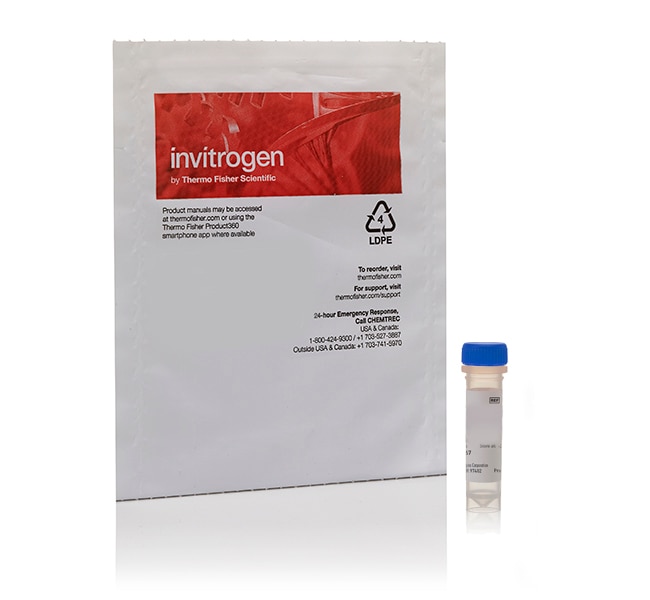
Homodímero de etidio-1 (EthD-1)
El homodímero-1 de etidio (EthD-1) es una indicador de viabilidad de permeabilidad celular de ácido nucleico de alta afinidad queMás información
| Número de catálogo | Cantidad |
|---|---|
| E1169 | 1 mg |
Número de catálogo E1169
Precio (USD)
822,96
Each
Cantidad:
1 mg
Precio (USD)
822,96
Each
El homodímero-1 de etidio (EthD-1) es una indicador de viabilidad de permeabilidad celular de ácido nucleico de alta afinidad que es débilmente fluorescente hasta que se une al ADN y emite fluorescencia roja (excitación/emisión máximas de ∼528/617).
Para uso exclusivo en investigación. No apto para uso en procedimientos diagnósticos.
Especificaciones
ColorNaranja
DescripciónHomodímero de etidio-1 (EthD-1)
Método de detecciónFluorescente
Tipo de coloranteImpenetrable en células
Emisión617 nm
Intervalo de longitud de onda de excitación528 nm
Para utilizar con (aplicación)Ensayos de tinción celular
Para utilizar con (equipo)Microscopio de fluorescencia
Cantidad1 mg
Condiciones de envíoTemperatura ambiente
Tipo de etiquetaFluorescent Dye
Tipo de productoHomodímero de etidio-1
Sub Cellular LocalizationNucleicos, ácidos nucleicos, Nucleus
Unit SizeEach
Contenido y almacenamiento
Almacenar en el congelador de -5 °C a -30 °C y proteger de la luz.
Preguntas frecuentes
I am doing a Live/Dead assay using Calcein, AM, for live cells and ethidium homodimer-1 for dead cells. Can I fix the cells after labeling and retain the staining?
Citations & References (225)
Citations & References
Abstract
Enzymatic isolation and characterization of single vascular smooth muscle cells from cremasteric arterioles.
Journal:Microcirculation (New York, N.Y. : 1994)
PubMed ID:9110282
OBJECTIVE: The goal of the present study was to develop a method to isolate viable arteriolar muscle cells from single cremasteric arterioles, which retain the contractile and electrophysiological phenotype of the donor microvessels. METHODS: Arterioles were hand-dissected from rat and hamster cremaster muscles and dissociated by incubation in papain and
Enzymatic isolation and characterization of single vascular smooth muscle cells from cremasteric arterioles.
Journal:Microcirculation (New York, N.Y. : 1994)
PubMed ID:8930888
OBJECTIVE: The goal of the present study was to develop a method to isolate enzymatically viable arteriolar muscle cells from single cremasteric arterioles, which retain the contractile and electrophysiological phenotype of the donor microvessels. METHODS: Arterioles were hand-dissected from rat and hamster cremaster muscles and dissociated by incubation in papain
A stable double-stranded DNA-ethidium homodimer complex: application to picogram fluorescence detection of DNA in agarose gels.
Journal:Proc Natl Acad Sci U S A
PubMed ID:2339125
The complex between double-stranded DNA and ethidium homodimer (5,5'-diazadecamethylene)bis(3,8-diamino-6-phenylphenanthridini um) cation, formed at a ratio of 1 homodimer per 4 or 5 base pairs, is stable in agarose gels under the usual conditions for electrophoresis. This unusual stability allows formation of the complex before electrophoresis and then separation and detection
Successful storage of peripheral nerve before transplantation using green tea polyphenol: an experimental study in rats.
Journal:Exp Neurol
PubMed ID:14769360
Green tea polyphenol is known to act as a buffer, reducing biological responses to oxidative stress. Several effects of polyphenol have been reported, such as protection of tissue from ischemia, antineoplasmic and anti-inflammatory effects, and suppression of arteriosclerosis. In this study, we investigated whether peripheral nerve segments could be kept
Indirubin enhances tumor necrosis factor-induced apoptosis through modulation of nuclear factor-kappa B signaling pathway.
Journal:J Biol Chem
PubMed ID:16785236
'Although indirubin is known to exhibit anti-cancer and anti-inflammatory activities, very little is known about its mechanism of action. In this study, we investigated whether indirubin mediates its effects through interference with the NF-kappaB pathway. As examined by the DNA binding of NF-kappaB, we found that indirubin suppressed tumor necrosis