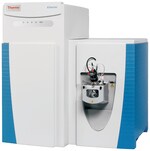
Espectrómetro de masas híbrido cuadrupolo Orbitrap™ Q Exactive™
Thermo Scientific™

Espectrómetro de masas híbrido cuadrupolo Orbitrap™ Q Exactive™

Identifique, cuantifique y confirme una amplia gama de compuestos con rapidez y fiabilidad mediante este espectrómetro de masas Orbitrap híbrido cuadrupolo Thermo Scientific™ Q Exactive™ de sobremesa.

Have Questions?
Número de catálogo IQLAAEGAAPFALGMAZR
Precio (USD)
-

Identifique, cuantifique y confirme más compuestos con rapidez y fiabilidad gracias al espectrómetro de masas Orbitrap híbrido cuadrupolo Thermo Scientific™ Q Exactive™. Este sistema LC-MS/MS de sobremesa combina la selección de iones precursores en el cuadrupolo con detección de masa exacta de alta resolución (HRAM) Orbitrap, por lo que ofrece un rendimiento y una versatilidad excepcionales. Del mismo modo, el espectrómetro de masas Q Exactive es muy útil para el cribaje específico o no específico, así como para una amplia gama de aplicaciones cualitativas y cuantitativas en sectores como el descubrimiento de fármacos, proteómica, seguridad alimentaria y medioambiente, investigaciones clínicas y toxicología forense.

Análisis de impurezas genotóxicas en productos farmacéuticos

La Food and Drug Administration (agencia de alimentos y medicamentos de EE. UU.) publicó un método de cromatografía de líquidos mediante espectrometría de masas de alta resolución (LC-HRMS) para la cuantificación de N-nitrosodimetilamina (NDMA) en la sustancia y los productos farmacológicos de ranitidina utilizando el espectrómetro de masas híbrido cuadrupolo Obtitrap Q Exactive.

Rápida obtención de resultados altamente fiables

  • Las funciones de barrido completo y HRAM capturan todos los datos de las muestras, en todo momento, lo que permite efectuar análisis retrospectivos de los datos sin necesidad de volver a analizar las muestras.
  • La potencia de resolución de hasta 140.000 FWHM elimina las interferencias isobáricas, lo que aumenta la fiabilidad de los resultados a la hora de analizar muestras en matrices complejas.
  • La exactitud de masa superior a 1 ppm en los modos de barrido completo y de fragmentación de todos los iones (AIF) garantiza una identificación fiable de los compuestos.
  • El barrido rápido a 12 Hz y el multiplexing espectral son perfectos para las aplicaciones de UHPLC.
  • La rapidez en el cambio de polaridad maximiza la información obtenida.
  • Las diversas técnicas de disociación y la fragmentación de todos los iones (HCD y CID en el interior de la fuente) facilitan la identificación de compuestos.——
  • El intervalo de masa ampliado hasta 6000 m/z mejora la detección de las biomoléculas y las moléculas pequeñas de una sola carga.
  • El hecho de disponer de más de cuatro órdenes de magnitud de intervalo dinámico en un mismo barrido, además de la sensibilidad de nivel de femtogramos, permite efectuar detecciones de compuestos muy abundantes o a nivel de trazas en el mismo barrido.

Mayores índices de certeza en los estudios de metabolismo y el descubrimiento de fármacos

  • Se obtiene un mayor rendimiento al poder aplicar el equivalente de los triples cuadrupolos para cuantificar los compuestos principales y los metabolitos, junto con la confirmación de identidades.
  • La rápida tecnología HRAM Orbitrap elimina las interferencias para ofrecer una identificación estructural de metabolitos de gran fiabilidad y una generación de perfiles a gran escala de muestras lipidómicas y metabolómicas.
  • El rápido cambio de polaridad de barrido a barrido tanto en el modo MS como en el MS/MS maximiza la detección de metabolitos y su identificación a partir de una única inyección.

Más información para estudios proteómicos de nivel superior

  • HCD ofrece una fragmentación superior y unos espectros MS/MS de la mayor calidad, en comparación con CID, lo que mejora las identificaciones.
  • Gracias a la gran calidad espectral y al amplio rango dinámico, es posible identificar y cuantificar proteínas que pasan desapercibidas para otros instrumentos.
  • Su capacidad cualitativa y cuantitativa facilita el paso de los experimentos de descubrimientos proteómicos a la cuantificación de proteínas específicas.

Análisis de seguridad alimentaria y medioambiental con alta especificidad

  • Este espectrómetro de masas, gracias a su especificidad que supera los niveles de los sistemas Q-TOF o Q-Trap de triple cuadrupolo, es la plataforma preferida para el cribaje cuantitativo y cualitativo.
  • Las capacidades de análisis dependientes de datos, MS/MS de barrido completo y datos HRAM garantizan el mayor nivel de fiabilidad posible en cada identificación.

Identificación, cuantificación y confirmación de gran fiabilidad en investigaciones clínicas y toxicología forense

  • El uso conjunto de las capacidades SRM y HRAM posibilita un sencillo proceso de identificación, cuantificación y confirmación de gran fiabilidad en el caso de esteroides endógenos, drogas y analgésicos.

Mayor rendimiento gracias softwares específicos para aplicaciones

  • El software Thermo Scientific™ ExactFinder™, LCQuan™, Mass Frontier™, MetQuest™, MetWorks™, SIEVE™ y TraceFinder™ está disponible para acelerar el análisis de datos.
Especificaciones
Intervalo dinámico> 5000:1
Exactitud de masaInterior: <1 ppm RMS, externo: < 3 ppm RMS
Cambio de polaridadUn ciclo completo en < 1 s (un modo de polaridad positiva de barrido completo y un modo de polaridad negativa de barrido completo con la resolución definida en 35 000)
Velocidades de barridoHasta 12 Hz
SensibilidadBarrido completo MS: 500 fg de buspirona en columna S/N 100:1, SIM: 50 fg de buspirona en producciones de columna S/N 100:1 o superior
Intervalo de masasDe 50 a 6000 m/z
Resolución140 000 (a m/z 200)
TipoQuadrupole-Orbitrap LC-MS
Unit SizeEach

Preguntas frecuentes

Why is the turbomolecular pump not operating when using Orbitrap Exactive or Q Exactive mass spectrometry instruments?

A turbomolecular pump may be switched off because of one of the following reasons:

- Turbomolecular pump is blocked
- Failure of fans in turbomolecular pump
Each of the above reasons might lead to an overheating of the pump. When overheated, a turbomolecular pump switches off automatically to prevent its destruction. This overheating protection prevents the outbreak of a fire and minimizes the risk of destructing the pump.

If the Exactive Series mass spectrometer does not work as expected, use the Tune software for error diagnosis:
- The instrument status window displays real-time status information for the instrument components. All parameters are arranged in a tree view. In addition to showing numerical values of parameters (for example, pump speeds or component temperatures), the instrument status window uses icons to indicate the statuses of system components.
- The messages window displays real-time information about the statuses of the instrument, the control service, or other programs. It might display additional information.

In case of an overheated turbomolecular pump, shut down the mass spectrometer as described on page 6-8 of the manual (https://assets.thermofisher.com/TFS-Assets/CMD/manuals/man-bre0012255-exactive-series-manbre0012255-en.pdf). To prevent permanent damage to components of the Exactive Series mass spectrometer, Thermo Fisher Scientific recommends that you call a Thermo Fisher Scientific field service engineer.

Find additional tips, troubleshooting help, and resources within our Mass Spectrometry Support Center.

Why is the temperature of UHV chamber higher than expected when using Orbitrap Exactive or Q Exactive mass spectrometry instruments?

The UHV chamber heating control may have failed. During general operation of the mass spectrometer, the temperature of the UHV chamber is not regulated. Only during a system bakeout, electric power is supplied to the heating elements of the UHV chamber. The heating always operates at maximum power. Thus, failure of the heating control does not lead to a dangerous overheating of the mass spectrometer. If the Exactive Series mass spectrometer does not work as expected, use the Tune software for error diagnosis:

- The messages window displays real-time information about the statuses of the instrument, the control service, or other programs. If the heating was terminated, the window displays a corresponding error message.

In case of a failure of the UHV chamber heating control, shut down the mass spectrometer as described on page 6-8 of the manual (https://assets.thermofisher.com/TFS-Assets/CMD/manuals/man-bre0012255-exactive-series-manbre0012255-en.pdf). To prevent permanent damage to components of the Exactive Series mass spectrometer, Thermo Fisher Scientific recommends that you call a Thermo Fisher Scientific field service engineer.

Find additional tips, troubleshooting help, and resources within our Mass Spectrometry Support Center.

When using Orbitrap Exactive or Q Exactive mass spectrometry instruments, why does the tune software show bad vacuum?

Here are possible causes and solutions:
-System was vented because of a main power failure: A main power failure has the same consequence as switching off with the main power circuit breaker switch. If the power is available again, the system is started up automatically: the pumps are switched on and the vacuum is created. If the system has been vented during the mains failure, it is necessary to bake out the system to obtain the operating vacuum. See “Baking Out the System” on page 8-12 of the manual. If the log file of the data system shows a reboot of the system and the pressure reading in the Tune software shows a bad vacuum, this indicates that the system was vented. In case of frequent but short power failures, we recommend that you install an uninterruptible power supply (UPS). If main power failures occur frequently while the system is not attended (for example, in the night), we recommend that you install a power fail detector. - Vacuum leak: Refer to pages 7-5 and 8-12 in the Operator's Manual (https://assets.thermofisher.com/TFS-Assets/CMD/manuals/man-bre0012255-exactive-series-manbre0012255-en.pdf).

Find additional tips, troubleshooting help, and resources within our Mass Spectrometry Support Center.

Why does the metal needle insert in the heated ESI probe frequently clog when using Orbitrap Exactive or Q Exactive mass spectrometry instruments?

Clogging of the H-ESI spray needle is generally caused by the presence of non-volatile components in the injected samples. If the non-volatile components of the samples are not removed during sample preparation, they will be injected onto the column where they will gradually bleed off over time into the detector. They may also be directly introduced by the use of non-volatile buffers in the mobile phase. Non volatile buffers should be avoided in LC-MS analysis because the spray needle will clog frequently and in addition the MS optics will quickly become contaminated.

Clogging issues may be worsened when using a divert valve or bypass valve. This is because when the valve switches to waste the LC flow to the needle is stopped, causing the residual liquid in the hot needle to quickly evaporate. This in turn causes the non-volatile components to deposit on the inner wall of the tubing which will eventually clog it.

When using a divert or bypass valve, the issue may be fully resolved by adding another HPLC pump to supply make-up flow through the needle when the column eluent is bypassed. The second pump is connected to the divert valve or bypass valve so that when the eluent is diverted to waste, clean solvent flows through the needle to help keep it clean. Alternatively, sample preparation procedures should be modified to reduce the amount of non-volatile components in each sample injection.

Find additional tips, troubleshooting help, and resources within our Mass Spectrometry Support Center.

What is High Energy Collision Dissociation (HCD) as it relates to Orbitrap Exactive or Q Exactive mass spectrometry instruments?

The HCD Cell consists of a straight multipole (octapole) device mounted within a metal tube. The metal tube is in turn connected to the C-Trap in direct line of sight.

The voltage offset between the C-Trap and the HCD Cell is used to accelerate the precursor ions into the gas filled cell. Inside the HCD cell, ions collide with the neutral gas causing rotation, stretching and ultimately cleaving bonds to create fragment ions and neutral species, which are subsequently removed by the vacuum system.

The generated fragment or product ions are then pushed back toward the C-Trap and focused before being pushed toward the Orbitrap analyzer.

Find additional tips, troubleshooting help, and resources within our Mass Spectrometry Support Center.