Search
 Búsqueda por elementos
 Búsqueda por estructura


Thermo Scientific Chemicals
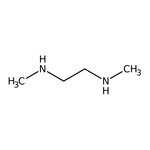
N,N'-Dimetiletilendiamina, 95 %, Thermo Scientific Chemicals
CAS: 110-70-3 | C4H12N2 | 88.154 g/mol
| Número de catálogo | Cantidad |
|---|---|
| L02204.14 también denominado L02204-14 | 25 g |
Número de catálogo L02204.14
también denominado L02204-14
Precio (USD)
-
Cantidad:
25 g
Identificadores químicos
CAS110-70-3
IUPAC Namemethyl[2-(methylamino)ethyl]amine
Molecular FormulaC4H12N2
InChI KeyKVKFRMCSXWQSNT-UHFFFAOYSA-N
SMILESCNCCNC
Ver más
Especificaciones Hoja de especificaciones
Hoja de especificacionesRefractive Index1.4270-1.4330 @ 20?C
FormLiquid
Identification (FTIR)Conforms
Appearance (Color)Clear colorless to pale yellow
Assay (GC)≥94.0%
N,N'-Dimethylethylenediamine is used in DNA binding effect. It is used to enhance the adsorption of carbon dioxide. It acts as a ligand and form coordination complex such as dinitrato(N,N'-dimethyl-1,2-ethanediamine)copper(II) and dichloro(1,4-bis-(diphenyl phosphino)butane)-(1,2-ethylenediamine)ruthenium(II).
This Thermo Scientific Chemicals brand product was originally part of the Alfa Aesar product portfolio. Some documentation and label information may refer to the legacy brand. The original Alfa Aesar product / item code or SKU reference has not changed as a part of the brand transition to Thermo Scientific Chemicals.
Aplicaciones
La N,N′-dimetiletilendiamina se utiliza en el efecto de unión al ADN. También se usa para mejorar la adsorción del dióxido de carbono. Actúa como ligando y da lugar a complejos de coordinación como el dinitrato(N,N′-dimetil-1,2-etanodiamina)copper(II) y el dicloro(1,4-bis-(difenil fosfino)butano)-(1,2-etilendiamina)rutenio(II).
Solubilidad
Miscible con cloroformo y diclorometano.
Notas
Incompatible con ácidos, cloruros ácidos, anhídridos ácidos, agentes oxidantes fuertes y dióxido de carbono.
La N,N′-dimetiletilendiamina se utiliza en el efecto de unión al ADN. También se usa para mejorar la adsorción del dióxido de carbono. Actúa como ligando y da lugar a complejos de coordinación como el dinitrato(N,N′-dimetil-1,2-etanodiamina)copper(II) y el dicloro(1,4-bis-(difenil fosfino)butano)-(1,2-etilendiamina)rutenio(II).
Solubilidad
Miscible con cloroformo y diclorometano.
Notas
Incompatible con ácidos, cloruros ácidos, anhídridos ácidos, agentes oxidantes fuertes y dióxido de carbono.
RUO – Research Use Only
General References:
- Reagent for protection of aldehyde groups as 2-substituted-1,3-dimethylimidazolidines, e.g. by azeotropic dehydration with benzene. The derivatives are stable to n-BuLi and LDA, and can be cleaved by acid hydrolysis, or in high yield by quaternization with MeI and mild hydrolysis: Tetrahedron, 41, 3803 (1985). With aromatic aldehydes, the imidazolidine derivatives are activated to ortho-lithiation, providing a route to o-substituted benzaldehydes: J. Org. Chem., 44, 2004 (1979).
- Kürkçüoğlu, G. S.; Yeşilel, O. Z.; Aksel, M.; Büyükgüngör, O. Hetero-octanuclear cubane-like and one-dimensional cyano complexes with the N,N-dimethylethylenediamine ligand. Polyhedron 2015, 85, 720-726.
- Mandal, S.; Naskar, B.; Modak, R.; Sikdar, Y.; Chatterjee, S.; Biswas, S.; Mondal, T. K.; Modak, D.; Goswami, S. Syntheses, crystal structures, spectral study and DFT calculation of three new copper(II) complexes derived from pyridoxal hydrochloride, N,N-dimethylethylenediamine and N,N-diethylethylenediamine. J. Mol. Struct. 2015, 1088, 38-49.