Search


Citas y referencias (14)
Invitrogen™
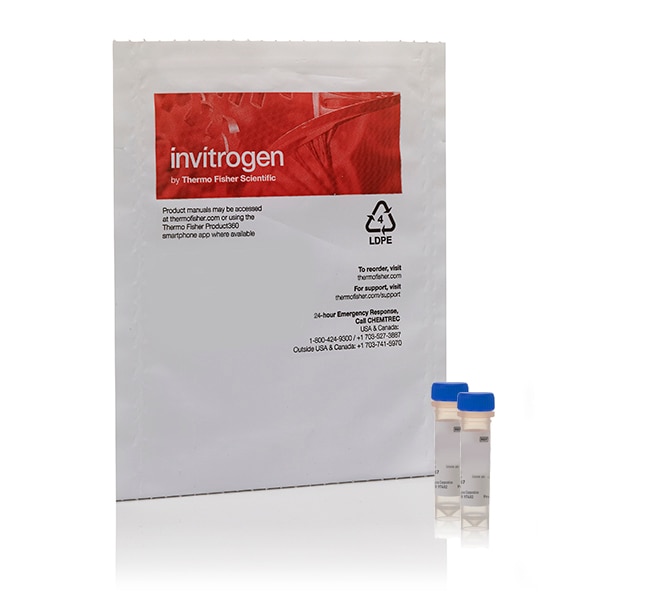
Kit de viabilidad de biopelículas Filmtracer™ LIVE/DEAD™
El kit de viabilidad de biopelícula FilmTracer™ LIVE⁄DEAD proporciona un ensayo de fluorescencia de dos colores de viabilidad bacteriana, basadoMás información
| Número de catálogo | Cantidad |
|---|---|
| L10316 | 1 kit |
Número de catálogo L10316
Precio (USD)
1.056,24
Each
Cantidad:
1 kit
Precio (USD)
1.056,24
Each
El kit de viabilidad de biopelícula FilmTracer™ LIVE⁄DEAD proporciona un ensayo de fluorescencia de dos colores de viabilidad bacteriana, basado en la integridad de la membrana, que ha demostrado ser útil para una variedad diversa de géneros bacterianos, incluidos los que crecen en comunidades de biopelículas. El kit de viabilidad de biopelícula LIVE⁄DEAD utiliza mezclas de tinción de ácido nucleico fluorescente verde SYTO® 9 y tinción de ácido nucleico fluorescente rojo y yoduro de propidio. Estas tinciones difieren tanto en sus características espectrales como en su capacidad para penetrar en células sanas bacterianas. Cuando se usa por sí sola, la tinción SYTO® 9 generalmente etiqueta todas las bacterias de una población: aquellas con membranas intactas y con membranas dañadas. Por el contrario, el yoduro de propidio penetra solo bacterias con membranas dañadas, causando una reducción en la fluorescencia de tinción SYTO® 9 con ambos colorantes presentes. Por lo tanto, con una mezcla apropiada de tinciones SYTO™ 9 y yoduro de propidio, las bacterias con membranas celulares intactas se tiñen de verde fluorescente, mientras que las bacterias con membranas dañadas se tiñen de rojo fluorescente.
Para uso exclusivo en investigación. No apto para uso en procedimientos diagnósticos.
Especificaciones
Método de detecciónFluorescente
Tipo de coloranteSYTO™ 9, yoduro de propidio
FormularioLíquido
Cantidad1 kit
Condiciones de envíoTemperatura ambiente
Localización subcelularCitoplasma & citosol
ColorRojo, verde
Intervalo de longitud de onda de emisiónVisible
Para utilizar con (aplicación)Ensayo de viabilidad
Para utilizar con (equipo)Microscopio confocal, Microscopio de fluorescencia, Citómetro de flujo, Lector de microplacas, Generador de imágenes de fluorescencia
Línea de productosFilmTracer, Molecular Probes
Tipo de productoKit de viabilidad de biopelícula
Unit SizeEach
Contenido y almacenamiento
2 ingredientes, almacenar en congelador de-5 °C a -30 °C; proteger de la luz
Preguntas frecuentes
How do I prepare dead cell controls for LIVE/DEAD cell viability assays?
Citations & References (14)
Citations & References
Abstract
Biofilm formations in nasopharyngeal tissues of patients with nasopharyngeal osteoradionecrosis.
Journal:Otolaryngol Head Neck Surg
PubMed ID:23348872
'Objective Determine the presence of nasopharynx biofilms in patients with nasopharyngeal cancer (NPC) and osteoradionecrosis (ORN) and patients with NPC but no ORN. Study Design Cross-sectional study. Setting Tertiary referral medical center. Subjects and Methods We enrolled 27 patients with NPC from our outpatient clinic during January 2010 to June
Comparison of methods for evaluation of the bactericidal activity of copper-sputtered surfaces against methicillin-resistant Staphylococcus aureus.
Journal:Appl Environ Microbiol
PubMed ID:22983970
Bacteria can survive on hospital textiles and surfaces, from which they can be disseminated, representing a source of health care-associated infections (HCAIs). Surfaces containing copper (Cu), which is known for its bactericidal properties, could be an efficient way to lower the burden of potential pathogens. The antimicrobial activity of Cu-sputtered
Fratricide is essential for efficient gene transfer between pneumococci in biofilms.
Journal:Appl Environ Microbiol
PubMed ID:22706053
Streptococcus pneumoniae and a number of commensal streptococcal species are competent for natural genetic transformation. The natural habitat of these bacteria is multispecies biofilms in the human oral cavity and nasopharynx. Studies investigating lateral transfer of virulence and antibiotic resistance determinants among streptococci have shown that interspecies as well as
Comparison of different live/dead stainings for detection and quantification of adherent microorganisms in the initial oral biofilm.
Journal:Clin Oral Investig
PubMed ID:22821430
The aim of the present study was to investigate different fluorescence-based, two-color viability assays for visualization and quantification of initial bacterial adherence and to establish reliable alternatives to the ethidium bromide staining procedure. Bacterial colonization was attained in situ on bovine enamel slabs (n?=?6 subjects). Five different live/dead assays were
Rapid Bacterial Detection during Endodontic Treatment.
Journal:J Dent Res
PubMed ID:28530469